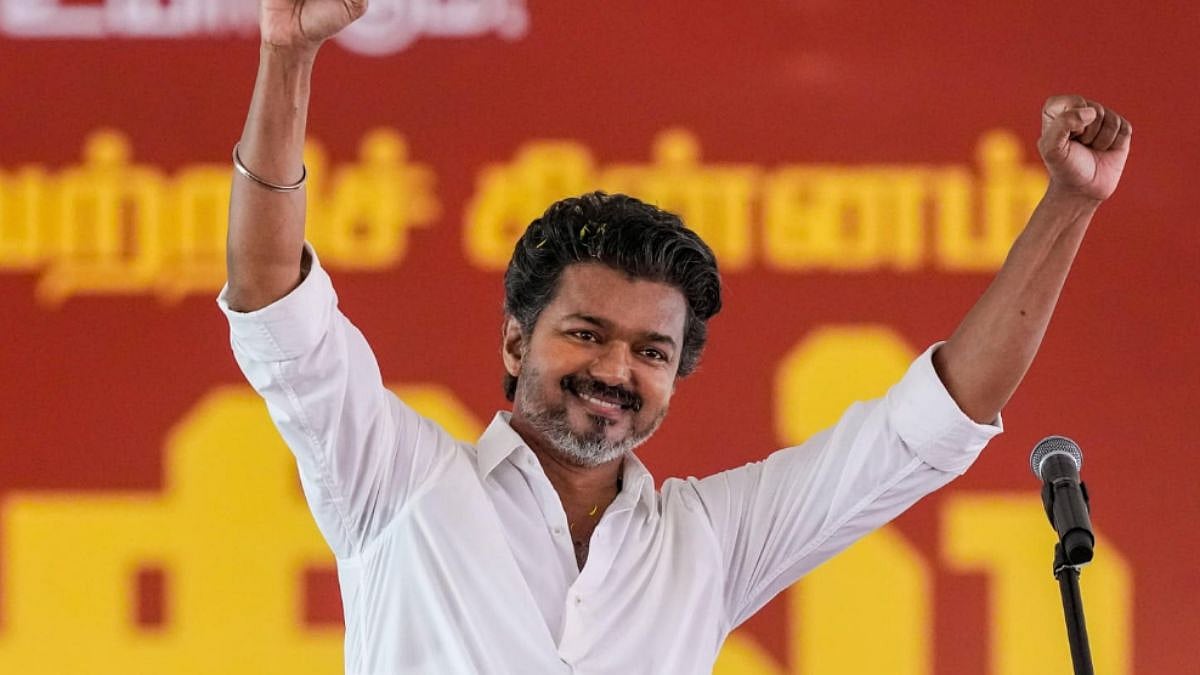
Six months ago, predicting 69-film-old Tamil superstar C Joseph Vijay as the 18th chief minister of Tamil Nadu would have been met with ridicule, dismissal as an ‘anil’ (squirrel, as Vijay’s fans are called), or directions to the Kilpauk medical college in Chennai, which hosts an Institute of Mental Health (IMH).
Even as late as April 21, two days before polling, few predicted that Vijay’s Tamilaga Vetri Kazhagam (TVK), India’s latest political start-up, would emerge as the single-largest party on May 4.
On the ground, though, something had transformed among the common TN voter, who usually preferred switching between the traditional Dravidian parties. A septuagenarian in a village few kilometres from where Rajiv Gandhi was assassinated in Sriperumbudur in 1991 professed to be a lifelong ‘two leaves’ (AIADMK) voter. On April 18, she confessed to this journalist that she would be ‘whistling’ this time, Vijay’s election symbol being a whistle. A few days earlier, in central Chennai’s Mylapore, a 30-year-old techie, who voted for DMK in 2021, made no bones of her support for Vijay.
The scale of TVK’s victory has surpassed even that of AIADMK founder MG Ramachandran, Vijay’s predecessor, in making the transition from the silver screen to politics. TVK polled 35% of votes after contesting all 234 seats (Vijay backed one independent). MGR fought his first assembly election in 1977 in alliance with the CPI(M) and won 33.5% of the vote share, though the combine won 144 seats to TVK’s 108.
While MGR had broken away a section of electorally trained DMK cadre, Vijay’s party has been largely built from scratch, feeding on the mobilisation and energy of his fans-turned-social-service club members.
TVK’s performance has not only upset the applecart of the DMK and its first family, Chief Minister MK Stalin and Udhayanidhi Stalin, but also upended the way electoral politics is conducted in the state.
Sample this: traditionally, one needs to be either rich or backed by moneybags to have a spending power upwards of Rs 5 crore to contest an assembly seat. One of TVK’s best performers was R Prakasam, a load van driver earning low enough to not file Income Tax Returns (ITR). He defeated the sitting DMK MLA from Poonamallee in suburban Chennai with a margin of 72,740, at least 20,000 more than that of Vijay in Perambur, 20 km away. In another corner of Chennai, a small-time businessman dealing in banners and design material won TN’s largest assembly constituency, Shozhinganallur, by a whopping 96,780 votes. In Madurai Central, a humble meat shop owner without higher secondary school education humbled the foreign-educated, globally renowned sitting minister PTR Palanivel Thiagarajan by 19,128 votes.
The TVK tsunami swept 14 of Chennai’s 16 constituencies, considered the DMK’s fortress even during MGR’s heady years; while Stalin lost to a former DMK MLA, Udhayanidhi scraped through just by 7140 votes. TVK made dents in traditional vote banks of the DMK and the AIADMK in every zone across the state; at least 15 sitting ministers lost, including KR Periakaruppan in Tiruppatur by a solitary vote.
Vijay’s superstar status and personal connect with his nanbas/nanbis (friends) transcended the caste, class, and religious divide. Top executives in banks and multinational corporations, techies, labourers, auto drivers, and house helps all voted for him en masse, even convincing ambivalent family members. Several flew down from foreign countries to press the ‘whistle’ on the EVM; after Periakaruppan’s loss, a tweet of one such Muscat native is going viral. It was the classic example of, as AR Rahman sang in Vijay’s 2018 political blockbuster ‘Sarkar’, an Oru Viral Puratchi (One Finger Revolution).
Women of all ages rallied behind him, perhaps drawing inspiration from the successful female protagonists from his 2019 blockbuster ‘Bigil’ (Whistle), a remake of Chak De India, where Vijay, as the football coach, galvanises a motley group towards an incredible victory.
Behind this stunning victory lies the sincere and dedicated groundwork of his Gen Z and millennial fans. Everything was planned; the cadre went door-to-door, and a special mobile app was launched with downloads tracked to gauge popularity in constituencies. Instagram reels, Facebook videos, and YouTube shorts replaced targeted advertisements as modes of publicity. The high smartphone and 5G/4G internet penetration in Tamil Nadu had dissolved the urban-rural divide, visible in TVK’s wins across the state.
TVK has also re-engineered caste combinations of the state; Ambedkarite circles are buzzing with information that at least 20 Dalits have contested in open constituencies, a transformation of epic proportions if true. The party has two Brahmin MLAs, a miracle given that both Dravidian majors gave no tickets to the community this time. TVK’s MLAs have young doctors, ex-bureaucrats and techies who were thirsting for political participation. On the flipside, one MLA is a notorious government contractor who switched over from the AIADMK.
When it came to booth-level work, young men and women were trained over Zoom conversations by people they had never met. On voting day, a young female lawyer walked up to a booth in western Tamil Nadu to work for the TVK; she was relieved from duty after a few hours by a young man she had never met but who enquired about her food and toilet needs and general well-being. In most places, these booth workers and voters wore beige pants and white shirts, Vijay’s signature dress, which is now a defining image of this election.
Vijay’s own campaign was simple; he drew from Michael Jackson’s ‘scarcity’ effect philosophy, conducted only a handful of rallies, did not give interviews, and targeted only the chief minister. Despite no striking new ideas, his manifesto promised clean governance and direct door-to-door delivery of government services in addition to the welfare schemes of both the Dravidian parties.
Cadre. Manifesto. Campaigns. These were just bricks. What held the structure together were Vijay, his charisma, and direct connection with the masses.
What is Vijay going to do for Tamil Nadu? His voters are unable to articulate; young mothers want better public schools and hospitals. To translate a song from his 2021 hit Master, 'They call me Master, Changes will come Faster'.
Siddharth Prabhakar is a Chennai based independent journalist. He specialises in investigative reporting, politics, and cricket.

