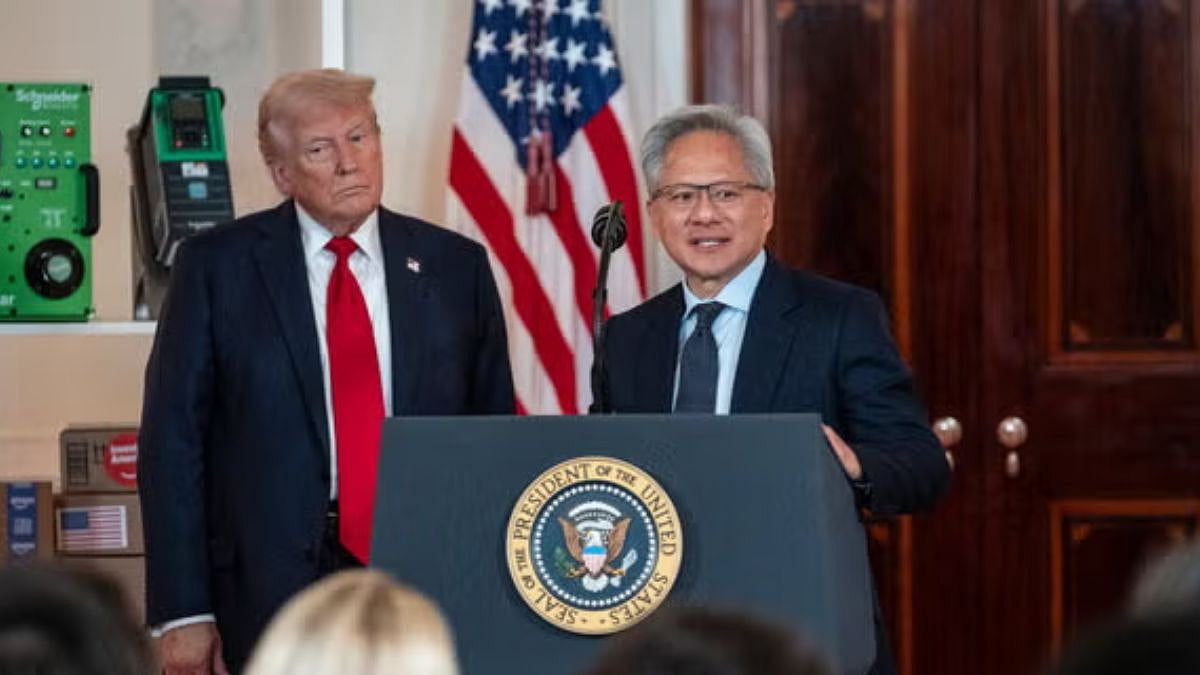
The reinstatement of Jensen Huang at the helm of affairs in the powerful Nvidia Corp., after an extraordinary intervention by US President Donald Trump, raises questions beyond the executive’s personal conduct and tests the credibility of both American national security safeguards and the concept of corporate independence. Huang’s return may have restored calm to Wall Street, spooked by the crash in Nvidia shares, but it has now opened a far more important debate on the tenuous relationship between corporate power, political influence, and national security in America.
Huang’s resignation on November 12, following revelations of extramarital affairs, including one involving a woman suspected by the US intelligence officials of having links to Chinese espionage, led to Nvidia’s board deciding against bringing him back. The public reversal of this decision came after a direct intervention by Trump, who publicly campaigned for Huang’s return to the firm valued at over $4 trillion. Nvidia insists that its decision followed consultations with senior American government officials, whose assessment apparently convinced the chipmaker that Huang’s reinstatement posed no national-security risk.
However, this explanation leaves two fundamental questions unanswered: First, can the government’s reassurance substitute for an independent corporate judgement when the executive concerned is at the centre of an unresolved investigation? Second, and even more importantly, what is the US intelligence establishment’s assessment of Huang’s vulnerability to possible manipulation by a foreign power, especially in light of fresh media revelations that the woman in question, Alice Huang, was not only a possible foreign agent but also had a partner who, too, is suspected to be in league with China’s spy agency?
Nvidia is not an ordinary commercial enterprise. Its advanced processors are central to America’s technological and military competition with China. Access to these chips has become a major instrument of Washington’s export control policy, intended to prevent Beijing from acquiring computing capabilities that could accelerate its military modernisation and artificial intelligence ambitions.
Consequently, the allegations surrounding Huang cannot be dismissed as merely a personal scandal. They raise questions about corporate access, information security, potential conflicts of interest, and the vulnerability of a company whose products occupy the frontline of strategic competition between the world’s two largest economies. There is little doubt about Huang’s importance to Nvidia, as he is not simply another chief executive presiding over a successful technology company. He is its architect and chief strategist under whose leadership Nvidia pivoted from being just a maker of graphics processors to the commanding position of being Numero Uno in the world of advanced AI chips. However, this raises a final question: If a corporation of Nvidia’s strategic importance cannot contemplate a future without one individual, it has a governance problem that no amount of executive charisma or support from the most powerful man in the world can resolve.

