An Election That Convinces No One
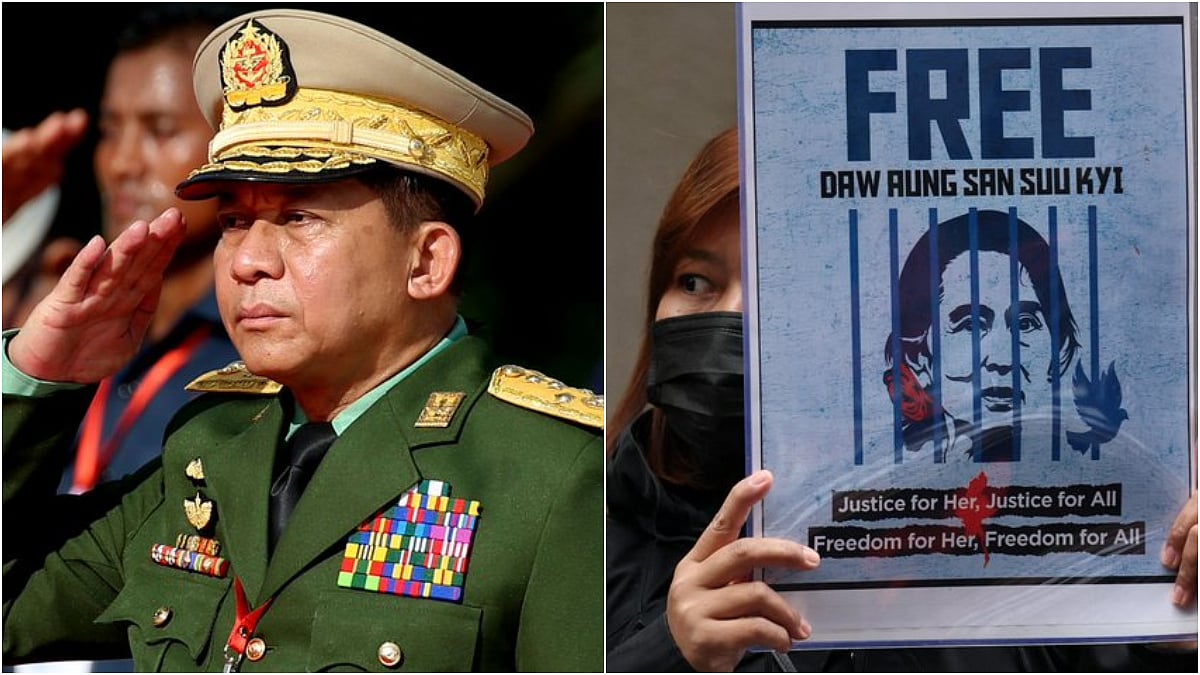
When Myanmar’s military chief, Senior General Min Aung Hlaing, announced that staggered elections would begin on December 28, 2025, the reaction across the country was one of cynicism rather than anticipation.
Four years after the 2021 coup that dismantled an elected government, the same generals now claim they are steering the nation back to democracy. Few inside Myanmar, and even fewer outside it, believe that narrative. With key opposition leaders jailed, the National League for Democracy dissolved, and large parts of the country engulfed in civil war, the proposed vote appears less a democratic exercise than an attempt to launder military rule through the ballot box.
Political parties opposed to the junta have already rejected participation, dismissing the polls as a carefully choreographed performance meant to legitimise continued military dominance. In a fractured country where guns, not institutions, determine authority, the promise of “free and fair elections” rings hollow.
Controlled Campaigns, Manufactured Consent
The electoral process is unfolding under suffocating restrictions. Campaigning is permitted only within narrow limits set by the authorities, dissent is criminalised, and state-controlled media saturates the public space with propaganda films portraying the military as the guardian of national unity. Revised election laws impose harsh penalties for criticism, ensuring that any genuine political contest is smothered before it can take shape.
These conditions have reinforced public distrust. For a population traumatised by airstrikes, mass arrests and economic collapse, the election looks detached from lived reality. Rather than reflecting political will, it risks becoming another instrument of coercion.
Designing the Vote to Suit the Generals
The junta’s intentions are evident in the architecture of the polls. Voting will not take place in roughly one in seven parliamentary constituencies, many of them active conflict zones or areas controlled by resistance forces. Dozens of opposition parties, including the NLD, have been barred after being ordered to disband by the military-appointed election commission.
By excluding hostile regions and eliminating rivals, the generals have engineered an outcome that favours military-aligned parties. The exercise is calibrated not to restore civilian rule but to entrench uniformed authority under a constitutional façade.
India’s Uneasy Balancing Act
For India, Myanmar’s political theatre presents a strategic headache. Instability has already crossed the border: refugees have streamed into Mizoram, and armed groups operate freely along the frontier. Flagship connectivity initiatives such as the Kaladan Multi-Modal Transit Transport Project and the Sittwe port remain stalled, vulnerable to shifting battle lines.
Initially, New Delhi maintained quiet engagement with the junta to protect its interests and counter China’s influence. As resistance forces gained ground, India broadened its outreach, opening channels to ethnic armed organisations and even the shadow National Unity Government.
This calibrated hedging reflects a deeper anxiety—openly backing the generals risks alienating democratic forces, while embracing the opposition could push the military entirely into Beijing’s embrace. Strategic neutrality has bought time, but it has also diluted India’s democratic messaging.
Beijing’s Advantage in Chaos
China has emerged as the most consistent external beneficiary of Myanmar’s turmoil. It continues to back Min Aung Hlaing diplomatically while simultaneously nurturing ties with powerful ethnic armies in the north. This dual-track approach ensures that Chinese influence remains decisive regardless of who controls territory on the ground.
Projects such as the Kyaukphyu deep-sea port and the China–Myanmar Economic Corridor anchor Beijing’s ambitions for access to the Indian Ocean. A regime fighting for survival depends heavily on Chinese arms and diplomatic cover, while resistance advances paradoxically increase Beijing’s leverage as both sides court its support. For China, the legitimacy of elections matters far less than securing strategic depth.
Washington’s Calculus Under Trump
Under Donald Trump’s second term, U.S. policy towards Myanmar is likely to be driven more by competition with China than by concern for democratic norms. While the previous administration imposed sanctions and extended support to the opposition, Trump has shown little enthusiasm for human rights advocacy abroad.
The central question is whether Washington sees Myanmar as strategically relevant in its rivalry with Beijing. Supporting resistance forces could complicate China’s access to the Bay of Bengal but might also deepen chaos. Ignoring Myanmar altogether would effectively concede space to Beijing. In a transactional worldview, engagement will depend less on values and more on geopolitical utility.
ASEAN’s Fading Credibility
The regional bloc, ASEAN, stands exposed by its inability to influence events. Its much-vaunted Five-Point Consensus has remained largely symbolic, ignored by the junta and unenforced by member states. Even at high-level meetings in 2025, the organisation produced familiar statements without concrete action.
By avoiding direct confrontation with Min Aung Hlaing, ASEAN has weakened its own standing and left democratic forces isolated. Elections widely rejected by the opposition and international observers will only underscore the bloc’s paralysis unless it meaningfully engages resistance actors and the NUG.
A Country Fragmenting on Ethnic Lines
Myanmar today resembles a mosaic of competing authorities rather than a unified state. The Three Brotherhood Alliance—comprising the Arakan Army, Ta’ang National Liberation Army and Myanmar National Democratic Alliance Army—has seized vast territory, including a majority of towns in Rakhine State.
Strategic border trade posts with India and China are no longer under junta control, draining revenue and eroding legitimacy.
Even if the military’s grip weakens further, the challenge ahead will be formidable. Reconciling dozens of armed groups with divergent goals will test any future political settlement, whether led by civilians or the military.
Beyond December 28
As the proposed polling date approaches, Myanmar confronts a bleak contradiction. Elections meant to signal transition may instead harden authoritarian rule. A faltering junta, an opportunistic China, an uncertain United States, a paralysed ASEAN and an expanding ethnic battlefield together form a volatile mix.
For India, the consequences are immediate and tangible. For China, instability offers strategic openings. For Washington, Myanmar is a measure of how far great-power rivalry has eclipsed democratic commitments. For ASEAN, it is a test of relevance.
What is clear is that these elections will neither heal divisions nor restore legitimacy. At best, they will freeze a failing order; at worst, they will accelerate Myanmar’s disintegration into enclaves of military control, ethnic autonomy and foreign influence. Democracy, like Aung San Suu Kyi herself, remains confined—waiting for a future that continues to recede.
(Writer is a strategic affairs columnist and senior political analyst based in Shimla.)

