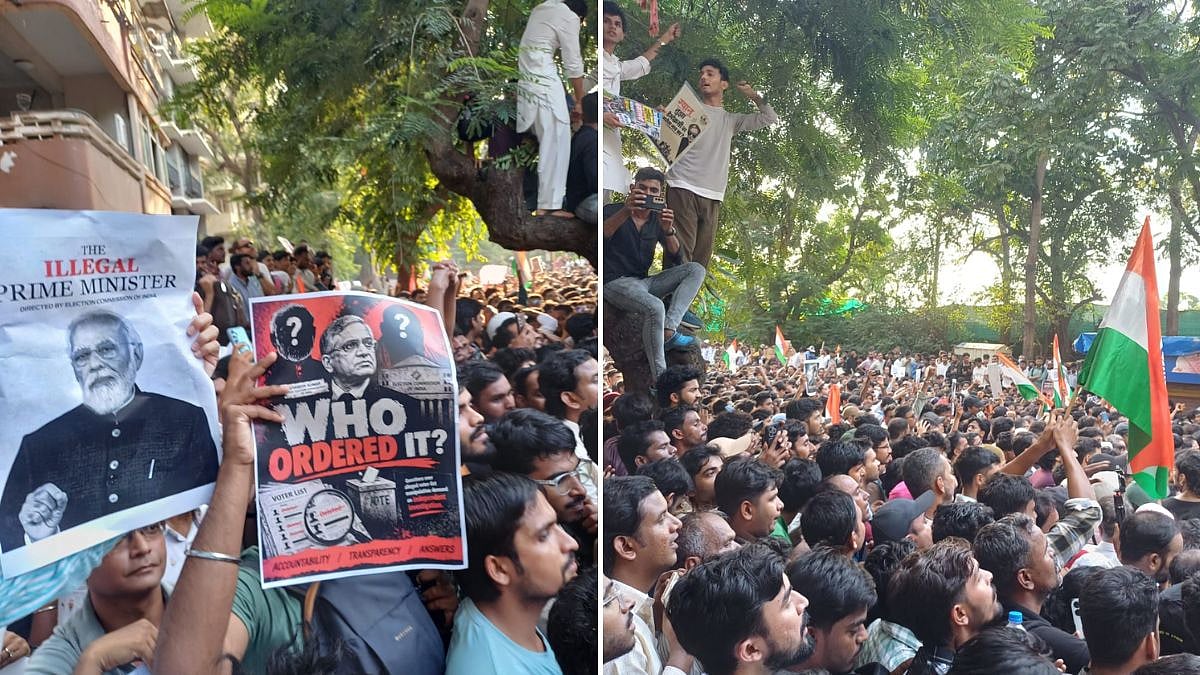
It’s the season of protests, and, quietly but firmly, Mumbai’s beloved ground, Shivaji Park, has come into its own in the past few months. The students’ protests in July and the rallying cry against Chief Election Commissioner Gyanesh Kumar earlier this month, with some hilarious and hard-hitting posters, creative slogans, and songs reverberating in the lanes of the planned neighbourhood, the nonchalance with which children and young adults practised their sports, residents peering from the balconies of older buildings around the ground and chipping in with water and snacks for protesters, and the lingering sense of change that it all evoked reminded Mumbai, once again, why public open spaces are not only necessary but should also be built a certain way.
Mumbai’s Historic Protest Grounds
This is not to take away from the glory from Azad Maidan, located opposite the Brihanmumbai Municipal Corporation headquarters and a stone’s throw away from the railhead, Chhatrapati Shivaji Maharaj Terminus. The place and honour that Azad Maidan holds in the history of Bombay/Mumbai is unparalleled. Similarly, the large maidans of central Mumbai—Kamgar Maidan, Jamboree Maidan, Lal Maidan, Nare Park, and others—have their significance in the historical arc of protests and workers’ movements in the city from the British era to the present day. If the working class was central to how the city was built, then these public open spaces had a stupendous role in collectivising lakhs of them and envisioning a city beyond what governments and private capital had imagined. The Oval and the Cross maidans are a breed apart—closed, fenced spaces, and unwelcome.
Shivaji Park As A Protest Haven
At a time when the Azad Maidan has been increasingly barricaded and made out of bounds for protesters, when metro and other construction projects are eating into its expanse, when protests are mostly being cornered into one well-policed section of the maidan, it is the Shivaji Park ground that continues to be a haven for protesters, rebels, challengers, and others who simply want to raise questions about the present and be visible while doing so. Indeed, visibility and accessibility are intrinsic to protests; barricaded spaces and forgotten corners generate little interest in the public and put almost no pressure on the government to respond.
The Shivaji Park could not be more perfect a venue—large enough to hold a lakh and more with arterial roads opening on all sides, proximity to the railway junction of Dadar that connects the Western and Central railway lines, a low parapet or kerb encircling the ground that also serves as seating spaces, wide pavements outside that regularly draw walkers and pet owners and can be occupied by protesters, a central and accessible space that carries the legacy of some of the most decisive moments in India’s and the city’s history, home to names that shaped Mumbai, and the grid-like layout of the neighbourhood that allows protesters to flee when the police action turns brutal because it almost always does.
A Democratic Open Space
“What strikes you most forcibly about Shivaji Park, besides its shady roads and Art Deco buildings, is the openness of the space,” writes the noted novelist, essayist, and translator Shanta Gokhale, who has lived in the neighbourhood for decades and wrote a book about it. “By that I do not mean the obvious, as in the space that is not enclosed. I mean open as in democratic. Shivaji Park is open to all people at all times of day and night. It is a place to relax in and fill your lungs with fresh air, to hold hands or argue, walk, jog, do asanas or stretch out for a siesta. It is open for post-prandial strolls under the stars or for indulgences like ice golas sold off carts.” And is a place for thousands or lakhs to gather united by a cause, for these multitudes to raise their voice as one, for leaders of movements to keep the tempo going with speeches that echo across the 28 acres of the park, and for being the setting to influence change, I would add.
The neighbourhood of Shivaji Park calls the ground its own, and there are frequent efforts by irate residents, privileged in many ways, against the noise and chaos that invariably emanate from the park during protests, demonstrations, and political meetings. But credit must go to the voices of sanity amongst them that the Shivaji Park ground—marked as a recreation ground in the British plan documents and on the plaque installed there, and a playground in the BMC documents—was not fenced or ‘protected’ so fiercely by residents that it turned into an exclusive space. It is still possible to be in the thick of protests unfolding and equally possible to stand on pavements opposite or nearby and watch it all. There may be an overwhelming presence of the police, but one look skywards or towards the sea provides the much-needed relief and context.
Lessons For Mumbai’s Future
If anything, the Shivaji Park ground, with its many associations and centres, multiple sports and games—most famously, cricket—and an open layout, creates what conservationists call “a sense of place”. The final report for the conservation of Shivaji Park as a heritage precinct says so too. Not only should the Shivaji Park neighbourhood have been firmly declared a heritage precinct (the ugly glass towers would not be a reality), but the template of the ground itself should have been replicated in suburbs that woefully lack maidans and grounds and in new areas like the Bandra-Kurla Complex where, sadly, open space is more a manicured and exclusive private garden.
Bombay/Mumbai knew how to build public open spaces and integrate them into neighbourhoods. That knowledge was not forgotten, only wilfully discarded or disregarded in the new city-making. Mumbai is poorer for it.
Smruti Koppikar, an award-winning senior journalist and urban chronicler, writes extensively on cities, development, gender, and the media. She is the Founder Editor of the award-winning online journal ‘Question of Cities’ and can be reached at smruti@questionofcities.org.

