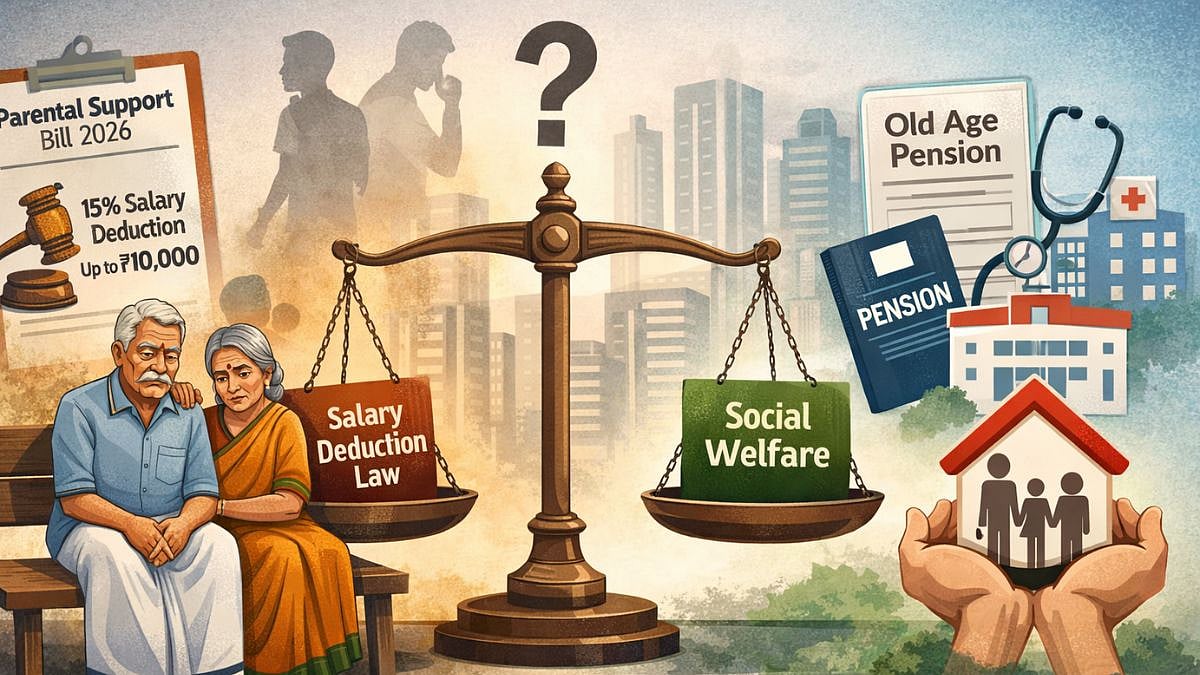
Confronted with a stubborn social malaise, governments often reach for the statute book. The Telangana Employees Accountability and Monitoring of Parental Support Bill, 2026, passed by the Assembly this week, follows that familiar instinct.
Its intent is noble: to ensure that elderly parents are not abandoned by their earning children. Its method is blunt: authorise a salary deduction of 15 per cent—capped at Rs 10,000—from government employees, private staff, and even elected representatives found neglecting their parents, with the amount transferred directly to the aggrieved elders. In effect, the law seeks to convert filial duty into an “enforceable morality”.
It is an appealing idea in a society that venerates the family. But it risks mistaking sentiment for system. The first difficulty is cultural, not legal. In India, a majority of parents will not complain against their children—even when neglect is palpable. Many will rationalise suffering as karma; others will conceal it to preserve family honour. This reticence cuts across class.
Limits of complaint-driven enforcement
A law that relies on parents to file complaints is likely to benefit only a small minority, since most parents are reluctant to come forward, leaving the vast majority without help. Not all neglect is wilful; some is born of scarcity. For a large segment of workers, especially in the low-wage private sector, supporting an additional household is simply beyond means.
A mandatory deduction may end up redistributing distress rather than alleviating it—hurting spouses and children without meaningfully improving the parents’ condition. Punitive approaches can thus make the solution worse than the problem.
Himachal Pradesh attempted a similar route in 2007, making it legally binding for children to care for parents, with penalties for failure. Nineteen years on, there is little public evidence of transformative impact.
Before doubling down on coercion, governments would do well to publish outcomes, assess uptake, and understand why such laws underperform.
Need for stronger social security
What the Telangana Bill overlooks is the central role of social security. Where modest, predictable pensions exist, they do more than provide subsistence; they confer dignity and bargaining power. A small, assured income often nudges families to offer better care, reduces dependence, and spares parents the humiliation of asking.
Several states have introduced old-age pensions, but coverage remains patchy and amounts meagre. If the aim is to protect the elderly, the answer lies less in policing families and more in strengthening the welfare state: universal or near-universal old-age pensions indexed to inflation, accessible healthcare, community-based support systems, and legal aid that does not rely solely on parental complaints.
The Telangana law can be a starting point—an acknowledgement of a real crisis. But unless it is embedded in a broader, adequately funded social security framework that covers all needy parents, not just those with salaried children, it will remain a well-meaning but limited remedy.
