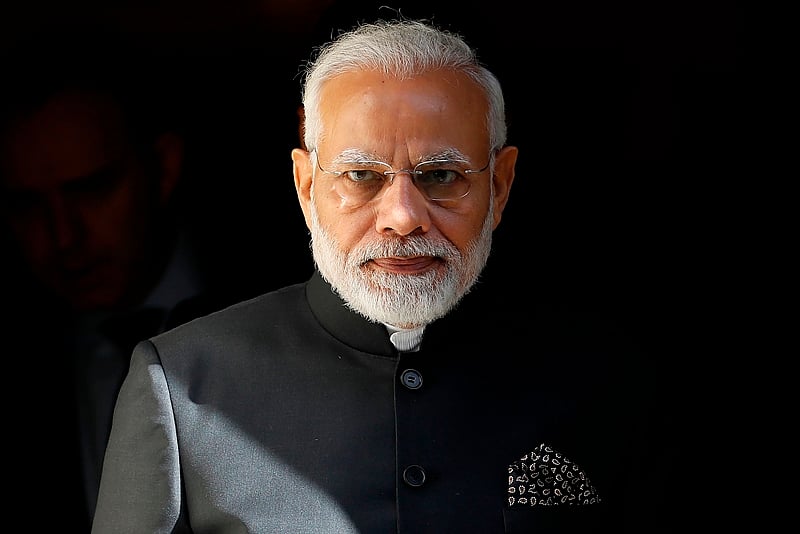
Since May 26, 2014, the day when Narendra Modi was sworn in as prime minister, the benchmark stock market index has risen nearly 40 per cent, while the mid-cap and small-cap indices have rallied up to 90 per cent. The last four years have seen the market going through a round of bull phase and making successive new highs, as the market cap of all BSE-listed companies rose by over 62 lakh crore. Though, it’s been a joyride for equity investors with returns on investments at around 40 per cent at index level, it is still not considered impressive enough, given the political stability the government enjoyed, which allowed it enough leg room to carry out bold reforms and keep the growth engines well-oiled. What it means is that the pro-reform Modi government, which is credited with a host of reforms, has actually under-performed in spite of its majority in parliament.
As the Modi government celebrates the completion of four years in office, for the investor community, the euphoria and optimism around reforms is long over. For the common man, the euphoria and optimism around ‘parivartan’ and ‘vikas’, which the prime minister had promised is also a thing of the past. Four years may be a short period for even the most ardent reformer to bring about a significant economic and social change. But, it is a reasonable time for a government to live up to the people’s expectations, more so when it promised far-reaching reforms and an overhaul of the old economic, social and political systems. As the government enters the fifth year, it is also a good time to judge its performance, particularly when it came to power on a galore of promises and has spent Rs 4,343 crore on advertising campaigns and publicity to highlight its achievements.
So, how has been the Modi government’s performance in these last four years? If one considers stock market as the barometer of the Indian economy, then the Modi government has done reasonably well. Though there is a definite interplay between the financial market and the economy, equity market does not truly represent the state of the economy as share of industry-related secondary sector in the economy is only 28 per cent and that of the listed corporate India is even lesser. While sentimentally, the ‘Modi factor’ did help take equity indices to life time highs, markets were primarily driven by surging equity flows from domestic investors and less by fundamentals in earnings.
The Modi government promised many things: good days, development, faster growth, 10 million jobs a year, education and skill development for youth, setting up of an effective Lokpal, minimum government and maximum governance, Rs 15 lakh in every citizen’s account after it had brought back black money stashed overseas and a peaceful and secure environment for citizens, particularly minorities and women. It’s not that the BJP/NDA government has not done some good work that will help the economy to grow faster in coming years. However, a close look at what the prime minister and his party had set out to do after winning majority in 2014 election reveals that there are several areas where the government has struggled to keep its promises.
Leaving aside poll promises and people’s expectations, even his zealous supporters, who had believed that Modi would catalyse the economy to new heights, may be disappointed. With GDP barely clocking 6.5 per cent, GDP growth has averaged 7.3 per cent in the last four years (new series), which is slower than the 7.6 per cent (old series) average clocked in the previous decade under the UPA regime. Private investment has lagged behind with gross fixed capital formation going down from 34.3 per cent in FY-12 to 28.5 per cent now. Industrial growth at 4 per cent average in the last four years is well below the 8 per cent plus registered in the old series. The biggest concern for the country in these four years has been the absence of growth in jobs.
With exports remaining a drag and wide-spread agony in the farm sector, boiling crude oil prices, widening current account deficit, depreciating rupee and mounting bank NPAs have caused things to fall apart. Experts believe that the government failed to capitalise on the bonanza it reaped from falling oil prices over three years which brought in additional revenue of 2.7 lakh crore. With the windfall gains gone now, the government’s fiscal math will go for a toss if it brings in subsidies to keep fuel prices low. High crude oil prices will have a contagious effect on current account deficit, inflation and interest rates, thus undoing all the work the government has done in achieving a balance.
While roll out of the GST is the government’s most notable policy initiative, despite several flaws, multiple rates and large scale initial disorder it caused to businesses, demonetisation was its most unsettling decision which caused large scale disruption to the economy. The resolution mechanism for stressed assets under the Insolvency and Bankruptcy Code, recapitalisation of banks and the creation of monetary policy committee are some of the other noteworthy policy reforms of the Modi government. Given its strength in parliament, the government was expected to bring in key changes to labour code and land acquisition laws. Instead, it introduced only labour-friendly laws like minimum wages, medical and pension benefits. The government’s focus on infrastructure has been a big plus. Another plus is the robust FDI flows and opening of FDI in defence, railways and insurance.
The share of manufacturing in GDP has remained stagnant and the much-publicised ‘Make in India’ is still a non-starter. While 100 per cent electrification of villages is an exaggerated claim, the Uday scheme, an initiative for financial turnaround of power distribution companies, is yet to show visible results. However, some of the government’s social welfare schemes like PMSBY, PMJJY, Ujjwala scheme and Jan Dhan Yojana have been appreciated for targeting the under-privileged. The four years of Modi government have had its share of ups and downs and hits and misses. Judging by the promises it made, it has not delivered enough. Politically it has gained, but on economic and development fronts, it lost the plot in spite of favourable macros.
Since weakening macros have started haunting the government, euphoria and optimism has given way to caution. As challenges to the economy are growing on many fronts, there are several nagging worries for the government in the final year of its rule.
A L I Chougule is an independent senior journalist.
