Promise the moon. Make people believe in it and win the election. Then turn around and tell them they must be really stupid to believe that they would one day get the moon. This is what Modi did in 2014 to win the election. And it is not Rahul Gandhi tweeting in one of his campus-class witticism, fed by his below-par social media team that we all have got used to by now, but on the authority of a senior member of Modi’s own cabinet. The cruelty in Nitin Gadkari’s joke in his controversial appearance on a Marathi television channel will not be lost on the poor people of India.
For us Indians, who have learnt to take even bigger insults as part of our life and rich culture, these things don’t really matter. Only recently we celebrated our country being dislodged from the number one position as home to the world’s largest number of poor people, conceding the honour to Republic of Congo; all this achievement due to, or despite, the best efforts of our government.
Recently, there was another set of statistics worth celebrating: We managed to slip down one point in a worldwide index of inequality, avoiding the ignominy of being in the last 10. The new worldwide index published by leading rights organisation, Oxfam, this month ranked India at the 11th from bottom on commitment to reduce inequalities in the population.
Japan was also at the 11th, but from the top. Oxfam’s ‘Commitment to Reducing Inequality (CRI) Index ranks India 147th among 157 countries and describes the country’s commitment to reducing inequality as a “a very worrying situation” given that it is home to 1.3 billion people, many of whom live in extreme poverty. Oxfam calculated that if India were to reduce inequality by a third, more than 170 million people would no longer be poor.
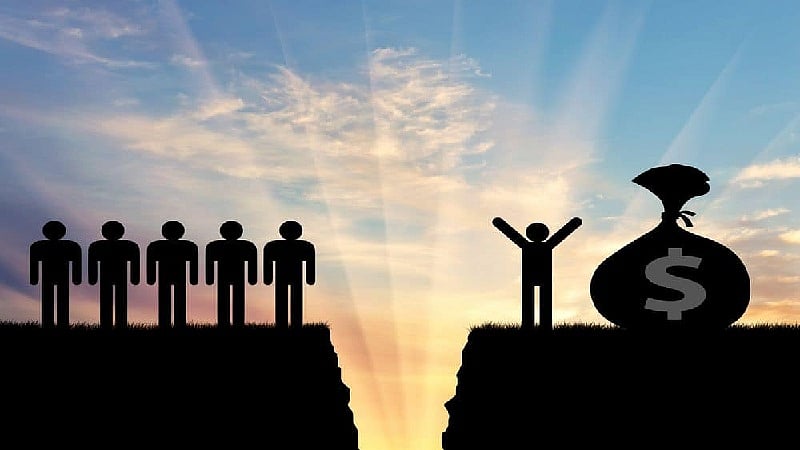
The index found that while the tax structure in India looks reasonably progressive on paper, in practice much of the progressive taxation, like that on the incomes of the richest, is not collected. One year ago, the richest Indians controlled only 58 per cent of the total wealth, indicating how the rich were becoming richer and poor turning poorer under the Modi government. In fact, there was an unprecedented increase in the number of billionaires in India in 2017, at a rate of one every two days.
Billionaire wealth has risen by an average of 13 per cent a year since 2010-six times faster than the wages of ordinary workers, which have risen by a yearly average of just 2 per cent, Oxfam pointed out. This is what happens when a government goes out of its way to accommodate favoured businessmen, scrapping more qualified public sector companies. Oxfam estimates that it will take 941 years for a minimum wage worker in rural India to earn what the top paid executive of a leading Indian garment firm earns in a year. By comparison, in the US it takes only one year for an ordinary worker to earn what a CEO gets for a day’s work. That gives an idea about the extent of inequality in India.
Various surveys have shown that even as the rich people were consistently adding to their wealth, the common people had become poorer under the Modi dispensation in the four years of his rule. A Gallup survey in the beginning of this year had found a big decline in the percentage of Indians who rated their lives positively since Modi assumed office in 2014. Family earnings remained almost flat for average Indians while wages paid to low-skilled workers actually declined by a quarter.
The Modi government has been claiming that its policies have helped India’s economy outperform most emerging markets in per capita GDP growth. It celebrated the news of India’s jump of 30 points in the Ease of Doing Business as ‘big achievement’ almost as a national festival.
But irrespective of the hype, the cold numbers show the hollowness of Modi’s celebrated Yojanas as these have failed to touch the lives of the people, the consequences of which may be visible when the PM seeks a return mandate in 2019 and the indications of which way the wind is blowing are clear. As the Gallup survey itself concluded “when people see their lives headed in the wrong direction, they want change.”
K Raveendran is a freelance journalist.
Views are personal.
