Over the past decade, numerous non-profits have scaled and impacted more than a million lives. We call these ‘non-profit unicorns’. These organisations iteratively develop an innovative solution that lowers the marginal cost of creating impact for each additional person.
For example, Educate Girls developed a community intervention model that has put more than two million rural girls in schools and retained them at just Rs 2,500 per girl.
On the other hand, CHILDLINE India Foundation experimented and perfected a helpline model to counsel children in distress. They now operate the helpline in partnership with the Government of India, covering 602 districts and handling 7 million calls annually.
Need for flexible funding
Change Engine’s ‘The Playbook for Non-profit Unicorns’ (co-authored by one of us) found that such organisations need $500K cumulatively in the first three years for de-risking. Most importantly, the funding needs to be flexible to allow iterative development of an effective lever, which can be scaled.
Line-item-based funding ties the hands of founders behind their backs, hampers innovation, and pushes organisations towards suboptimal solutions. We must fund non-profits like startups — providing them with flexible funding and focusing on outcomes.
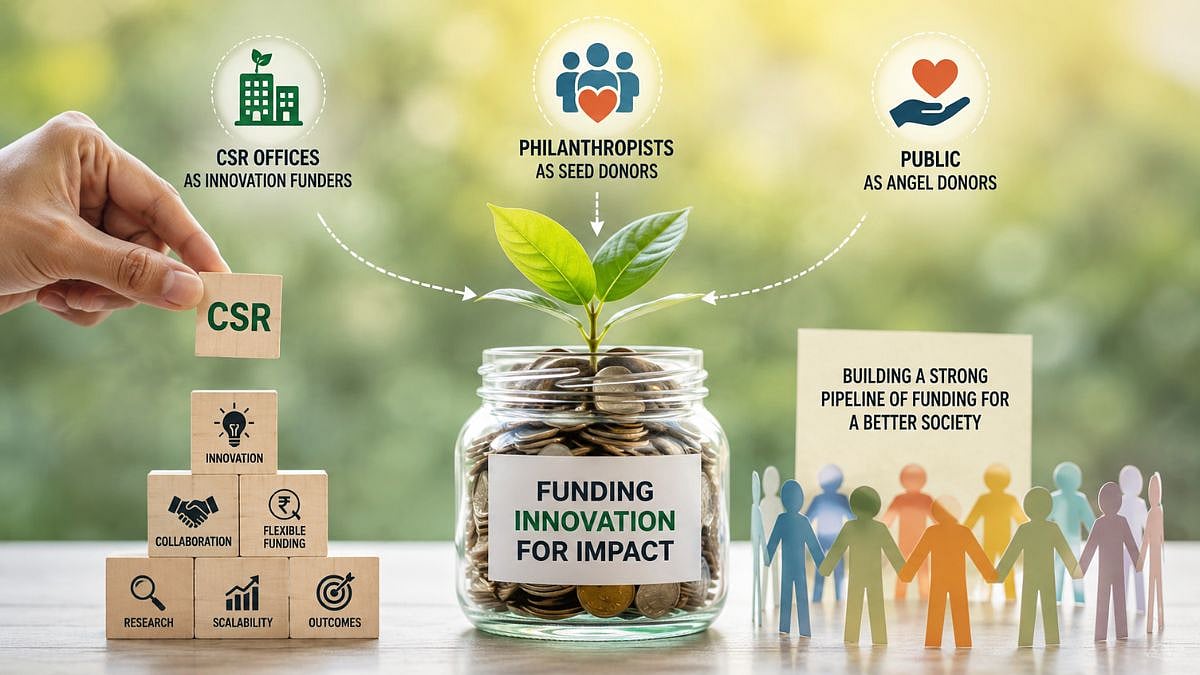
Much like startup funding rounds, non-profits receive follow-up donations for demonstrating non-trivial progress. This requires a completely new approach to funding non-profits. We have concrete suggestions for key funders: CSR offices, foundations, and the public.
CSR as innovation funders
CSR unlocks Rs 34,000 crore annually for non-profits. There are three ways CSR offices can make their funding decisions differently. First, in addition to funding direct service delivery by grassroots organisations, they should allocate a significant portion of their budget to support innovative organisations that develop scale levers to reduce the marginal cost of intervention.
The ecosystem needs non-profit unicorns to unlock multipliers and grassroots organisations for last-mile intervention. Currently, CSR funding tilts towards last-mile delivery, and a new balance is needed.
Second, there is a perception that CSR can be used only to fund service delivery with a direct beneficiary. The Act does not say so. CSR funds programmes to create social impact in areas specified in Schedule VII of the Act.
The programme may include putting together research reports, facilitating discussions, and disseminating findings to stakeholders. It can also fund technical advisories to the government to implement programmes more effectively.
For example, CSR can, and must, fund powerful studies like ASER by Pratham or a study to improve the effectiveness of cash transfers by the government. The non-profit playbook recognises such evidence reports and technical advisories as key levers of scale.
Third, CSR managers often create overtly restrictive micro line-item budgets as a way to prevent misuse. This not only stifles innovation but also leads to budget wastage due to the inability to spend as per a priori heads, and does not guarantee rightful use.
A better budgeting practice is to define broad areas of spending according to the programme design and provide organisations with flexibility to spend within these heads.
A periodic review and audit of spending will help prevent misuse and course-correct. That is how well-run corporations operate, providing budgets to departments and giving their leaders the flexibility to determine the specifics.
These steps will make CSR a powerful way to fund innovation and help create non-profit unicorns.
Philanthropists as seed donors
Philanthropic foundations should develop programmes to provide ‘seed donations’ for non-profit unicorns. These programmes should cover a lion’s share of the $500K that young organisations need.
They should provide patient risk capital and prioritise innovation for scale over quick results for a small set of beneficiaries. Funding work with beneficiaries is valuable, but as a sandbox, it identifies leverage points.
Another good practice is to provide multi-year grants for three to five years to give entrepreneurs a runway, rather than forcing them to spend substantial time fundraising.
Further follow-up grants on a larger scale can be provided based on success, much like how venture capitalists double down on their successes.
Such practices are already being followed by organisations such as the Azim Premji Foundation, the Convergence Foundation, and the ATE Chandra Foundation and must be replicated.
Public as angel donors
The phenomenon of ‘angel investors’ took root in India in the last decade. India’s middle class started writing small cheques to startups to be a part of the startup story, learn, and get a financial return. Today, angel investors are key risk investors for early-stage startups, buoying new ideas before institutional investors come in.
We now need the public to become ‘angel donors’, writing small cheques to fund non-profit innovation. They need to contribute their experience, learn from non-profits, and seek social returns. Clean air, safe roads, and a society with good mental health are what we all desire.
Non-profits are the engines that drive these returns, and we need to support them beyond the taxes we pay. Initiatives such as Social Venture Partners and LivingMyPromise are catalysing such efforts. We now need a movement of thousands of ‘angel donors’ supporting non-profits. They will be the real angels!
These three actors can create a full pipeline of innovation funding for non-profits, which is indispensable for Non-profit 2.0 and India’s socio-economic progress.
The article is co-authored by Varun Aggarwal, Co-founder, Change Engine, and Luis Miranda, Co-founder and Chairperson, Indian School of Public Policy.

