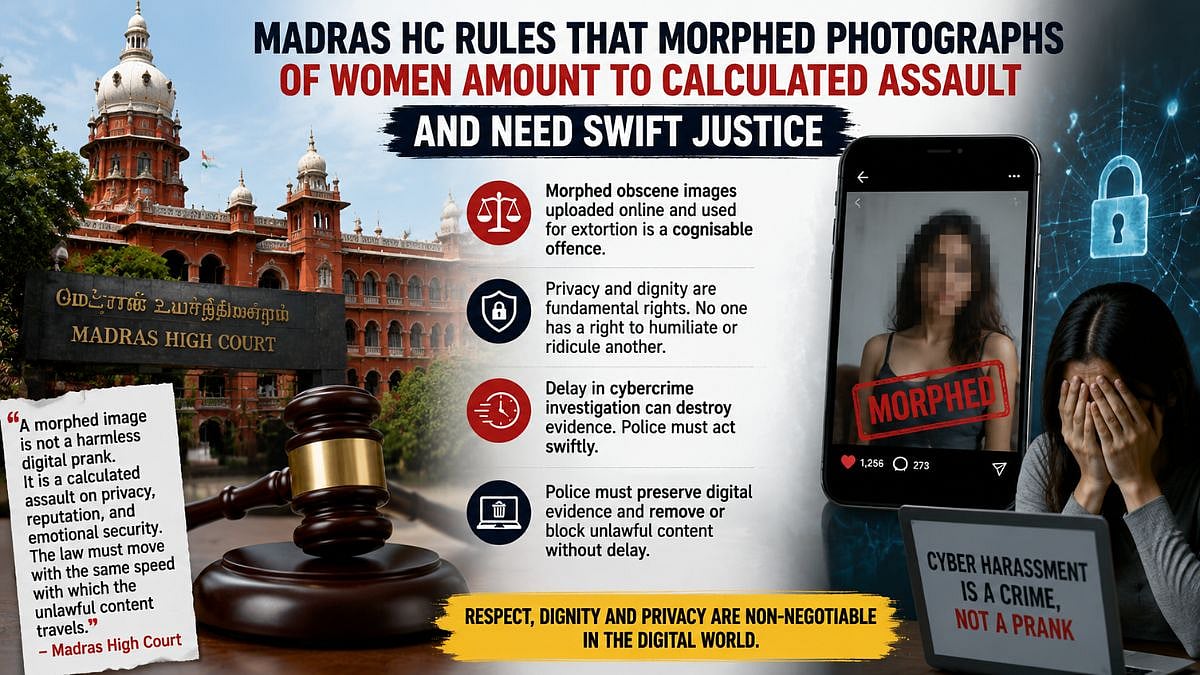
The Madurai Bench of the Madras High Court has delivered a timely reminder that cybercrime cannot be trivialised as online mischief. Hearing a petition involving the circulation of morphed obscene photographs of an Indian woman living in Singapore, it observed that “a morphed image is not a harmless digital prank. It is a calculated assault on privacy, reputation, and emotional security. The law must, therefore, move with the same speed with which the unlawful content travels.” That observation goes well beyond the facts of the case. It draws a clear line between humour and harassment, between free expression and criminal abuse.
The facts are disturbing. The complainant alleged that a man had digitally altered her photographs into obscene images, uploaded them on social media, and later demanded money for removing them. Such conduct is not a practical joke gone too far. It constitutes a cognisable offence involving cyber harassment, extortion, and a deliberate attack on a person’s dignity. The High Court rightly held that the allegations disclosed serious offences warranting immediate police action.
Limits Of Humour
The judgment also underlines an important moral principle: a prank is a prank only when everyone involved can laugh about it. Humour that humiliates another person is not humour at all. Nobody has an inherent right to make another individual the object of ridicule or public embarrassment. Freedom of speech, valuable though it is, does not include the freedom to violate another person’s privacy or reputation.
This principle applies equally to satire. Cartoonists and comedians have historically played an indispensable role in questioning power and exposing social and political hypocrisy. Yet, even satire has its Lakshman Rekha. It should target ideas, institutions and public conduct, not destroy anyone’s dignity. If a joke unintentionally causes offence and the person concerned objects, the civilised response is to apologise and make amends.
Need For Swift Action
Equally significant is the court’s emphasis on swift investigation. As Justice L. Victoria Gowri pointed out, digital evidence is fragile. URLs disappear, accounts are deleted, and IP logs may be overwritten within a short time. Delay in cybercrime investigations often means the loss of crucial evidence. The court, therefore, rightly held that the police cannot confine themselves to registering an FIR; they must also preserve electronic records and initiate prompt action to remove or block unlawful online content, thereby preventing continuing harm to the victim.
The digital world has vastly expanded the reach of speech and humour, but it has also magnified the consequences of abuse. Technology should never become a shield for cruelty or extortion. The judgment is a welcome affirmation that human dignity is non-negotiable. In the online world, as in the real one, respect for another person’s privacy and reputation must remain the first principle of responsible citizenship.
