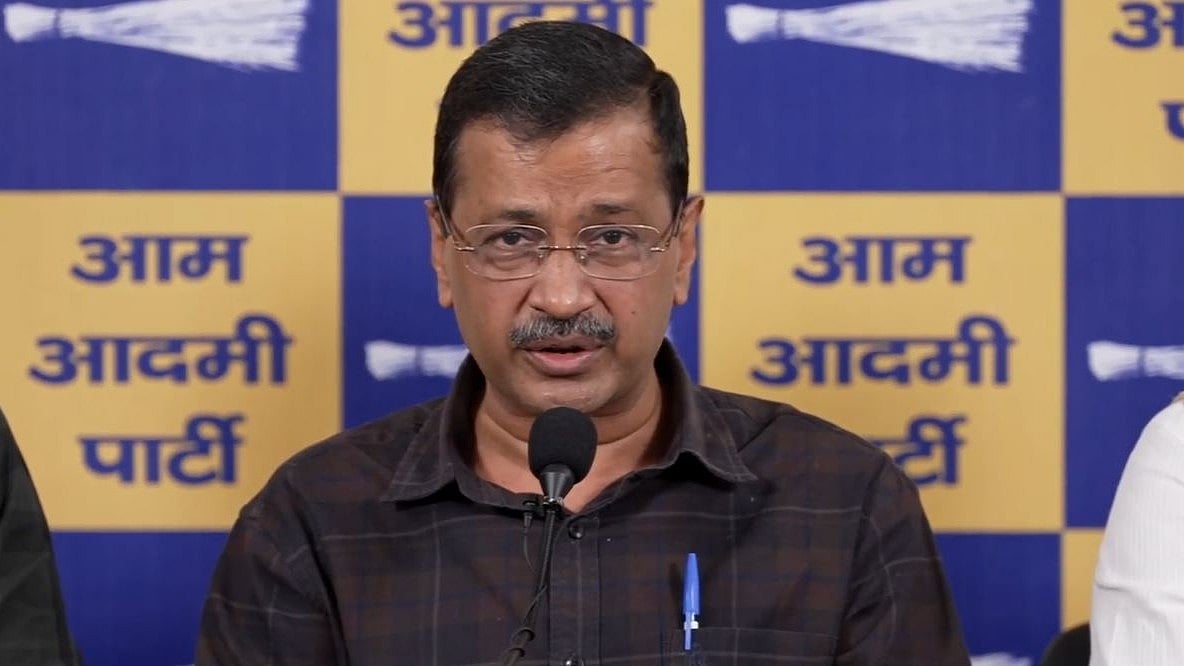
The dramatic collapse of the liquor scam case against former Delhi Chief Minister Arvind Kejriwal and his associates by the Central Bureau of Investigation (CBI) is not just a serious blow to the credibility of the country’s premier investigative agency.
It also raises disturbing questions on the vulnerability of political opponents of the central government to dubious and sometimes completely fabricated charges by the CBI and other investigative agencies controlled by the latter.
Thirteen years after the Supreme Court described the CBI as a “caged parrot”, highlighting the agency's lack of independence and acquiescence to the government in power, the political weaponisation of criminal investigation by supposedly independent central agencies has now become a routine affair.
From landslide victories to incarceration
Four years is a long time in politics. It was the liquor scam that wrecked Kejriwal and his Aam Admi Party (AAP) in Delhi, dislodging him from power and incarcerating him along with the entire top leadership of his party in jail for several months during this period.
Branded in the liquor scam case launched by the CBI and hounded by the media as one more corrupt neta, the reputation of Kejriwal and his party, mainly built on a populist anti-corruption platform that had scored two successive landslide victories in the Indian capital, lay in tatters.
Today, the trial court has almost contemptuously thrown out the entire legal proceedings against the political leader and all his fellow accused. Ruling on the evidence produced by the CBI, the court declared that it “does not disclose even a prima facie case, much less any grave suspicion”, and that the “excise policy case… is wholly unable to survive judicial scrutiny and stands discredited in its entirety”. It is not surprising that Kejriwal burst into tears when he heard the judgement.
Will the CBI appeal?
Despite the strongly worded judgement from the trial court Special Judge Jitendra Singh, who also asked for departmental proceedings against the CBI investigating officer, the investigative agency is believed to be considering an appeal to a higher court against the sweeping dismissal of its case.
It remains to be seen whether the senior judiciary of the land wants to risk the inevitable damage to its credibility should it choose to resurrect the proceedings against Kejriwal and his party.
Judicial delays and due process concerns
Over the past few years, the working of the judicial system in India, once considered a major achievement of its democracy except during the 19-month-long nightmare of the Emergency half a century ago, has come under a cloud.
A major reason is the inordinate length of time major criminal charges take to come to trial even as the accused languish behind bars, more often than not denied bail, and finally, when they do come for a hearing in the court, they are dismissed because of a lack of tangible evidence.
The most notable instances of delayed justice are the case of student activist Umar Khaled, who has been jailed for five long years without trial and has repeatedly been denied bail by all levels of the judiciary, and the Bhim Koregaon case that has dragged on for as many as eight years without being tried in court, although most of the accused have been granted bail over time.
Will this change the system?
Unfortunately, the denouement of the CBI in the Delhi liquor scam case, despite creating headlines and providing a morale booster for Kejriwal and his party, is unlikely to change the worrying trend of the wheels of justice grinding slowly, if at all.
There is also virtually no chance of the investigative agencies and their masters mending their ways because of the setback in court. This is largely because the political opposition and activists have failed to come together in galvanising popular opinion to make human and legal rights a major electoral issue.
Political implications for opposition
While unsurprisingly opposition parties have been quick to gloat over the humiliation in court of the CBI and, by inference, the central government on the Delhi liquor scam, this is not likely to prove much more than a talking point in their itinerant campaign against the Modi regime.
Despite the obvious threat to virtually all opposition state governments from a multitude of cases filed against their leadership and senior officials by investigative agencies, they are clearly at a disadvantage.
Some of them are genuinely compromised by some misdoing or malpractice, even though it is exaggerated in the charges, while others are clearly framed, but they all have a Damocles’ sword hanging over them, with the saga of Kejriwal’s fate in Delhi as a warning sign.
AAP’s road ahead in Delhi and Punjab
As for the former Delhi chief minister and the AAP leadership in the state, the first response has been an overwhelming sense of relief. They had expected to finally be acquitted when the case went for trial on such flimsy evidence but were pleasantly surprised when the trial court judge dismissed the case out of hand for being unworthy of a trial. It will definitely restore hope and vitality in the devastated party, which will now have to painstakingly work for a resurrection in Delhi.
Yet, despite the court clearing Kejriwal’s name, thereby restoring his moral credentials, a full-fledged political comeback will not be easy. Many of the former chief minister’s welfare schemes floundered because they were deliberately sabotaged by the Delhi Lt Governor, armed by the central government with extraordinary powers and complete control over the state bureaucracy.
This constant bickering between the chief minister and the centrally appointed governor did lead to the erosion of his vast popular following, although over the past year the BJP administration in Delhi has made a palpable hash despite the advantage of a double-engine government.
In Punjab, where elections are due soon, Kejriwal will no doubt campaign with renewed zest, but the real test of popularity will be that of the sitting AAP Chief Minister Bhagwant Singh Mann and his five-year term in office.
There is considerable anti-incumbency against the AAP government, and it is unlikely that the court’s rejection of the case against Kejriwal and party leaders in Delhi would make much difference. Instead, the continuing shortcomings of the political opponents of AAP in Punjab, like the Congress, the BJP, and the Akali Dal, could play a much bigger role.
The writer is a senior journalist.

