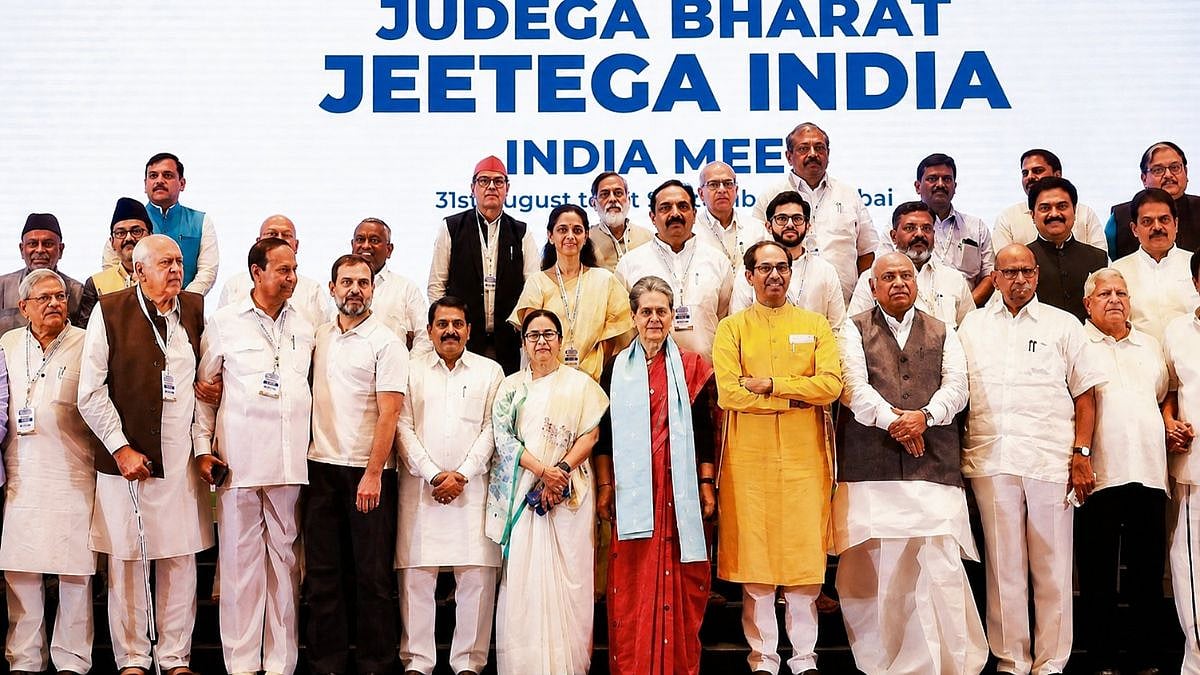
Is the Indian Opposition alive? Rather, a more pertinent question would be: Is the INDIA alliance alive after the serious drubbing of Mamata Banerjee in West Bengal? In the same breath, one can also ask whether the Opposition is in a position to give the BJP a good fight in 2029 or if it will prove to be a cakewalk for the BJP.
I know it is too early to predict any outcome for the 2029 parliamentary battle, but the picture as of now looks very dim for the Opposition, and it should really scare the leaders of the INDIA alliance. The 2024 election results must have scared the BJP, as it almost missed the bus then. It had failed despite the BJP and its allies making tall campaign claims that they would win 400 seats. The BJP could win only 240 seats, 32 seats short of the majority.
No doubt it was a great setback to the party, but even more so for Prime Minister Modi, whose victory margin was drastically reduced in Varanasi. Then it was believed that the BJP might also lose state elections thereafter, where it had not done well in parliamentary elections. But state elections since then have proved to be a nightmare for the Opposition. It has been losing elections, state after state, by huge margins. Especially, the Opposition’s loss in Haryana and Maharashtra, where the BJP/NDA's loss had been taken for granted, was heartbreaking.
Opposition faces organisational crisis
The Opposition can blame the SIR for its rout in states like Bihar and Bengal, but the reality is that it needs to realise that the BJP's election machinery, which seemed to be tiring out in 2024, has sprung back into action with much more energy, and it again looks invincible.
Tragically, the Opposition does not seem to realise that the “New BJP” is much more dangerous than the BJP that won the 2014 and 2019 elections. And this makes the Opposition's job and ambition, to dislodge the BJP in 2029, extremely difficult.
The problem with the INDIA alliance is much more serious. Fundamentally, there is a lack of national perspective and understanding. Regional leaders are firmly ensconced in their respective states where they wield power and hope to form a government sooner or later. For them, national politics is not that important. They are more than happy to reach the chair reserved for the CM, but with Modi as the prime minister, the whole paradigm has changed.
Regional parties and ideological vacuum
If anyone believes that the BJP will be more than happy to see a weakened Congress vis-à-vis regional parties, they should wake up. The BJP is in for a long haul in Indian politics. It would like to dominate the Indian political scene as Congress once did, but it can only do so if it decimates regional parties. The Congress could rule for more than 50 years because Indian politics was not so fragmented, and regional parties were almost non-existent.
During the Congress domination, three major political formations existed: the Left (CPI and CPM), the socialist parties and the Jan Sangh. They were small, but they couldn’t be called regional parties. They had a national agenda and a national perspective. They had more or less well-defined opinions on every national issue from foreign policy to economic policy.
Regional parties owe their existence mainly to the several splits in Congress and socialist parties, mainly the Janata Party and the Janata Dal. And these parties shrunk around a single leader, and their march was reduced to forming a government.
Need for united opposition front
Since forming a government was the priority, ideology took a back seat. Be it the TMC, the DMK, the TDP or the JDU/JDS, they all had no qualms in aligning with either the BJP or the Congress. Mamata is a classic example. After leaving the Congress, she partnered with the BJP and was in Vajpayee’s cabinet. Later, to defeat the Left, she broke with the BJP and aligned with the Congress.
But since Modi became the prime minister, the whole paradigm changed. Unlike the Congress, the BJP is a party deeply entrenched in a well-defined, robustly structured ideology. It is very difficult for the regional parties, devoid of ideology, to fight an ideological party.
No wonder regional parties, which are pitted against the BJP in states, are losing ground. The Shiv Sena, the TMC, the JDU, the JDS, the AAP, the PDP, the Samajwadi Party, the RJD, the INLD and the BJD are all prime examples.
These parties should realise that individually they can’t fight the BJP’s election machinery. They can survive only if they are united, speaking in one voice, like a single unit. In this fight, they have to set aside their differences and animosities toward the Congress.
History offers lessons for INDIA bloc
However much they may hate the Congress, the stark truth is that no opposition unity is possible without the Congress.
I have no doubt that if the Opposition, sooner or later, does not form a united front and does not revive the dying INDIA alliance, it can forget about putting up any semblance of a fight against the BJP in 2029.
Opposition and regional parties, including the Congress, should learn from history that whenever a splintered opposition came together, as in 1967, 1977, 1989 and 2024, and fought, they succeeded in neutralising the dominance of the ruling party at the Centre. Will these parties learn from history?
The writer is Co-Founder, SatyaHindi.com, and author of Hindu Rashtra. He posts on X at @ashutosh83B.

