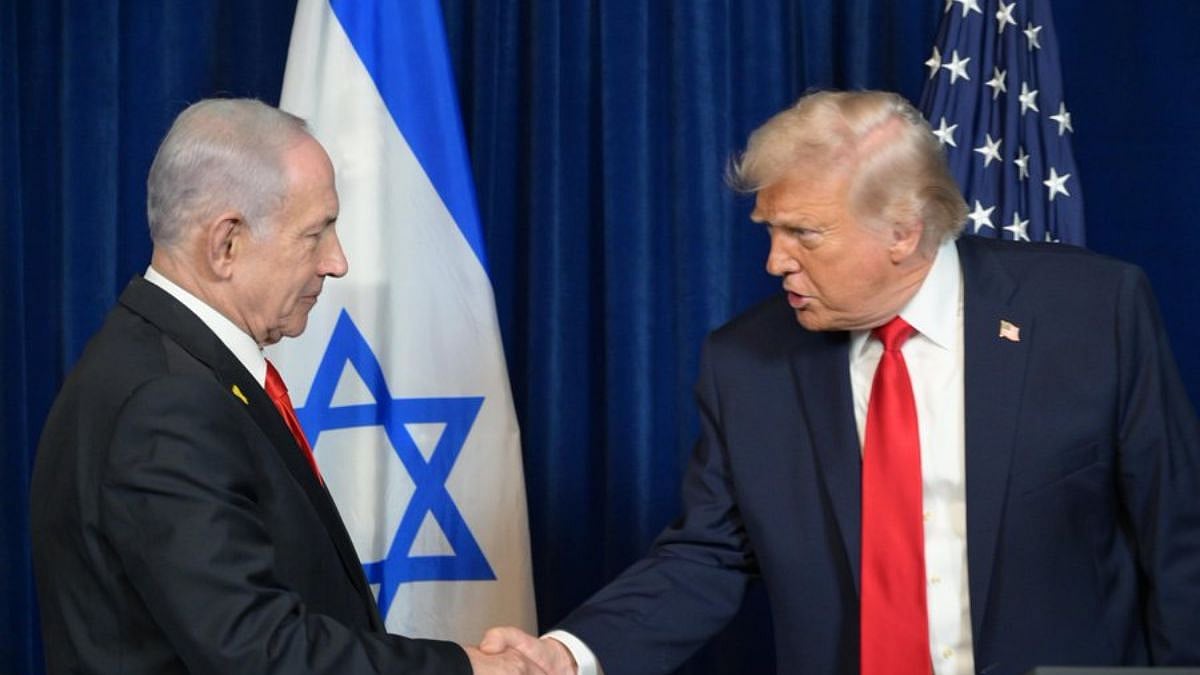
The ten-day ceasefire currently settling over the smouldering hills of southern Lebanon is less a triumph of diplomacy than a desperate, timed experiment in restraint. At its narrowest and most cynical, the truce is a diplomatic "clearance operation" designed to halt the kinetic momentum of war long enough for President Trump to physically haul Prime Minister Benjamin Netanyahu and the Lebanese President Joseph Aoun into a room in Washington so he can wear the garb of the peacemaker that he has beguiled himself into believing.
In this role, Trump will, of course, use the softest feather to specially plead with the Israelis and deploy a cosh on Aoun. The urgency, however, is dictated by a grim new geography and acquisitive Israeli military cartography: roughly 80,000 Israeli troops, comprising five combat divisions, now sit entrenched in a ten-kilometre "security zone" carved out of sovereign Lebanese soil.
Lebanon’s long history of conflict and devastation
This territorial "gobbling" is the latest chapter in a long, agonising history of depredations visited upon a nation that has spent half a century as a regional laboratory for violence. From the 1982 invasion to the indiscriminate, inhuman aerial bombardments of recent weeks that have levelled entire city blocks and displaced over a million souls, Lebanon has been systematically hollowed out—not only by Israeli ordnance but also by the parasitic "state-within-a-state" of Hezbollah as well.
The group’s myriad octopi arms have strangled the government in Beirut, using social services to build loyalty while its military wing turned civilian villages into a subterranean fortress of tunnels and silos, effectively inviting the very ruin that has now arrived.
Global stakes tied to US-Iran negotiations
Yet, the stakes of this ten-day window extend far beyond the Litani River. This truce is the essential, non-negotiable prerequisite for the larger high-stakes initiative between the United States and Iran—a rapprochement that has floundered not so much on the technicalities of nuclear enrichment, which were largely resolved through quiet Omani mediation, but on the visceral carnage in Lebanon.
For Tehran, the systematic dismantling of Hezbollah—its most prized strategic asset—is a domestic and regional red line that threatened to scuttle the broader deal.
Pakistan’s mediation and a high-risk diplomatic gamble
Here, the unexpected catalyst of Pakistani mediation has proved decisive. By positioning Islamabad as a neutral ground for "shuttle diplomacy", Pakistani officials have convinced both sides that the Lebanon ceasefire is the only viable bridge to a grand bargain.
If the truce holds, it validates the US-Iran overture; if it breaks, the cycle of Israeli expansion and Iranian-backed resistance will likely swallow a chance for a modicum of regional stability. The world is witnessing a 240-hour gamble: a test to see if the "heads can be knocked together" before the realities of occupation and grievance reignite a fire that no intrepid field marshal will be able to contain.

