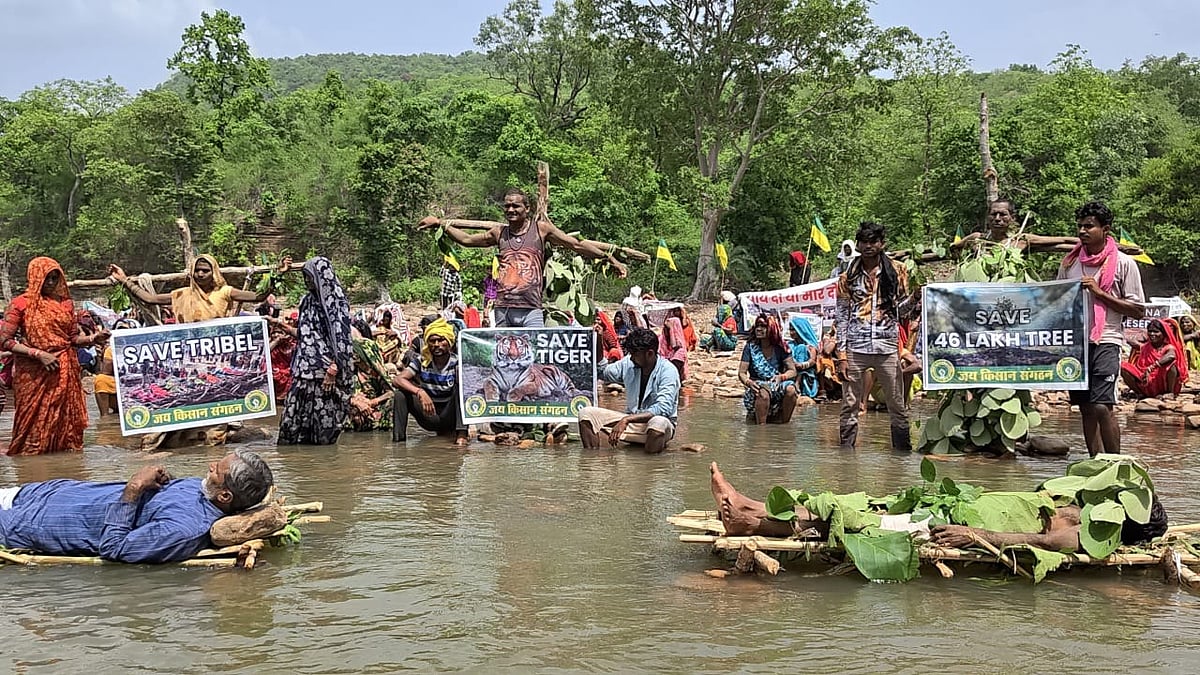
Before the first concrete is poured for a grand development project, the first foundation that must be laid is public trust. That principle appears to have been forgotten in Madhya Pradesh, where the government chose police muscle over meaningful dialogue to end the ‘Chita Andolan’ at Kupi in Chhatarpur district. It may have dispersed the protesters, but it has done little to address the grievances that brought them together.
The agitation, which began on July 3, drew several hundred protesters, mostly tribals, who feared displacement and questioned the implementation of the Rs 44,605-crore Ken-Betwa Link Project. On July 19, thousands of police personnel reportedly descended on the protest site with hundreds of vehicles.
Instead of engaging with the demonstrators, officials allegedly bundled them into buses and sent them back to their villages. Baton charges were reportedly used against those who resisted. Movement leader Amit Bhatnagar, then on the 14th day of his hunger strike, was detained along with others.
Development And Displacement
The administration may congratulate itself for restoring order. Yet, the ease with which a peaceful protest was dismantled exposes not the strength of the state but the vulnerability of those protesting. India’s tribal communities have long borne the heaviest burden of development.
Their forests become mines, their villages become reservoirs and their ancestral lands become industrial townships. The benefits of these projects are widely distributed, but the costs are disproportionately borne by those with the weakest political voice.
History offers sobering lessons. Whether in the displacement caused by the Heavy Engineering Corporation in Ranchi or the prolonged struggles associated with the Narmada projects, rehabilitation has too often fallen short of official promises.
Compensation packages announced with fanfare frequently fail in execution. The gap between policy and practice remains wide, breeding distrust among affected communities.
Need For Transparency
The Ken-Betwa Link Project promises substantial benefits: irrigation for drought-prone Bundelkhand, drinking water for millions and hydropower generation. These objectives deserve support. However, noble ends cannot justify unjust means. Large infrastructure projects derive legitimacy not merely from economic returns but also from the fairness with which affected citizens are treated.
River-linking itself remains a subject of scientific and economic debate. Its enormous financial cost and ecological consequences warrant constant scrutiny.
Allegations raised by protesters, including claims of irregularities, deserved examination rather than suppression. Even if such allegations ultimately prove unfounded, they should have been answered through transparency, not arrests.
Development cannot be measured solely in kilometres of canals or megawatts of electricity; it must also be measured by how a democracy treats its most vulnerable citizens.
A government that silences tribals instead of listening to them may win a day's battle, but it risks losing the moral argument. Progress built on forced consent is neither sustainable nor just.

