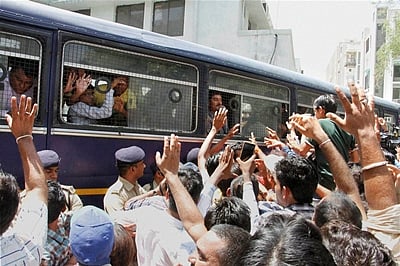
Finally, justice seems to have been delivered in the case of the Gulberg Society killings during the 2002 Gujarat riots. A special court last Friday sentenced eleven of the 24 convicts to life imprisonment. Twelve others were given seven years in jail for arson and rioting while one was given a ten-year sentence for his role in the riots in Ahmedabad following the carnage at the Godhra Railway Station.
Nearly 60 pilgrims returning from Ayodhya were charred to death when miscreants set the stationary compartment on fire. The resulting anger spiralled into state-wide riots, though the carnage was the worst in and around Ahmedabad. Sixty-nine people were killed at the Gulberg Society complex. Among them was a former Congress MP, Ehsan Jafri.
While pronouncing the quantum of sentence on Friday, Justice P B Desai described the Gulberg massacre as the “darkest day in the history of civil society.” Thirty-six people, including a BJP municipal councilor, Bipin Patel, were acquitted for want of credible evidence. The court also rejected the charge that the Gulberg murders were pre-planned as part of a bigger conspiracy. The implication was inescapable.
After the Godhra outrage, in which nearly 60 of their co-religionists were burnt to death, a wave of shock and anger had swept across the State. The resulting protests erupted into rioting in several places, including at the Gulberg Society. Here, the court order is an eye-opener. The judge said that the mob that gathered at the Gulberg complex was not “really interested in causing deaths” but it turned murderous once Jafri opened fire at it.
In Desai’s own words, the motley group was “largely involved in stone-throwing and attempting to burn and damage the vehicles, and properties of members of the minority community outside Gulberg Society.” However, “private firing on the part of the deceased Shri Ehsan Jafri, which resulted in some deaths from amongst the members of the mob and injuries to a few others infuriated the mob who saw persons belonging to the majority community falling to the bullets being fired…” It is the death of a few among the protesters that turned the situation ugly, making the mob indulge in a killing spree. The order termed the killings “unfortunate.”
As if not to leave it to any doubt, the court order restated that “it was the private firing by Shri Ehsan Jafri that acted as a catalyst and which infuriated the mob to such an extent that the mob went out of control. The court dismissed the testimony of witnesses who claimed that Jafri was “immobile and could not move out of his bungalow” as a case of “selective amnesia” and emphasised the “private firing from Shri Ehsan Jafri’s weapon” made the situation ugly.
Of course, no sensible person can condone the orgy of violence and death in the riots, be it Gujarat or anywhere else. But the way the foreign-funded NGOs, aided and abetted by the self-styled secularists, went on and on about the Gujarat riots being a premeditated anti-Muslim pogrom, ignoring the fact that nearly 300 out of a total toll of 1000-odd were Hindus, and that Godhra was a huge provocation, it would seem such killings were the first and last in free India. What is more shocking is that in the one-sided narrative the fact that Jafri had virtually triggered the killings by gratuitously opening fire at the mob — maybe to defend his self-assumed position as a most important resident of the Gulberg Society — was virtually left out. It was being made out that the Gulberg killings were unprovoked.
Of course, the mob behaviour was appalling and nobody can condone it but objectivity demanded that commentators on the Gujarat riots took due note of the real context to the trouble at Gulberg Society. The cabal of NGOs and the secularist media conspired to suppress that fact which Justice Desai has now brought out in stark detail. Meanwhile, if the media-driven frenzy still obliges the widow of Jafri to cry injustice at the convictions in the Gulberg case, there is nothing that anyone can do or should do. The justice system has worked, and worked rather well at least in the case of the Gujarat riots. Wish we could say the same about a long series of riots before Gujarat and since.

