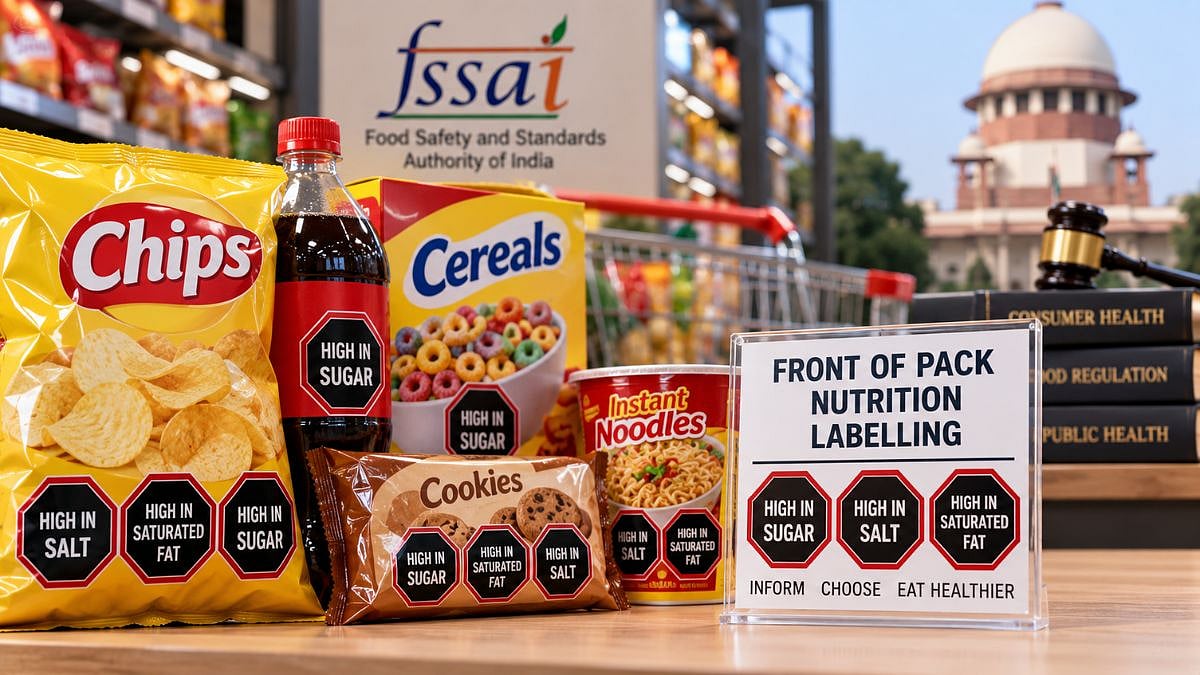
After a four-year-long process of trying to determine what kind of labelling can best inform consumers about the health profile of the packaged food they buy, the Supreme Court has reserved orders in the matter. Foods high in salt, sugar, and unhealthy fats are commonly sold with colourful and attractive packaging in India, and the industry has resisted the introduction of Front of Pack Nutrition Labelling (FOPNL) to caution consumers.
It is unedifying that the Food Safety and Standards Authority of India (FSSAI), which should bat for the health of the citizens, made a last-minute effort to avert a binding decision in court by asking for a fresh regulatory exercise inviting stakeholder objections and suggesting voluntary compliance for a year. Justices JB Pardiwala and K Vinod Chandran took a comprehensive view of the matter and questioned the FSSAI on its record in the matter since 2022.
Clearly, the FOPNL is of critical importance in India, given that the consumption of packaged food is worth nearly Rs 10.18 lakh crore annually and growing. While there is locally produced food sold in packages, it is industrial-scale production, using highly processed ingredients, that worries public health experts amidst a rising trend of even young people becoming overweight and the significant levels of diabetes and hypertension.
There is evidence of ultra-processed ingredients, which are used to make many packaged food items, harming intestinal health by affecting beneficial gut bacteria.
Supreme Court Backs Public Health
Promising to strike a blow for public health, the Supreme Court has said, while reserving orders in the case, that it will uphold the right of citizens to a healthy life under Article 21.
The FSSAI has also been warned that it must implement the orders on FOPNL sincerely without delay. Some sections of the food industry have seen the writing on the wall and come out in favour of the FOPNL, which should lead to a positive consumer response.
As a responsible regulator, the FSSAI would do well to drop attempts at hair-splitting in arriving at the safe thresholds for ingredients; for instance, separating added sugar and total sugars in the calculation. Also, the presence of even a single ingredient, such as salt or sugar, above the threshold needs to be indicated in the warning label.
There are many ways to highlight unhealthy foods through a clear label on the front, not necessarily through the proposed red hexagon that might confuse the consumer into thinking it is not vegetarian in origin. If healthy is green, unhealthy could be black or brown.
In fact, the presence of any ultra-processed material, such as hydrogenated fats in packaged food, should automatically lead to a prominent warning. Consumer awareness is growing, and some food producers boldly declare on their packaging, even now, that the product is free of palm oil. A health warning based on individual nutrients cannot be delayed any further.

