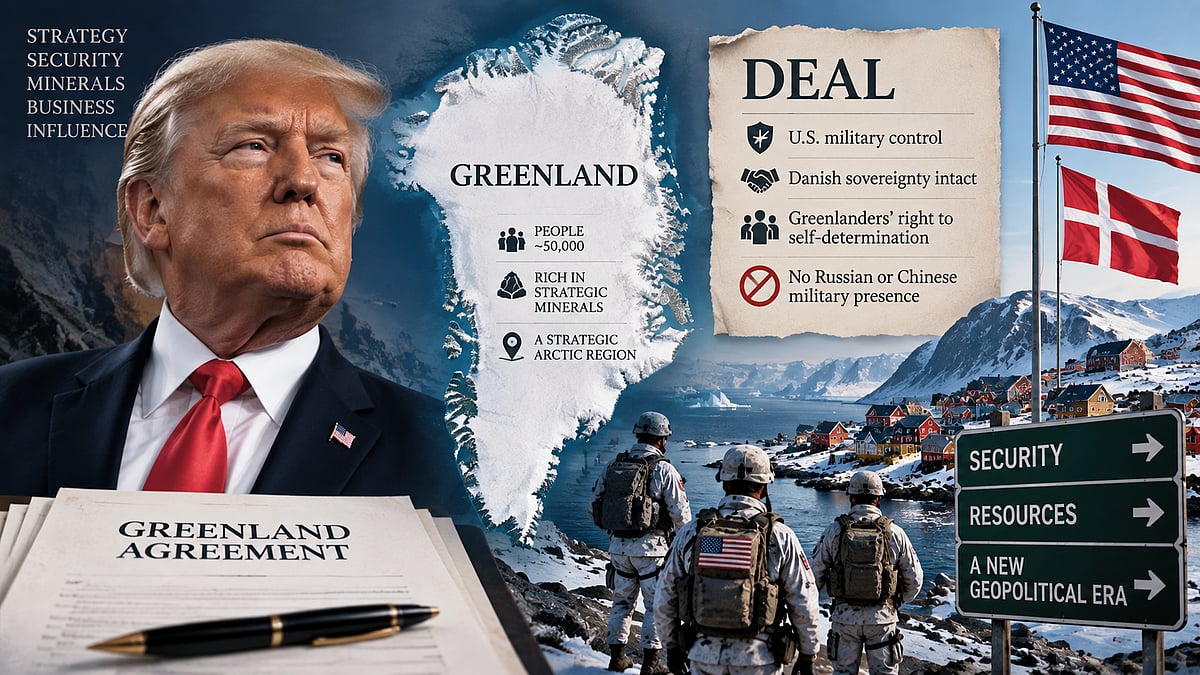
The terms built into Friday’s deal, ceding Washington full military control over Greenland, ostensibly without violating the territorial sovereignty of the Kingdom of Denmark, sound too good to be true. But the claim must be trusted if only in the hope that it would draw a line under one of many ugly and unprovoked attacks on the sovereignty of nations that have dogged President Donald Trump’s second term in the White House. The controversy, triggered when Trump threatened to acquire the small Danish territory of about 50,000 people for a price, or if need be by force, rattled Copenhagen, sending Washington’s allies in the North Atlantic Treaty Organisation (NATO) into a desperate scramble for a diplomatic resolution. Such an option never materialised, perhaps never seriously existed. Trump got busy ratcheting up annexation threats against Canada, coerced Ukraine into a rare earths deal, and deployed strong-arm methods to force Venezuela to capitulate.
When many European powers pushed back against the planned moves on Greenland, he actively considered slapping more tariffs before backing off. The US attack on Venezuela in early January was reportedly a turning point that forced Copenhagen to coordinate a military response, alongside other European powers, in the event of an invasion. President Trump revived his threat to take Greenland by force as recently as in the July summit of NATO leaders in Ankara. What must have transpired in the span of weeks largely remains in the realm of speculation.
Friday’s agreement—to be signed this week at the UN General Assembly—hands Washington full authority to develop its military presence over Denmark’s semi-autonomous region of Greenland. Jens-Frederik Nielson, Prime Minister of the region, has expressed confidence that its terms do not compromise the territorial sovereignty of the Kingdom of Denmark or the right to self-determination of Greenlanders. Nielson’s words will be scrutinised closely. The region has been under Danish control for centuries, and eyeballs will be raised whether the new pact is an early warning sign of an eventual transfer of authority to the US.
There are strict redlines in the deal: prohibiting Russia and China from nursing their military ambitions in this strategic minerals-rich Arctic region. But more significant are the gateways for American business consortia, including those headed by Trump’s billionaire associate, who, in 2018, steered the President to the idea of acquiring Greenland. Another Trump-linked oil firm was, in August, forced to delay drilling activity, owing to concerns over a protected wetland that is home to rare birds. These firms may be expected to go into an overdrive once the decks are cleared to commence drilling operations.
As the Nobel season draws closer, could Trump be so naïve as to contemplate that his Denmark deal could sway the Peace Committee? One can never tell.

