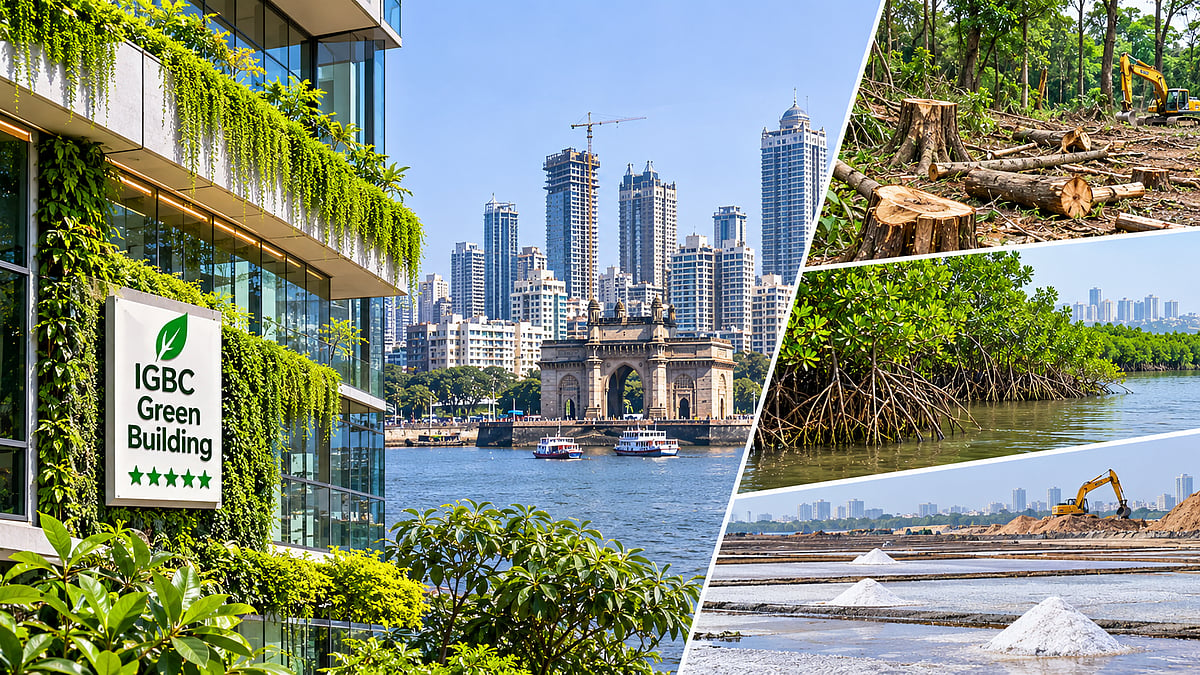
With Mumbai accounting for approximately ten per cent of the 20,621 green buildings across the country registered with the Indian Green Buildings Council (IGBC), as per its latest report, the claim is that the city leads India’s transition towards sustainable urban development. On the face of it, this seems an easy buy-in; the Maharashtra government and the Brihanmumbai Municipal Corporation might even launch a round of their now-familiar self-congratulation blitz. However, there’s more than meets the eye to Mumbai getting the ‘top rating’ for cities with green buildings and, indeed, to its relationship with nature or sustainability itself.
It is next to impossible to ignore the fact that the IGBC—one of the two authorities in India to certify buildings as ‘green’ on a rating system that emphasises energy efficiency, water conservation, indoor environmental quality, and carbon lifecycle—is an arm of the Confederation of Indian Industry (CII); the CII, of course, sees construction industry as the country’s foremost and critical industry. Equally important is that the agency is slated to helm the annual Green Building Congress in Mumbai later this month, with participation of the highest levels of the state government. To impress, Mumbai sets the stage for an exclusive gathering, so to speak.
Mumbai and Maharashtra bagging the top spots for cities and states with green buildings is a no-brainer because they have the largest number of registered projects, given the large number of commercial and residential buildings under construction here. Karnataka follows a close second. However, the overarching pertinent point to note is that between the IGBC and the relatively more independent GRIHA—Green Rating for Integrated Habitat Assessment—the certified green or sustainable buildings account for just over 4 per cent of the construction stock in India. Moreover, the rating parameters leave much to be desired as compared to the international frameworks for green building certification.
Though both the rating agencies have tried to popularise the concept of green buildings, the prevailing lack of awareness and a voluntary approach have stymied the expansion. However, focusing on green buildings is like looking at one detail in a large artwork. Green buildings mean little when the government and the BMC have, by plan and design, slashed thousands of trees in Aarey Colony, earmarked nearly 46,000 mangroves to be cut for the coastal road extension to Bhayander, released over 250 acres of salt pan lands for construction, and are moving to reduce the eco-sensitive zone of the Sanjay Gandhi National Park, among other unsustainable decisions. Ecological philosophy asks that sustainability—and green buildings within it—be seen not as a choice but as a responsibility to nature and citizens. Crowing about green buildings while making Mumbai less green is hardly responsible.

