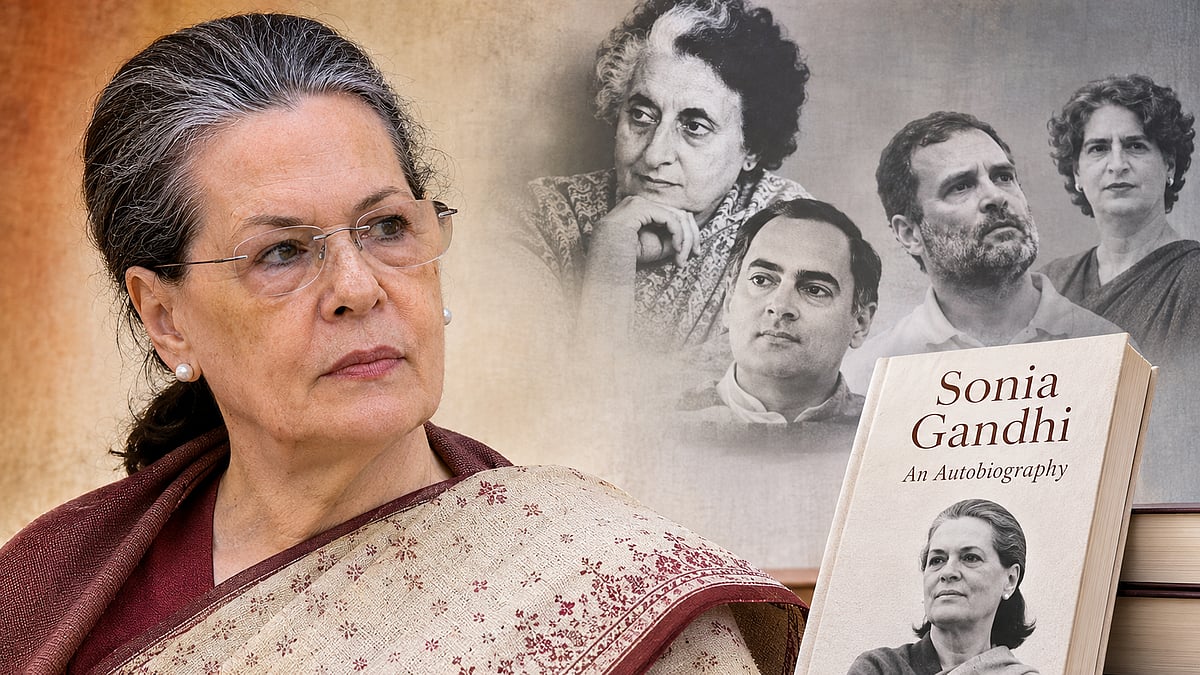
Sonia Gandhi’s memoir is creating ripples in Indian politics. There was a controversy long before the book hit the market. As a good reader, I also got my copy and have almost finished reading. I, too, have my opinions and complaints. I, too, wanted her to be more open and forthright. I also wanted to know the truth about the Bofors scandal and why she chose Manmohan Singh as the prime minister. But she has left history guessing on that score. Who knows if she will write another one to do justice to history.
I can understand her dilemma. When I left AAP after spending four and a half years, I had also gone through the same dilemma—should I write my reasons for leaving the party? I decided not to divulge. And until now, on every conceivable platform, I have been asked this question; even abroad, it does not leave me alone. Unlike me, Sonia Gandhi is a towering personality who has witnessed many events that have shaped and reshaped India’s history, from the day she came to India before her marriage to Rajiv Gandhi until today, when she has written her memoirs. Once Rajiv Gandhi became prime minister, she became a key witness to events.
While reading her memoir, I could guess that she has been extremely careful to avoid many narratives of which she was not directly a part. She preferred to write more about her experiences and about events she herself had participated in. Any event she was not directly involved in, she avoided commenting on or ignored. Till Indira Gandhi was alive, she was more of a housewife, whose husband was the son of a very powerful prime minister who lived in the same house as her. As an insider, her writing gives readers a perspective on Indira Gandhi, the Iron Lady of Indian politics. It opens a window for readers who otherwise had no access to her inner persona. The book tells us that Indira Gandhi, like any woman, had her own vulnerabilities and insecurities and, at times, looked extremely edgy and weak, suffering from human frailties. She also got upset when she was attacked by the outside world of politics, and she adored her grandchildren and doted on them. She took extra care, knowing Sonia Gandhi was not Indian and needed to make her feel comfortable in her new home.
The reader also learns about Indira Gandhi’s inner turmoil stemming from political events. It is fascinating to read Sonia Gandhi's account of how Indra Gandhi reacted, away from the public glare, when the Allahabad High Court pronounced her election invalid. Indira Gandhi then asked Rajiv, “What should I do? What should I do, Rajiv? Do you think I should resign?” Rajiv responds, “Yes, Ma, you should. Elections are just barely six months away. That will clear the air.” She reacts, “I think you are right. That’s what I will do.” But she decides the opposite. She herself gives the reason for imposing the emergency. “If I resign, the party will split and scatter, and the RSS will have its way.” The next moment, readers witness another facet of Indira Gandhi, as she bares her helplessness when she faces Maneka Gandhi. She writes, “She does not listen to me. I don’t know what to do.”
Indira Gandhi died a violent death. We all know that. But we did not know that after her death, Rajiv Gandhi wrote to his children, “I am convinced that Dadi knew that she was going to die on that day—I didn't know how or why she knew, but she did. Many things that she did indicate that she had prepared to leave us, not because she really wanted to but because life had given her very hard decisions to make and she had chosen to do what was required of her as a leader of her people.” The family had very, very unfortunate experiences. Before Indira Gandhi, Sanjay Gandhi also met an unnatural death. And after Indira Gandhi’s death, the family lived in dread that the same might happen to Rajiv, even when he was the prime minister. After he lost the election in 1989 and the SPG was withdrawn, Rahul, who was then studying in the USA, told his mother, “Ma, if something is not done about Pa’s security, I know I will soon have to come back for his funeral.” Sadly, this is what happened. After Rajiv Gandhi was assassinated and Rahul was telephoned and told, “Buri khabar hai”, he instantly said, “Papa is dead, isn’t he?”
Sonia Gandhi never wanted Rajiv Gandhi to become the prime minister. She feared that he would meet his mother’s fate. She failed to persuade Rajiv Gandhi as events overtook her, but Rahul prevailed over his mother when Congress chose her as the leader of the parliamentary party, and allies were ready to accept her as prime minister despite her foreign origin in 2004. Rahul shouted at her angrily, “They will kill you too.” Manmohan Singh became the prime minister.
But as fate would have it, despite her reluctance, Sonia Gandhi was left with no choice but to enter politics. She succeeded in installing a government with the help of allies in 2004 and remained the most powerful leader till 2014. Now, she is semi-retired. And Rahul Gandhi today is in the eye of the storm. His sister is also in politics, and she tells him, “You are playing with fire.”
History has its own way of writing a story. Sonia Gandhi has her own. She wrote it; it’s her story. She is the architect of the book, and she should have the luxury of telling the story she wants to. We should let her be.
The writer is Co-Founder, SatyaHindi.com, and author of Hindu Rashtra. He tweets at @ashutosh83B

