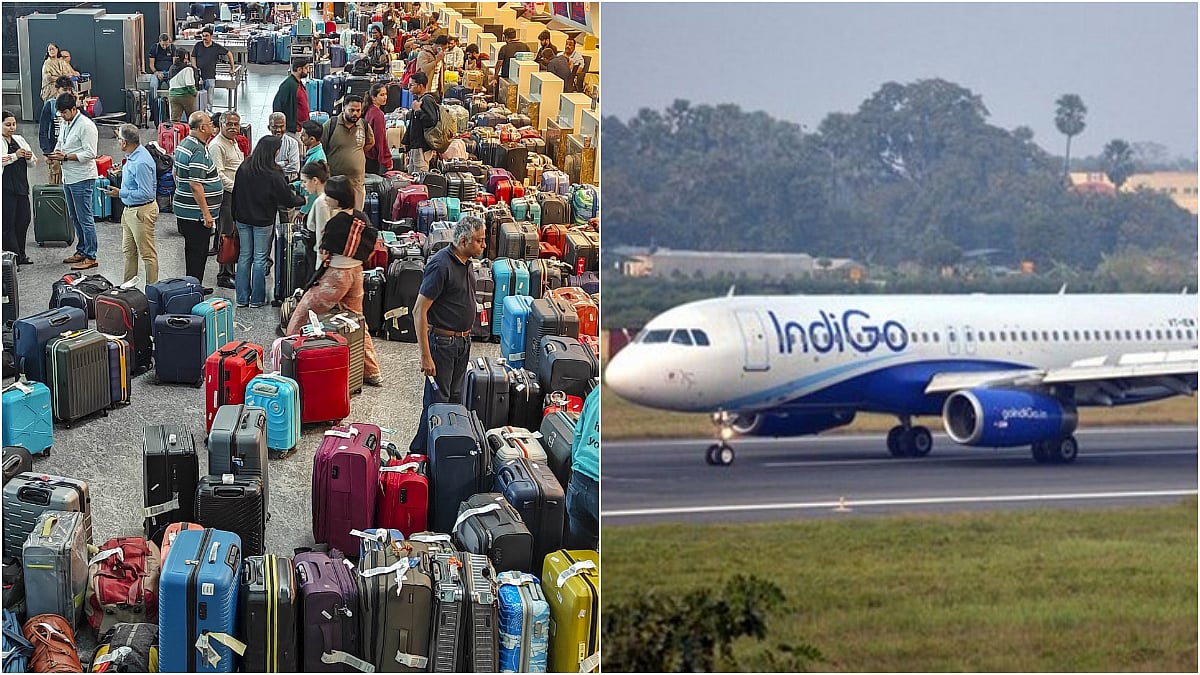
When IndiGo cancelled thousands of flights this December—stranding lakhs of passengers, destroying travel plans, and exposing India’s vulnerability to a quasi-monopoly airline—it was tempting to blame it all on one company’s “rogue behaviour”.
But scratching the surface reveals a deeper malaise: a chronic weakening of India’s regulatory institutions and a form of tainted capitalism where dominant private players face little real accountability. The crisis was not an aberration; it was an inevitability.
Indian regulators are meant to be quasi-judicial bodies—independent, evidence-driven, and powerful enough to discipline the biggest corporations. In principle, they play a role analogous to courts: interpreting rules, enforcing compliance, and protecting public interest. In practice, most regulators resemble departments inside ministries, staffed by junior officers who simply cannot stand up to billion-dollar incumbents.
Contrast this with the United States, where even a junior federal judge could issue adverse rulings against the sitting President Donald Trump and his whimsical tariffs. In India, the median regulatory staffer is neither empowered nor insulated. They are expected to regulate conglomerates, whose annual profits exceed the regulator’s entire budget and whose influence networks reach deep within the government.
The result is predictable: regulatory hesitation, delayed enforcement, and a culture of looking away until a crisis becomes impossible to ignore.
Long before the present airline fiasco, take the case of telecom, inching toward duopoly, which also offers a clear example. Over the past two decades, spectrum auctions were repeatedly followed by post-hoc rule changes—in pricing, revenue sharing, Adjusted Gross Revenue (AGR), and merger norms. Policy shifts came not through transparent processes but through continuous firefighting and lobbying. Companies bet on getting rules changed later, because history suggested they would. Regulation was characterised by volatility, not predictability.
This is the antithesis of the rule of law. When rules are unstable, discretionary, and revisable under pressure, firms learn that the real game is not competition or efficiency but regulatory capture.
The NITI Aayog–CRISIL report on airport PPPs (Public Private Partnerships) shows the same tension. India needs nearly $50 bn in airport investment over the next decade. Yet foreign participation is declining, not because the sector is unattractive, but because investors fear arbitrary regulation, delayed clearances, unpredictable tariffs, and lengthy disputes.
AERA, our regulator of airports, is theoretically an independent, quasi-judicial authority. But tariff-setting, its core mandate, has become a high-stakes litigation maze. Concession agreements contain ambiguities, while operators, often part of large conglomerates, deploy legal and political influence. As the NITI report notes, even basic issues like expansion triggers, equity lock-in, and termination payments remain unresolved or inconsistently applied.
When regulators are weak, the operator becomes the real policymaker.
The December meltdown of IndiGo was not “bad luck” or a “perfect storm”. The roots go back to 2019, when the pilot union challenged exploitative rostering and fatigue norms in court. That legal battle eventually led to the DGCA’s stricter Flight Duty Time Limitations (FDTL)—a long-delayed reform aligned with global safety norms. The irony is sharp: a labour union had to step in where the regulator failed. And the corrective action that came five years too late triggered a staffing crisis that IndiGo did not resolve proactively. It is a separate arguable matter whether setting working hours is within the mandate of the regulator.
In aviation, safety decisions are paramount. Yet IndiGo behaved as if compliance was optional, dragging its feet on inventorying crew shortages and adjusting schedules. The DGCA learnt of these lapses internally, but its junior staff either did not escalate or felt unable to push back. After all, how does a 28-year-old deputy director “warn” India’s largest airline, which carries nearly two-thirds of all domestic passengers?
This is a structural imbalance. When one company becomes too big to regulate, the public becomes a hostage.
The IndiGo crisis also reveals something uncomfortable about India’s political economy: labour cannot negotiate except through courts. Pilots, highly skilled professionals, could not achieve basic fatigue protections through bargaining. They needed a judicial intervention.
If this is the fate of pilots, imagine the condition of informal workers, gig workers, or teachers in private colleges. In India’s celebrated growth story, capital has become organised, concentrated, and politically entrenched; labour has become fragmented, precarious, and voiceless.
A society where only capital can speak is not merely unequal; it is unstable.
Another example of a quiet regulatory failure is in the higher education sector. India’s education regulators—AICTE, UGC, and state councils—have long been unable to discipline powerful private institutions. Excellence and fidelity to education goals is by exception, not the rule. Capitation fees, faculty shortages, infrastructure violations, and quality lapses persist because regulators fear litigation, political backlash, or simply administrative overload.
The result is a parallel universe, where rules exist but only for the weak. Big institutions innovate new ways to bypass norms, while smaller ones collapse. Parents and students have no real grievance redressal. The problem is not only rogue institutions.
There are far too many examples across sectors of how regulators have the title of judges but the autonomy of clerks.
India’s development narrative often celebrates private enterprise, and rightly so. But when regulatory checks are weak, capitalism becomes tainted, especially aggravated by cronyism or monopolistic behaviour. What follows are discretionary concessions and selective enforcement, monopolistic dominance that stifles competition, or regulatory capture that substitutes private interest for public interest.
The IndiGo episode is not an aviation story. It is an economic governance story. A system with a strong rule of law would have the following: (a) compelled airlines to disclose staffing adequacy months earlier; (b) penalised schedule overextension; (c) ensured transparent tariff and slot allocation; (d) protected whistleblowers inside the DGCA; (e) institutionalised class-action remedies for passengers.
Instead, passengers bore the costs, airlines deflected the blame, and regulators scrambled to respond after the damage was done.
The Way Forward: Rebuilding the Capacity to Say “No”
India does not suffer from a lack of regulations. Strengthening the regulatory spine will need the following reforms: (1) Institutional autonomy with fixed tenures, independent budgets, and non-transferable leadership. (2) Professionalised cadres with domain specialists, not just bureaucrats. (3) Legal empowerment that leads to swift penalties, binding directives, and statutory protection for staff acting in good faith. (4) Transparency and accountability by publishing all concessions and enforcing open consultations. All approvals should be digitised. (5) Preventing dominance in sectors like airlines, telecom, and digital markets.
IndiGo’s meltdown, telecom’s flip-flop policy history, the fragility of airport PPPs, and the helplessness of education regulators—all point to one truth: India’s regulatory state is not yet strong enough to discipline the giants it has created, nor can they rein in monopolies.
Until regulators regain independence, authority, and credibility, India will continue to oscillate between private excess and public helplessness. Rogue companies will be blamed, but the deeper fault will lie in a system where rules are flexible for the powerful and rigid for everyone else.
Strengthening the rule of law is not anti-business. It is the only way to build a capitalism that is fair, stable, and genuinely democratic.
Dr Ajit Ranade is a noted Pune-based economist. Syndicate: The Billion Press (email: editor@thebillionpress.org)

