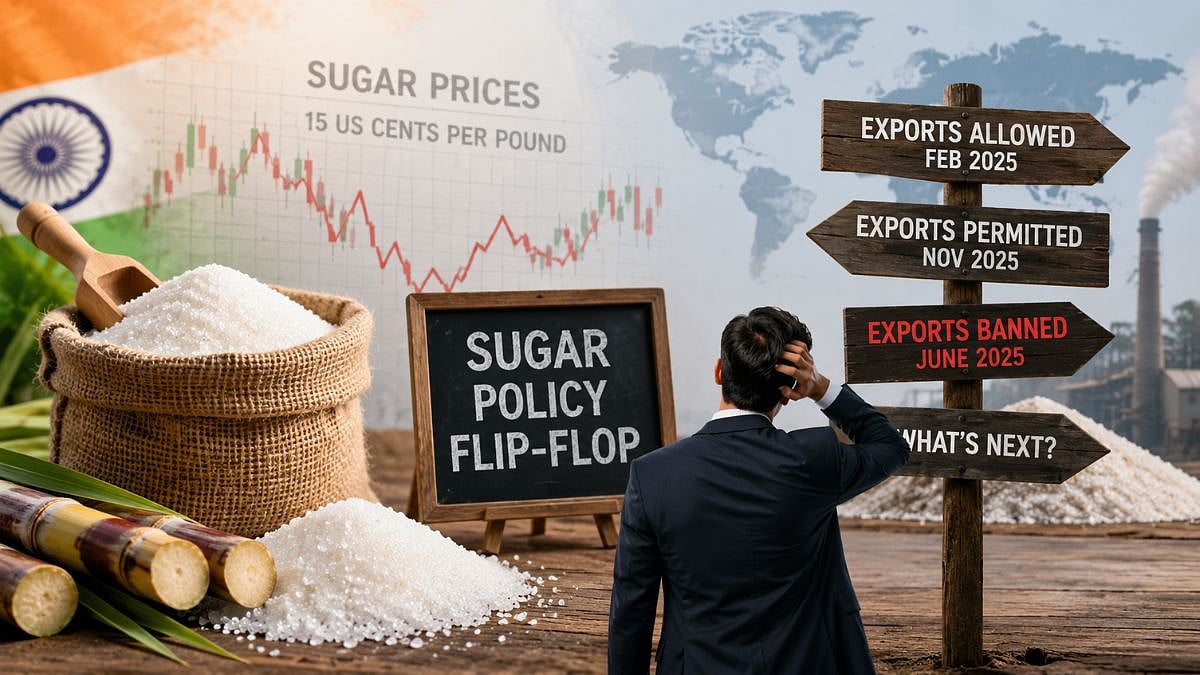
The oversupply in the world sugar market may end soon. Oversupply had caused the price of raw sugar to fall to a five-year low by mid-April. Since then, it has recovered somewhat from that level. The price is currently trading at just under 15 US cents a pound, back at the level seen at the start of the year.
A few days ago, a large global sugar trading house placed the expected supply surplus for the current crop year at 6.8 million tonnes. It also projected a smaller supply surplus of 1.4 million tonnes for 2026/27. However, the surplus expected for next year could disappear altogether if El Niño leads to production shortfalls or if Brazil diverts more sugarcane for ethanol.
At the same time, demand for sugar is likely to stagnate. Demand has, in any case, been sluggish for several years now.
Global supply outlook
The International Sugar Organisation (ISO) expects a slight supply deficit of 262,000 tonnes in 2026/27, following an upwardly revised surplus of 2.24 million tonnes in the current crop year. The main reason for this is the expectation that sugar production will fall by 2 million tonnes.
In this context, the ISO also points to the El Niño weather phenomenon, usually associated with low rainfall and dry conditions, that could lead to lower sugar production.
In addition, ethanol production is set to increase in Brazil and India. The rise in global energy prices following the military conflict in the Persian Gulf region has boosted demand for biofuels, and some countries have introduced or expanded blending programmes. This could be at the expense of sugar production unless the sugarcane harvest increases suitably, something that is unlikely due to El Niño.
India’s changing export policy
India was widely perceived as a source of oversupply. However, the country recently curtailed the export of all types of sugar—raw, white and refined—till September 30 this year in order to prioritise domestic supply and control inflation. In effect, India has reversed its February decision to permit the export of 500,000 tonnes in addition to its November 2025 decision to allow 1.5 million tonnes.
Importantly, actual sugar production during the sugar year 2025-26, after taking into account diversion for ethanol, is now projected at 28 million tonnes, lower than the initial optimistic estimate. Consumption is estimated at approximately 28.5 million tonnes, leaving the inventory level (approximately 4 million tonnes) less than comfortable.
This development confirms previous speculation that exports might be curtailed, as sugar production in India was expected to be lower than initially anticipated.
At the same time, demand for sugar in India has weakened in the wake of the Iran war and rising inflation expectations. Should El Niño lead to a weaker southwest monsoon season, it could also affect production in the coming crop year. According to the government, the planted area for cane (5.6 million hectares) and sugarcane production (500 million tonnes) reached record levels in the 2025-26 season but are expected to shrink in the 2026-27 season.
Ethanol diversion and policy concerns
Elsewhere, significant reductions in planted areas have been reported in Europe, suggesting that world sugar production is likely to be lower. There are, thus, growing signs that the sugar price may have bottomed out.
With elevated energy prices, the propensity to divert traditional food products for fuel has increased. While this happens mostly in food-surplus countries, such as Brazil and the USA, India has to be a lot more careful in allowing diversion of food for fuel.
The Indian policy for diversion of sugarcane for ethanol has been unsteady. The government imposed restrictions on the use of sugarcane for ethanol production in December 2023. Sugar mills and distilleries were restricted from using sugarcane juice and B-heavy molasses for ethanol to safeguard domestic sugar supplies and control retail inflation during a drop in cane output.
However, after a few months, the quantitative restriction was lifted in August 2024. By the 2025–26 ethanol supply year, the government removed all limits on ethanol production from sugarcane derivatives. Now comes the ban on sugar exports.
Need for reliable crop estimates
This policy flip-flop shows the government’s crop estimation process in a poor light. The estimates are unreliable, and any policy intervention based on unreliable data is sure to confuse market participants and encourage speculative tendencies.
G. Chandrashekhar is a commodity market specialist. Views are personal.

