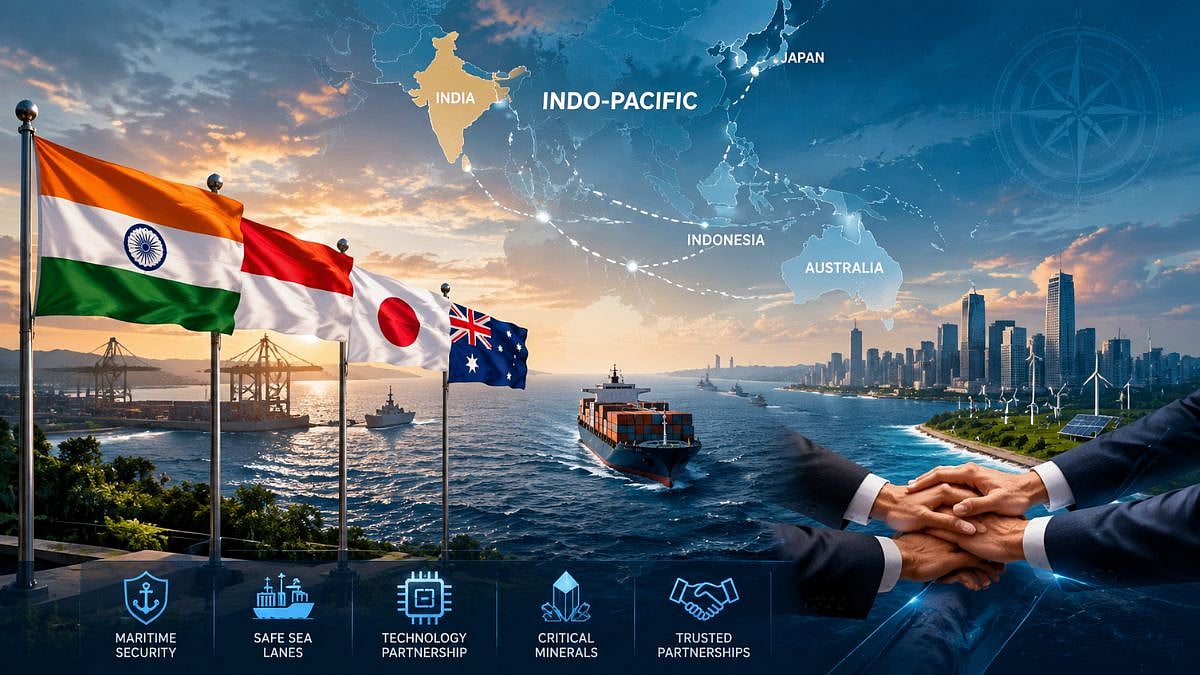
Prime Minister Narendra Modi’s three-nation tour, which ended last Sunday, has inevitably been interpreted through the prism of strategic competition with China by many observers. That reading is certainly prescient to an extent, but there is more beyond the China calculus.
It is also about the need to draw friends closer in an uncertain world, where US power is gradually declining and “Middle Powers” need to combine to secure their resources and supply chains. Reducing the visit to another chapter in Sino-Indian rivalry in the Indo-Pacific diminishes its larger significance.
Beyond The China Calculus
The tour, particularly the visits to Indonesia and Australia, and the visit by Japanese Prime Minister Sanae Takaichi just days before the Indian Prime Minister embarked on his eastern sojourn, possibly reflect India’s attempt to redesign its strategic play for an era in which economic security, technological capability and maritime power have become inseparable.
The Indo-Pacific is no longer simply a theatre of naval deployments or diplomatic summits, where the world’s largest superpower underwrites security; it has become the principal arena where the future distribution of economic and military power will be decided.
India, whose ambitions extend from becoming a manufacturing hub to a leading artificial intelligence economy, needs access to secure supply chains and trusted strategic partners who can help it keep sea lanes and choke points free of conflict or threats.
India’s Andaman and Nicobar Islands, Indonesia, Malaysia and Singapore have the strategic advantage of controlling the narrow Strait of Malacca, through which 70 per cent of Asia’s energy supplies and a quarter of global trade flow. Of all the nations in the vicinity, the largest navies are Indian, Indonesian and Australian.
Here again, China is the context for the new arc of maritime cooperation rather than the explicit subject. Beijing’s rapidly expanding naval capabilities, its growing presence across the Indian Ocean and its investments in strategically located ports have altered regional calculations. Many Indo-Pacific nations are uncomfortable with an increasingly assertive China, yet equally unsure of Washington’s interest in the Indo-Pacific or its intent, for that matter.
This reflects a wider trend across the Indo-Pacific, where “Middle Powers” such as India, Japan, Indonesia and Australia increasingly recognise that while the United States remains central to regional security, domestic political uncertainty in Washington makes exclusive dependence increasingly risky.
Strengthening Regional Partnerships
Rather than replacing American leadership, countries are constructing denser networks among themselves. The talks with Japan just ahead of the three-nation tour, therefore, may not have been just a coincidence, many analysts feel.
Their cooperation strengthens regional stability without creating rigid military blocs, while also allowing each country greater flexibility in responding to future uncertainties, whether generated by Chinese assertiveness or shifts in American foreign policy.
However, while that explains the talks on maritime cooperation with both Canberra and Jakarta, the centrepiece of the trip was not merely defence cooperation but discussions on uranium, critical minerals, investment and technology.
Australia occupies a unique place in that equation and, understandably, India concentrated on talks to buy uranium there and tie up for critical minerals. However, deals were also signed in Indonesia to process rare earths and jointly produce permanent magnets, as well as certain grades of stainless steel.
Canberra controls some of the world’s richest reserves of uranium, lithium, rare earths and other critical minerals indispensable to batteries, semiconductors, renewable energy and advanced defence systems.
As India seeks to build data centres, artificial intelligence infrastructure and expand its civilian nuclear energy programme, Australian resources assume strategic importance far beyond ordinary trade. The reported discussions over greater uranium imports illustrate how economics and national security increasingly overlap.
Imported uranium could help fuel India’s expanding civilian nuclear sector, allowing domestically mined uranium to be allocated more flexibly within the country’s broader strategic programme. China’s dominance across much of the global critical minerals supply chain lends a degree of urgency to the deals struck during the three-nation tour.
Building Economic Resilience
Beijing’s corporate empire, with links to its People’s Liberation Army, exercises enormous influence over mining operations across Africa and Central America, as well as Myanmar’s contested northern regions, while retaining an overwhelming advantage in mineral processing worldwide. Even countries rich in natural resources frequently remain dependent on Chinese refining capacity before those minerals can enter global manufacturing chains.
India’s response has to be a bid to dilute its own vulnerability and not an attempt to replicate China’s stranglehold—first, because India does not have the cash needed to buy up whole nation-states that supply China with their mineral resources; and second, because that is not the way New Delhi conducts its business.
Rather than asking countries to choose sides, New Delhi has increasingly presented itself as a partner offering practical cooperation without alliance obligations. This approach resonates particularly well across Southeast Asia, where governments continue to value strategic flexibility above ideological alignment.
Indonesia embodies that preference, as Jakarta has consistently sought to preserve its diplomatic autonomy while engaging all major powers. India’s own longstanding commitment to strategic autonomy makes it a more acceptable security partner than states perceived as extensions of broader great-power rivalry.
India is positioning itself not as the leader of an anti-China coalition but as a reliable middle power capable of strengthening regional resilience without forcing uncomfortable political choices.
Strategic Cooperation Expands
Relations between New Delhi and Canberra are no longer about cricket, education and migration, and have evolved with remarkable speed over the past decade. The partnership now encompasses intelligence exchanges, defence logistics, military interoperability, cyber security and maritime cooperation.
The mutual logistics agreement, expanding naval exercises and proposed maritime security roadmap demonstrate that both countries increasingly view each other as indispensable strategic partners. Yet neither seeks a formal alliance that could upset other powers or create misapprehensions among smaller states.
Infrastructure cooperation carries similar significance and, possibly, this is where the talks with Japanese Prime Minister Takaichi complete the jigsaw of the new relationships being built.
Joint projects across the Indo-Pacific, including ports and connectivity initiatives, provide alternatives for smaller regional countries seeking investment without becoming overly dependent on any single external power. Such projects are not simply development assistance; they represent an emerging contest over standards, influence and regional connectivity.
The Indo-Pacific has become too economically integrated and strategically contested for the regional “Middle Powers” to remain passive observers. India’s, as well as the entire region’s, prosperity increasingly depends upon secure sea lanes, diversified supply chains and trusted technological partnerships.
None of these objectives can be achieved in isolation; they are threaded into one string—not of Chinese pearls but of Indian and Indonesian spices, combining with Japanese technology and Australian mining prowess.
The author is Editor, United News of India.

