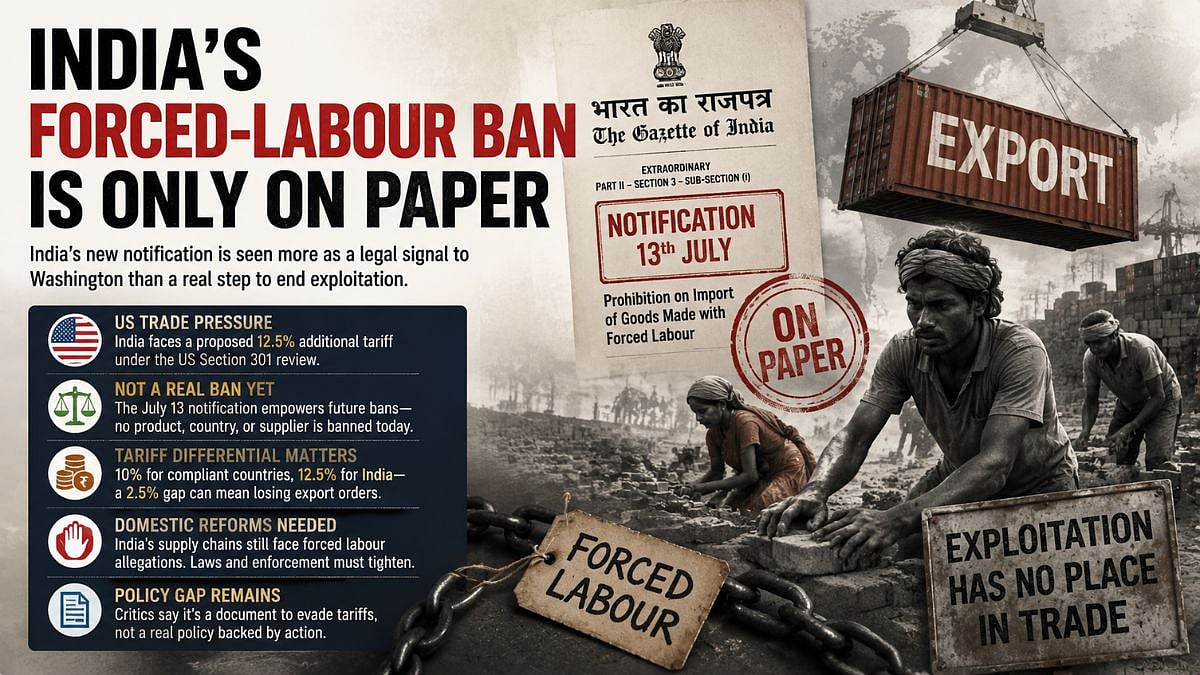
The gazette notification on July 13, banning the import of goods made with forced labour, was not a voluntary measure by the Indian government but rather a legal telegram to Washington. This is because, in a few weeks, the United States Trade Representative is expected to finalise a Section 301 report that could impose an additional tariff of 12.5% on Indian exports. America bars imports of raw materials produced with forced labour. The logic is simple: when a trading partner keeps buying the 'tainted' versions, its manufacturers can roll out finished goods at prices American producers cannot match.
The forced-labour discount, in effect, becomes an export subsidy—one paid for by the world's most exploited workers. The tariff schedule makes the incentive explicit. Countries that adopted domestic measures against forced-labour imports—the EU, Pakistan, Mexico, Canada, and Indonesia among them—were proposed a lower 10% rate. India, without such a regime, faced 12.5%. The July 13 notification is India's move to join the cheaper club. The fine print of the notification reveals that not a single product, country, or supplier is actually banned today. The rule merely empowers the government to prohibit specific goods later, after a DGFT inquiry, under procedures that have not yet been set out in the Handbook of Procedures.
Tariff Pressure Drives Policy
But the US is not going to let India go without imposing the tariff unless it shows that it is in the process of weeding out the defaulters. The countries that earned the 10% rate had demonstrated such operations. The United States is India's largest export market, absorbing textiles, gems, pharmaceuticals, and engineering goods. These sectors operate on thin margins, and hence a 2.5-percentage-point tariff differential against compliant rivals, such as Mexico or Indonesia, can redirect orders. Between 10% and 12.5% lies the difference between winning and losing contracts.
Whether it was forced or voluntary, the government could have used this opportunity to correct the wrongs occurring within the country. India's own supply chains—brick kilns, quarries, agriculture, and portions of the textile belt—have long faced credible allegations of forced labour. Hence, overhauling the system needs a calibrated approach, with the government tightening the laws governing such illegal acts and punishing those who fall foul of the system. Once that clean-up starts yielding results, it will be in a better position to showcase the country's path towards eradicating forced labour from its own backyard. It can then expect the same from those who export products to India. But that needs political will, which is found wanting on several fronts.
Policy Versus Implementation
The way critics will read the scenario is that there is, currently, a document to present to the US that attempts to evade the tariff. What it does not show is the policy itself, and that will take a lot of work, which may not happen soon.

