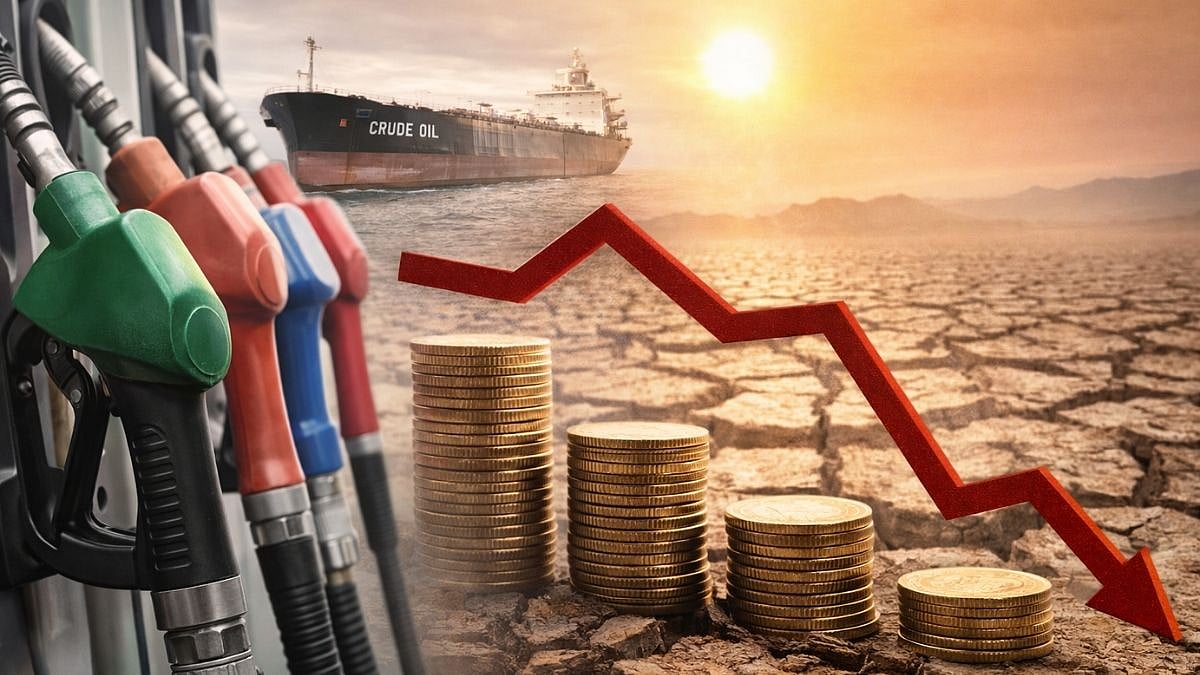
Global oil markets have already delivered their verdict. The Strait of Hormuz, one of the world’s most critical energy arteries, has been in strategic confrontation.
The escalation involving President Trump and Iran has pushed crude prices past the 100-dollar threshold, reintroducing a level of volatility that the global economy has not confronted in recent years. For India, which depends heavily on this corridor for energy imports, the implications are immediate and material.
Yet, domestic fuel prices remain conspicuously stable. This reflects a conscious policy choice to defer the transmission of global price shocks, particularly in the run-up to politically sensitive state elections.
Policy choices and fiscal pressure
State-run oil marketing companies are absorbing substantial under-recoveries, estimated at approximately Rs 18 per litre on petrol and Rs 35 per litre on diesel. It is only a matter of time before these losses are curtailed and the pricing realigns with market realities.
The policy arithmetic is unforgiving. India faces a constrained set of choices. It can pass on higher global prices and risk reigniting inflation. It can continue absorbing losses through public sector balance sheets and weaken institutional financial health. Or it can reduce taxes further and widen the fiscal deficit. None of these choices is without consequence.
Recent actions suggest a calibrated attempt to balance these trade-offs. Excise duty reductions and export adjustments have provided partial relief, cushioning consumers while distributing the burden across the fiscal system.
This approach reflects prudence but does not eliminate the underlying pressure. A post-election price correction is, therefore, not merely likely; it is structurally embedded.
Inflationary trends and economic signals
At the same time, recent inflation data underscores the breadth of underlying pressures. The positive rate of inflation recorded in March 2026 has been driven not only by higher crude petroleum and natural gas prices but also by increases across manufacturing, non-food articles, basic metals, and food products. This points to a generalised cost push within the economy.
Ongoing trade negotiations between India and the United States remain another important variable shaping the medium-term trajectory. While discussions continue, the final contours are yet to be defined, leaving both opportunity and uncertainty. The direction of this engagement will influence market access, capital flows, and investor confidence.
Climate and supply disruptions
Recent weeks have also offered a reminder that energy is not the only source of price vulnerability. Unseasonal rains across parts of India have disrupted crop cycles, affecting produce, including mangoes and other seasonal fruits and vegetables. This comes alongside the prospect of an unusually harsh summer, reinforcing the growing unpredictability driven by climate change.
The concern deepens when one considers that these disruptions may not be episodic. Early forecasts from the India Meteorological Department suggest the 2026 southwest monsoon could be below normal alongside a rising probability of El Niño conditions.
This would mark a reversal after two favourable years and carries significant implications for a rain-dependent agricultural system. A weaker monsoon affects yields, raises food prices, and introduces a more persistent layer of inflation risk alongside elevated energy costs.
Impact on sentiment and markets
The interplay of these variables extends beyond macroeconomic indicators into sentiment. Consumers respond not only to actual price increases but also to expectations of sustained cost pressures. As inflation expectations rise, discretionary consumption moderates, savings behaviour shifts, and confidence weakens. Domestic investors also recalibrate.
Equity markets become more sensitive to cost pressures and policy uncertainty, while risk appetite narrows. In an economy where domestic capital has become a stabilising force, such shifts matter. A convergence of energy shocks, climate disruption, and inflation signals has the potential to temper both consumption and investor conviction.
Limits of policy control
It is important to recognise the limits of control. Neither geopolitical disruptions nor climate-induced shocks lie within the direct remit of the government or the Reserve Bank of India.
Yet, policy responsibility will drive hard decisions on pricing and liquidity, and fiscal prioritisation may be unavoidable to ring-fence macroeconomic stability and sustain consumer confidence. The credibility of response will matter more than the origin of disruption.
The fiscal position will come under renewed scrutiny. Revenue foregone through duty reductions and implicit subsidies via under-recoveries cannot be extended indefinitely without affecting deficit trajectories. Fiscal credibility will need to be carefully preserved.
External vulnerability will also intensify. A higher oil import bill expands the current account deficit and pressures the currency. In an environment of global financial tightening and geopolitical fragmentation, such pressures can transmit quickly.
Structural challenges and resilience
There is, however, a deeper structural signal. Despite diversification efforts, India’s energy security remains tethered to West Asia. Alternative sourcing, including from Russia, provides tactical flexibility but does not alter structural dependence.
At the same time, India’s response reflects institutional maturity. There has been no panic, no strategic supply disruption, and no abrupt pass-through of global shocks. The system has absorbed pressure with composure that would have been far less assured in earlier decades.
A calibrated, transparent, and phased price adjustment post-elections would be the most credible path forward. Sudden increases would risk unsettling inflation expectations and sentiment. Gradualism combined with clear communication can preserve trust while restoring alignment with global realities.
Outlook for growth
The larger question is whether this convergence of shocks will materially slow India’s growth trajectory. The evidence thus far suggests moderation rather than derailment. India has navigated successive external disruptions in recent years with a degree of resilience that is neither accidental nor trivial. Yet, this moment is different in its simultaneity.
Energy volatility, climate uncertainty, and inflationary pressures are unfolding together, not sequentially. The task ahead is, therefore, not to avoid adjustment, but to manage it with credibility.
If policy remains anchored in prudence, transparency, and continuity, this phase will be absorbed as part of a longer economic transition. The rise in prices, when it comes, will not define the moment. The credibility of a response will.
Dr Srinath Sridharan is a policy researcher and corporate adviser. X: @ssmumbai

