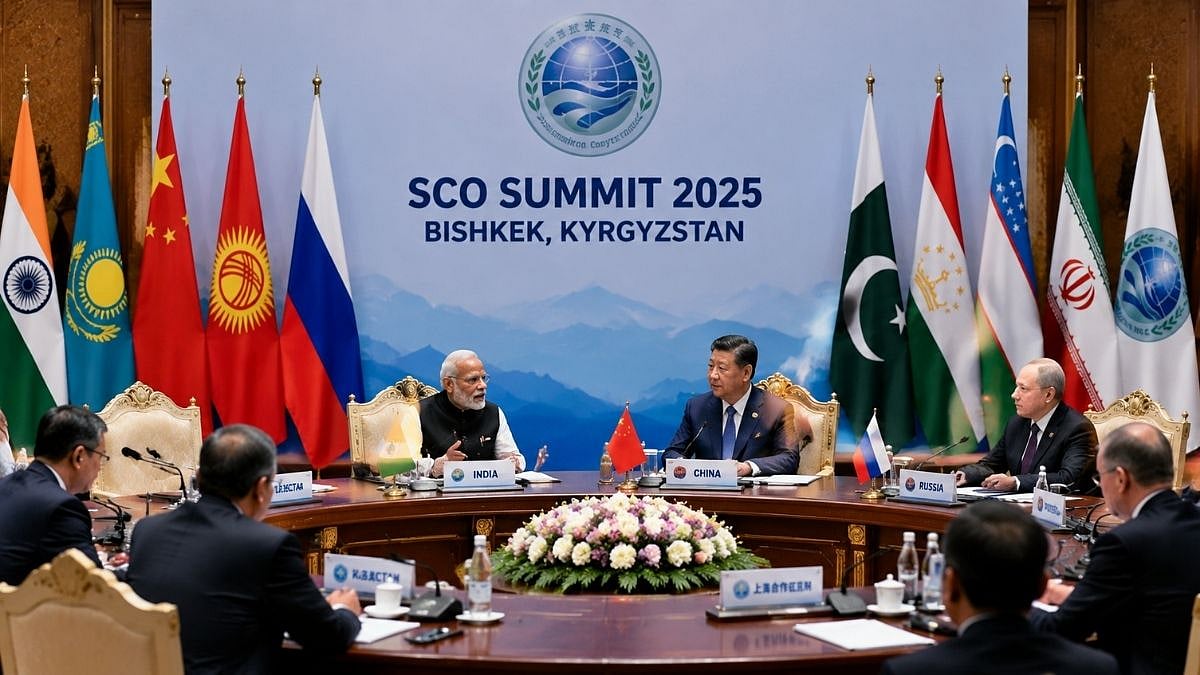
With war still raging around Iran and the Strait of Hormuz, the SCO is likely to become an alternative mechanism to find peace where Eurasia’s big three—China’s President Xi Jinping, Indian PM Narendra Modi and Russia’s President Vladimir Putin—have a chance to shape talks towards global peace and trade flows.
Modi’s meeting with Putin has already seen India publicly endorse efforts to end the war in Ukraine. Russia may well now use India’s and China’s access to European and American leaders to search for the elusive peace in the West.
India-China Tensions Continue
At last year’s SCO meeting in Tianjin, Xi had told Modi that Beijing and New Delhi should be partners rather than rivals. The message unsettled some observers, who saw a possible easing of tensions between Asia’s two largest powers as part of a broader recalibration of the global balance of power.
However, since then, tension on the McMahon Line and in Ladakh has not really ended, though India-China trade has ratcheted up to $151 billion. Recent talks on the disputed border haven’t really given much of a result, though they have kept the conversation going and have seen China indicating that relations between China and India were no longer merely a bilateral concern but had acquired wider global and strategic significance.
SCO’s Limits And Potential
The problem with the SCO meeting is that the body is neither a NATO-style military alliance nor a cohesive economic union along the lines of the European Union or even Asean. Its members are scattered across Eurasia and have sharply divergent interests. India and Pakistan remain rivals; India and China continue to contest their border; and Russia remains locked in confrontation with the West. Its consensus-based structure also makes ambitious collective action difficult.
What the SCO does is that it brings together most of the powers that matter to Asia. Giant nations like China, India and Russia, alongside the four Central Asian states that were once part of the Soviet Union, as well as Iran and Pakistan, sit together across the table. Discussions as well as decisions on energy, trade, supply chains and connectivity can, therefore, serve as signals of wider shifts in the global order.
Hormuz Crisis Raises Stakes
The crisis around the Strait of Hormuz has become a geopolitical risk for all nations, especially those which, like India, depend on trade for a large chunk of its GDP and its energy needs. The latest fighting in the region has already disrupted maritime traffic and pushed up oil and other commodity prices. Efforts to secure shipping through the Strait of Hormuz have struggled to contain the risks to commercial vessels, underscoring the vulnerability of one of the world’s most important energy corridors.
This helps explain the importance of Modi’s meeting with Iranian President Masoud Pezeshkian on the sidelines of the summit. The two leaders discussed the situation in West Asia as well as energy security and the need to keep navigation safe. The engagement comes despite warnings from the United States against economic engagement with Tehran.
India’s position is a familiar but increasingly consequential one. New Delhi wants to keep Iran engaged, the Strait of Hormuz open, and commercial shipping protected. At the same time, it has little interest in being drawn into the strategic confrontation between Tehran and Washington.
India’s Balancing Act
The so-called Mecca Pact between Saudi Arabia, Turkey, and Pakistan, although ostensibly directed at Israel, will also be closely watched in New Delhi for what it may mean for the emerging balance of power in West Asia.
Modi’s meeting with the Iranian President will also have to be seen from the perspective of these twin concerns—the need to secure energy lines and trade on the one hand and to talk to friendly nations on the emerging security architecture of the continent on the other. The two leaders did discuss the West Asian situation and also issues arising from the lack of energy security and safe navigation, which have arisen as a direct fallout of the conflict.
While the US cannot be too pleased about any formal talks with Iran on trade or energy, it has to understand that neighbours need to talk and every nation needs to secure energy resources, and unilateral diktats on trade can actually create more mistrust and slow down efforts at reaching peace.
New Delhi Seeks Strategic Autonomy
India has long been making a case for peace in the region and a resolution through talks rather than conflict. The tables in some ways have turned. Just last year, it was the US which claimed it tried and guaranteed peace between India and Pakistan (though India disputes this version), and now countries like India are urging for peace and reconciliation.
New Delhi, however, shows little appetite for being drawn into the strategic confrontation between Tehran and Washington and is likely to stay out of the peacemaking role that countries like Qatar and Pakistan have donned in the past.
India sees the SCO offering as a useful setting for diplomacy, nudging the world towards peace. India can support calls for restraint, dialogue, and respect for international law without signing up to an explicitly anti- or pro-US position.
Balancing Multiple Partnerships
However, the Bishkek meeting fits into India’s broader foreign-policy strategy. It will discuss security, trade, and connectivity with China and Russia without depending entirely on Western institutions. But at the same time, India will continue its dialogue with Russia for defence, hydrocarbons, and fertilisers; China for an understanding to reduce conflict and give both space to manoeuvre; Central Asian countries for minerals, markets, and connectivity; and Iran for connectivity and access to Central Asia.
New Delhi will, at the same time, continue its dialogue with the US, Europe, and Japan for freedom of the seas in South China and the Arctic for a safer Indo-Pacific region for technology, investments, and markets. This policy of running with the hares and hunting with the hounds gives India some degree of strategic autonomy for hedging.
However, this also means it cannot enter into any ideological alignment with a China-Russia-Iran axis, even while pursuing closer ties. It also means, while being in agreement with the West on ideological issues such as democracy and freer trade, it cannot turn groupings such as Quad into militarised versions of Nato.
India’s Foreign Policy Dilemma
This central dilemma which faces New Delhi at every turn is unlikely to be resolved in the near future. India will continue to search for its place in the sun and its ability to stay free of pacts which may bind it down to any one side. However, the turn of events in the future cannot be foretold, and whether India remains the free spirit it wishes to be will depend on the shape of the world to come.
The Author is Editor, United News of India.

