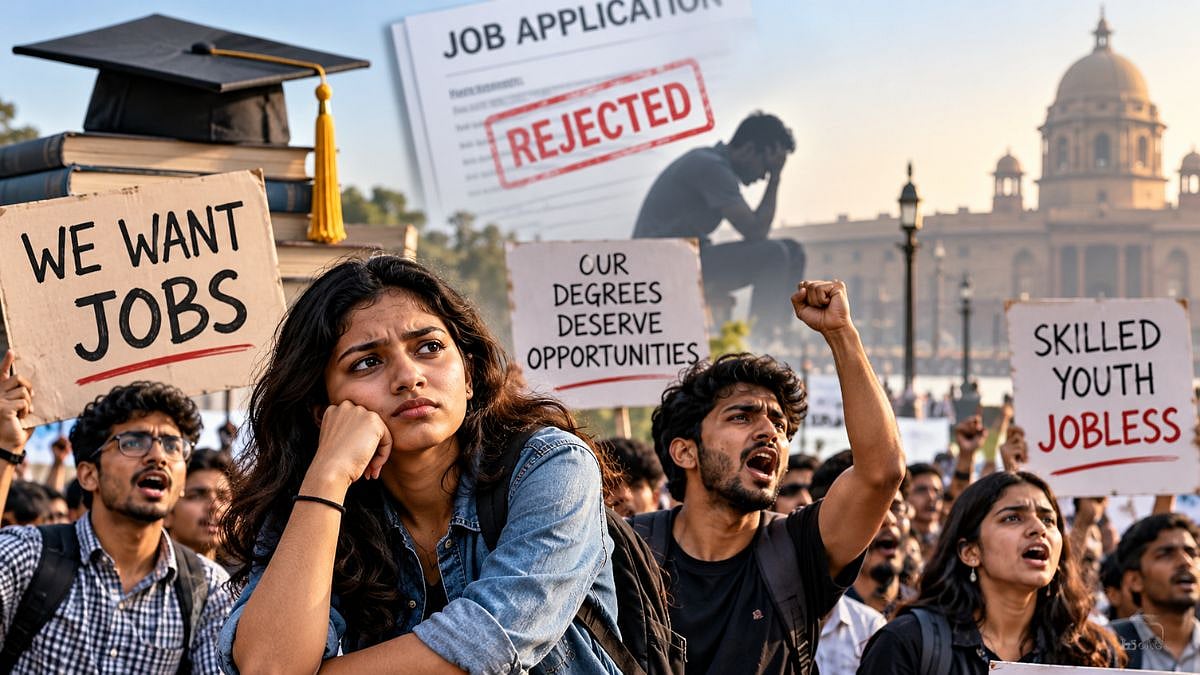
India’s young people are out on the streets—first it was over examinations, where they suspected there had been malpractices, and now over the process of correcting voter lists. The last two times when the streets had been taken over by India's burgeoning youth population were in 1990, when reservation in jobs and educational institutes was a burning question, and before that, in the 1960s and 1970s, over myriad issues, ranging from the Vietnam War to joblessness to "language imposition".
The truth is, youth power takes to streets on issues that are but straws in the wind, but the real cause for the "Angry Young Man" syndrome is usually structurally far more complex. The main cause for the revolt usually stems from the struggle to find productive, quality jobs. In the 1960s, the Indian economy grew at a sluggish rate, creating few jobs, while the number of India’s unemployed doubled between 1956 and 1972. Similarly, in 1990, youth unemployment hovered at roughly 17–20 per cent for those in the 15–24 age bracket.
In 2026, India’s young people have more education, higher aspirations, and greater access to information than any generation before them. What many do not have are jobs. The resulting frustration is becoming harder to ignore, as official figures boast of an economy that has posted rapid growth even in years which have been difficult for the rest of the world.
Youth Unemployment Reaches New Highs
In June this year, unemployment among Indians aged between 15 and 29, who were actively seeking work, reached 16.2 per cent, the highest in the 15-month monthly series based on the Periodic Labour Force Survey (PLFS), a significant climb up from 13.8 per cent in April 2025. Most significantly, urban India reported a higher unemployment rate of 18.2 per cent, considerably more than the 15.1 per cent rate in rural areas. Women were worst hit, with unemployment at an astounding 20.7 per cent.
In the 1970s, movie maestro Satyajit Ray caught the student unrest in his 1970 movie, Pratidwandi (The Adversary), exploring joblessness, urban despair, and generational disconnect. Around the same time, Gulzar's Mere Apne, with Shatrughan Sinha as the flamboyant Chennu, leader of a group of unemployed, directionless youth, hit a chord with the youth of that generation.
However, youth anger was perhaps better understood after it was caught on the silver screen by blockbuster movies like Zanjeer and Deewar, with India’s ultimate angry young man—Amitabh Bachchan—revolting against society in myriad ‘rebel’ roles.
History Repeats Itself
The current year, 2026, in many ways, is a repeat of those stormy autumns seen in the 1960s, when Naxalites first came into play in this country, and in 1990, when the youth took to the streets over a report prepared by a hitherto little-known social reformer, BP Mandal.
The problem, like in those epochal years, is not that young Indians lack qualifications; the problem is that their qualifications no longer guarantee a foothold in the economy.
Nearly 40 per cent of graduates aged 15–25 and about a fifth of those aged 25–29 are unemployed, according to estimates cited in recent analyses. Roughly, two-thirds of unemployed young Indians hold a degree, which, once seen as the most reliable route out of poverty and towards middle-class security, is increasingly failing to deliver on that promise.
The Growing Gap Between Education And Jobs
This gap between aspiration and opportunity, even as the economy posts an average 7 per cent GDP growth, has huge political consequences. The scale of the challenge is formidable, as India has roughly 367 million people aged 15–29. Each year, millions more enter a labour market that does not create enough formal jobs suited to their expectations and qualifications.
Jobs that are growing are in sectors where the gig economy flourishes. These do not pay adequately for the years these young men and women have toiled for to get their degrees, often at huge costs to their parents.
The problem for these young would-be workers is that capital-intensive industries can increase output without hiring workers at the same pace; in fact, robotisation and mechanisation are actually shrinking the factory floor headcount.
India's much-touted services sector creates a small pool of highly paid jobs for a relatively small number of specialists, while leaving many graduates competing for a limited number of entry-level positions, where the coming of artificial intelligence is playing havoc with their job prospects.
Skills Gap Compounds The Problem
Even those who find work may discover that the transition from education to employment is far from straightforward. India’s schools and colleges often emphasise formal qualifications over practical skills, while employers complain about a shortage of candidates with the experience they need.
NITI Aayog has highlighted the limited reach of vocational training: only 8 per cent of secondary and higher-secondary schools offered courses aligned with the National Skills Qualifications Framework, according to one assessment. Apprenticeships, internships, and structured training remain insufficiently widespread to bridge the gap between classrooms and workplaces.
This is not merely a problem of matching skills to vacancies. Better training cannot compensate indefinitely for a shortage of jobs. If too many qualified people chase too few openings, improving employability may simply intensify competition for the same positions. India needs both a workforce better prepared for modern industry and businesses willing and able to employ it.
Unemployment And Political Discontent
However, every protest or political grievance cannot be attributed to unemployment alone. Young Indians have diverse concerns, and political mobilisation depends on many factors. Nevertheless, joblessness, underemployment, and the loss of faith in education as a path to prosperity can provide a common source of discontent. Social media aids that frustration in spreading rapidly, while comparisons with the lives and opportunities of others elsewhere in the world can sharpen the sense of exclusion.
The danger for the government is not simply that jobless young people may protest; it is that prolonged disappointment can erode confidence in institutions and in the promise of economic development itself. A generation, which has been told that India is becoming a global economic power, will reasonably ask why that power has not created more opportunities for it.
The writer is Editor, United News of India.

