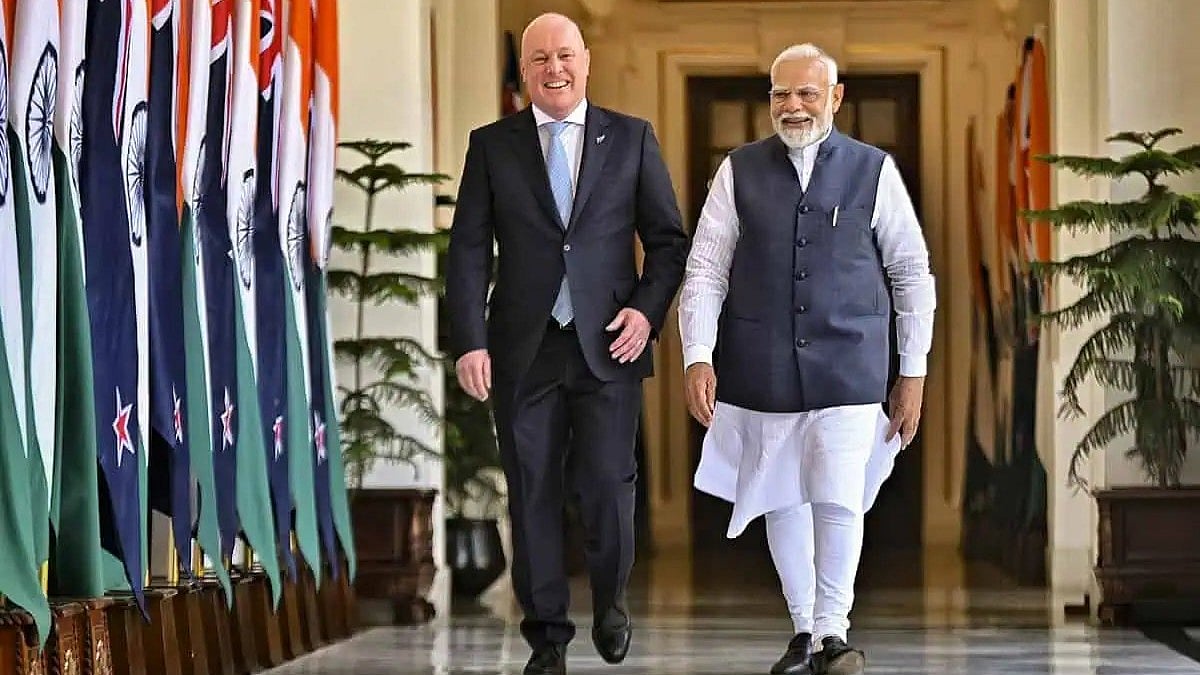
Any trade agreement, by its very nature, involves give and take. No country secures everything it wants, and no agreement can satisfy all domestic constituencies at once. What ultimately matters is whether the overall balance of gains serves long-term national interest.
Judged by that yardstick, the India-New Zealand Free Trade Agreement (FTA) represents a significant economic and strategic step forward for both countries.
Projections that bilateral trade could touch $5 billion in the next few years and that investments of around $20 billion could flow over the next 15 years underline the potential of this partnership. These are not marginal numbers; they point to a relationship moving beyond symbolism to tangible economic cooperation.
Criticism of trade agreements is neither unusual nor unhealthy in a democracy. In New Zealand, concerns have been raised about limited access for dairy products to the Indian market and about provisions relating to labour mobility. Such objections reflect domestic priorities and political compulsions.
However, it would be a mistake to view these concerns as a rejection of the agreement in its entirety. Trade negotiations are complex, and sectoral sensitivities—especially in agriculture and employment—are among the most difficult to resolve anywhere in the world. What deserves attention is the broader context in which this FTA has emerged.
The global trading system has been unsettled in recent years by unilateral tariff hikes, protectionist impulses, and geopolitical rivalries. These disruptions have compelled countries to look for dependable bilateral and regional arrangements.
For India, such agreements are also a way to reduce excessive dependence on any single country for critical imports and to diversify export destinations.
New Zealand, too, stands to gain from closer economic engagement with one of the world’s fastest-growing major economies. India offers a vast market, a growing middle class, and opportunities for collaboration in technology, services, education, and innovation.
Trade, after all, is a two-way road: exporters gain markets, and importers gain choice, competitiveness, and access to resources they lack.
It is also worth noting that India has been steadily expanding its network of trade partnerships. New Zealand becomes the third country, after Britain and Oman, with which India has finalised such an agreement in recent times.
Negotiations are underway with several others, including the United States, Australia, and the European Union. This reflects a clear strategic direction rather than an ad hoc approach. Securing markets for Indian goods, attracting investment, and integrating with global value chains are permanent necessities for sustained growth.
No trade deal is ever perfect on day one. Space always exists for review, adjustment, and incremental concessions as trust deepens and trade volumes expand.
Seen in that light, the India-New Zealand FTA is less an endpoint than a beginning—one that promises mutual benefit if approached with pragmatism rather than absolutism.

