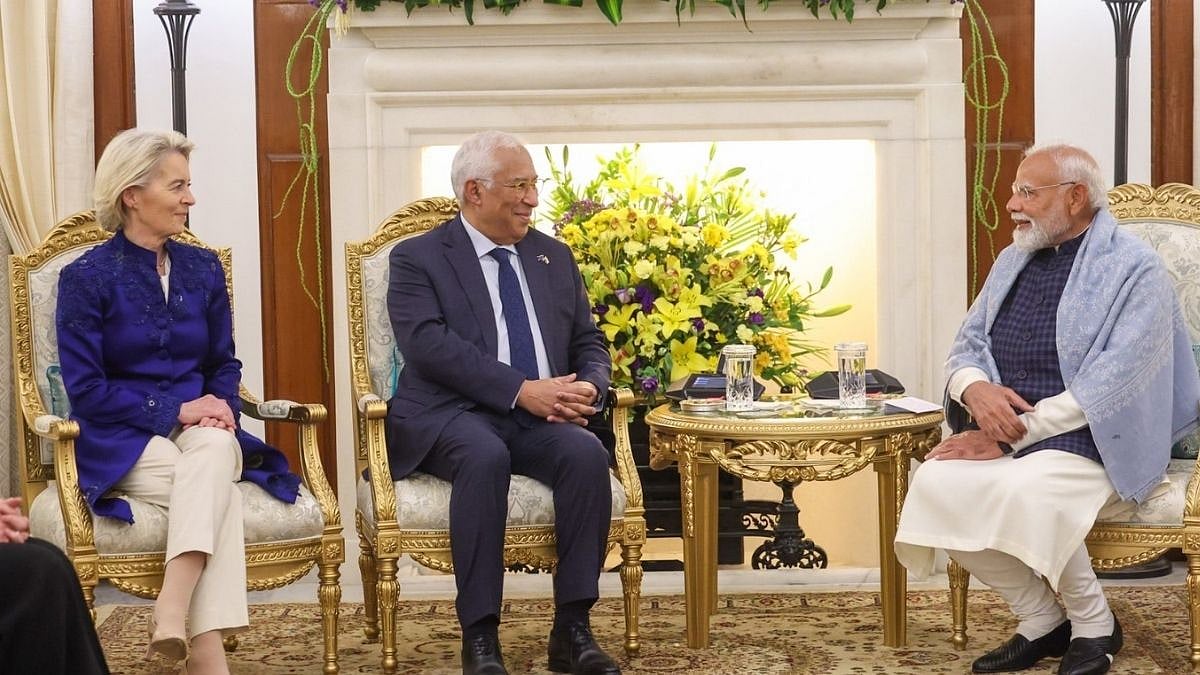
When India and the European Union finally concluded their long-delayed free trade agreement, the symbolism was as powerful as the economics. Coming after nearly two decades of stalled negotiations, shifting global alignments, and mounting protectionism, the pact represents more than a tariff-cutting exercise. It signals a structural reorientation of global trade at a moment when old certainties are eroding and middle powers are asserting greater autonomy. For India and the 27-nation European bloc, the agreement arrives at a time when economic resilience, supply-chain security and consumer welfare have become strategic imperatives rather than policy afterthoughts. The creation of a free trade zone encompassing nearly two billion people has the potential to reshape production patterns, consumer markets and geopolitical equations well beyond Europe and South Asia.
Ripple Effects across Asia and the Global South
Across Asia, the ripple effects will be closely watched. Southeast Asian economies may face competitive pressure as India becomes a more attractive manufacturing destination. Japan and South Korea could seek deeper engagement with India to avoid marginalisation. At the same time, the agreement strengthens India’s credentials as a serious trade partner capable of concluding complex, high-standard deals, reinforcing its leadership aspirations in the Global South.
‘Mother of All Deals’: Scale, Scope and Political Messaging
The agreement ranks among the most comprehensive trade pacts India has ever concluded. Prime Minister Narendra Modi underscored its scale by noting that it covers nearly one-third of global trade, describing it as the “biggest free trade deal in history”. He said the pact would open vast opportunities for 1.4 billion Indians as well as millions across European countries, adding that it stands as a compelling example of economic synergy between two of the world’s major economies.
Strategic Gains for India and Europe
For India, now the world’s most populous nation and among its fastest-growing major economies, the deal marks a decisive step in integrating with high-value global markets without sacrificing domestic priorities. For Europe, facing demographic stagnation, energy insecurity and trade frictions with the United States and China, India represents both a growth engine and a strategic hedge. At the consumer level, the pact promises lower prices, greater choice and improved standards, while at the macroeconomic level it could accelerate investment flows, technology transfer and employment creation. In that sense, the agreement is as much about future economic architecture as it is about immediate commercial gains.
Market Access on an Unprecedented Scale
Yet the scale and ambition of the deal also bring complex challenges. India has agreed to slash tariffs on automobiles from as high as 110 per cent to 10 per cent over five years, opening a fiercely protected sector to European giants such as Volkswagen, Mercedes-Benz, BMW and Renault. Duties on wines and spirits will fall sharply, while machinery, chemicals, electrical equipment and steel will gain easier access to Indian markets. In return, the EU will eliminate or reduce tariffs on 99.5 per cent of Indian goods, granting near-universal access for textiles, garments, leather products, gems and jewellery, chemicals, marine products and pharmaceuticals. By value, tariffs will be cut on 96.6 per cent of bilateral trade, a scale unprecedented in India’s trade diplomacy.
India’s Opportunities—and Domestic Pressures
The benefits for India are substantial but uneven. Labour-intensive sectors such as textiles, apparel and leather stand to gain significantly from improved access to Europe’s affluent consumer base. Pharmaceutical exports, already a global strength, will benefit from reduced regulatory friction and tariff barriers. The gems and jewellery sector, a major employer, could see a revival as duties fall and demand rises. Over time, the agreement is likely to incentivise European investment into India’s manufacturing and services ecosystem, particularly in automobiles, renewable energy, advanced engineering and digital services. For Indian consumers, the entry of European products at lower prices could improve quality, choice and safety standards, exerting competitive pressure on domestic producers.
India’s resistance to opening agriculture in trade deals is rooted in scale. The country has 146.45 million operational farm holdings (2015-16 Census) and over 97.14 million farmer families currently covered under PM-Kisan. By contrast, the US has just 1.88 million farms (2024), while the EU had 9.07 million farms in 2020. This asymmetry makes unrestricted market access politically untenable for India. Even within Europe, farm trade liberalisation has proved volatile: the EU’s interim Mercosur agreement was referred to the European Court of Justice in January 2026 after farmer protests over beef, sugar and poultry imports—highlighting why New Delhi remains cautious about exposing its far larger farm base to import competition.
Subsidy Asymmetry: India Versus the West
OECD data underscores why an FTA with the US is particularly risky. During 2022-24, the EU’s Producer Support Estimate (PSE) averaged $97.3 billion annually, equal to 16.4% of gross farm receipts, while the US provided $38.2 billion, or 7.1%. India, despite input subsidies averaging $47.9 billion, recorded a negative commodity price support of $129 billion, driven by export curbs and domestic controls that suppress farm-gate prices. After accounting for modest direct payments of just $7.9 billion, India’s net PSE stood at minus $73.1 billion, or –14.5% of farm receipts—effectively a taxation of farmers. This contrasts sharply with China, whose PSE exceeded $270 billion, showing how uneven global farm competition really is.
Why the EU Deal Is Safer—and Offers Upside
From an agricultural standpoint, the EU is a less disruptive partner than the US. American exports of corn, soyabean, cotton and ethanol could overwhelm Indian markets, whereas the EU lacks cost competitiveness in most bulk farm products, apart from limited premium segments like cheese or wine. More importantly, India already exports heavily to Europe: in 2024-25 alone, seafood shipments exceeded $880 million, coffee $775 million, rice $279 million, grapes $175 million, and spices such as cumin and turmeric over $95 million combined. A calibrated EU FTA can deepen these gains while posing minimal import risk—and where subsidies distort trade, countervailing or sterilisation duties of around 15% can provide adequate protection. For Indian farmers, the EU pact is not just safer than a US deal—it is strategically more aligned with India’s export strengths.
Adjustment Costs and Regulatory Challenges
However, the challenges are equally real. India’s automobile industry, long sheltered behind high tariffs, will face intense competition, forcing consolidation, innovation and cost rationalisation. Small manufacturers could struggle unless supported by targeted policy measures. Regulatory compliance with European standards—particularly in sustainability, labour practices and data protection—will require adjustment costs. Moreover, the EU’s Carbon Border Adjustment Mechanism remains a looming concern for Indian exporters in steel, cement and fertilisers, even though New Delhi has secured assurances of future flexibility if concessions are granted to other partners.
Europe’s Economic Upside and Political Tests
For the European Union, the agreement offers a rare growth opportunity at a time of economic fatigue. With EU exports to India expected to double by 2032 and European companies projected to save nearly €4 billion, or about ₹43,600 crore, annually in duties, the pact could revitalise manufacturing and services across the bloc. Germany’s auto sector, France’s luxury and wine producers, and Europe’s engineering firms stand to gain early. Strategically, the deal reduces Europe’s overdependence on the United States and China while reinforcing its claim as a global rule-maker in trade and sustainability. Yet Europe, too, faces internal resistance. Farmers, environmental groups and protectionist lobbies may challenge the pact during the legal vetting process, as seen with the Mercosur agreement. Political consensus across 27 diverse economies will remain a test.
Washington’s Unease and the Trump Factor
The agreement’s timing inevitably draws attention to Washington and President Donald Trump’s likely reaction. Trump’s second presidency has revived aggressive tariff policies, with India already facing duties of up to 50 per cent on certain exports and the EU confronting threats of punitive measures over disputes ranging from trade to geopolitics. The India–EU pact is therefore as much a defensive alliance as an economic one. It signals a quiet but unmistakable pushback against unilateralism and weaponised tariffs. While Washington may publicly downplay the agreement, it is likely to view the emergence of a large, rules-based trade bloc outside American influence with unease. Over time, the pact could reduce both India’s and Europe’s exposure to US market volatility, subtly weakening Washington’s leverage.
China and the Reconfiguration of Supply Chains
China, however, may be the most consequential external stakeholder affected by the deal. Beijing’s dominance over global manufacturing and its control over critical supply chains have triggered unease across capitals. By deepening India–EU economic integration, the agreement creates an alternative production and sourcing network that could gradually dilute China’s centrality. For India, European investment and technology offer a pathway to move up the value chain, reducing reliance on Chinese inputs. For Europe, India provides scale without the political risks associated with China. While the pact is not explicitly anti-China, its strategic implications are unmistakable, particularly in sectors such as clean energy, electronics and advanced manufacturing.
A Strategic Bet on a Fragmented World
Ultimately, the India–EU free trade agreement is less about short-term trade balances and more about long-term strategic positioning. It reflects a convergence of interests between two large, pluralistic economies navigating a fractured global order. If implemented effectively, the pact could reshape supply chains, empower consumers, and offer a template for cooperation among middle powers. As Ursula von der Leyen observed, this is only the beginning. Whether it truly becomes the “mother of all deals” will depend on political will, regulatory adaptation and the ability of both sides to translate ambition into durable economic transformation.
(Writer is strategic affairs columnist and senior political analyst based in Shimla)

