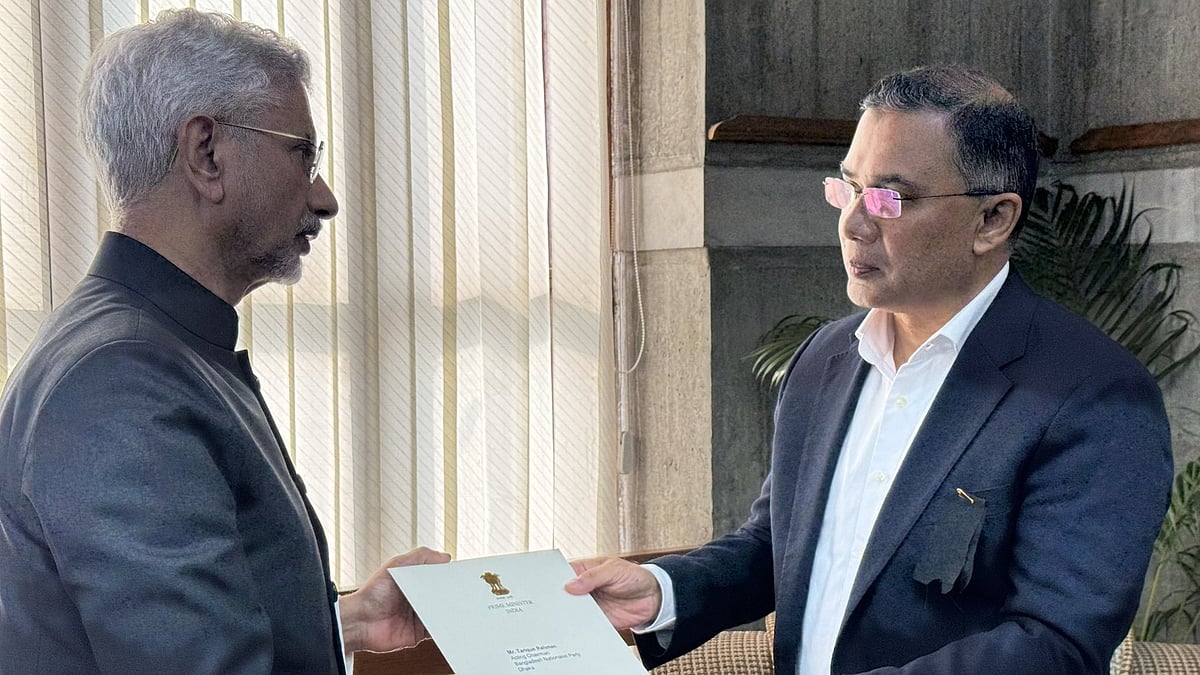
External Affairs Minister S. Jaishankar’s brief, four-hour visit to Dhaka for the funeral of former Bangladesh prime minister Khaleda Zia was far more than a ceremonial call. It was a carefully calibrated diplomatic signal at a moment when India–Bangladesh relations are under visible strain. By choosing to engage, India made clear that it does not wish to abandon a neighbour that has long been central to its “Neighbourhood First” policy.
From a golden chapter to growing uncertainty
For much of the last decade, Bangladesh had been the most convincing success story of that policy. Stable governance under Sheikh Hasina, deep security cooperation, booming trade, and unprecedented connectivity produced what was widely described as a golden chapter in bilateral ties. Today, that chapter looks fragile. Since the interim government led by Muhammad Yunus took charge after the violent upheaval of August 2024, Dhaka’s posture towards India has hardened. Anti-India rhetoric has grown shriller, attacks on minorities have multiplied, and there are visible efforts to tilt towards Pakistan and China.
Historical memory and political irony
The historical irony is unsettling. Pakistan’s genocidal violence against Bengalis in 1971 compelled India to intervene, paving the way for Bangladesh’s liberation. Yet, sections of the Bangladeshi political class now appear willing to forget that legacy, often using India as a convenient external foil to mobilise domestic sentiment. Dhaka must recognise that crossing India’s threshold of tolerance would carry consequences with serious implications for bilateral relations.
India’s own strategic blind spots
At the same time, India must confront its own missteps. By investing heavily—politically, economically and emotionally—in Sheikh Hasina’s government, New Delhi came to equate Bangladesh’s stability with regime continuity. Trade rose dramatically, lines of credit touched $8 billion, and security cooperation reached unprecedented levels. Yet, contingency planning for political change remained weak. What India believed were institutionalised gains are now exposed as being dangerously regime-contingent.
Humanitarian refuge, not political hostility
Providing refuge to Hasina when she fled a rampaging mob was a humanitarian and morally defensible act. It does not, however, imply hostility towards the current dispensation in Dhaka. As the world’s largest democracy, India legitimately expects a credible, democratic transition in Bangladesh.
Engaging all stakeholders ahead of elections
It is in this context that Jaishankar’s Dhaka visit assumes significance. By meeting BNP leader Tarique Rahman and acknowledging Khaleda Zia’s contribution to democracy, India signalled its willingness to engage all legitimate stakeholders ahead of the February elections. His expression of optimism about closer ties was an attempt to steady a relationship buffeted by suspicion and misinformation.
A shifting generation, a recalibrated approach
Bangladesh today is undergoing a generational and emotional shift. A post-1971 generation increasingly views India not as a liberator but as a powerful neighbour to be questioned. India, in turn, must abandon the illusion that historical goodwill guarantees permanent alignment. Nostalgia is no substitute for prudence.
India’s challenge is to prevent an important neighbour from sliding into chronic instability, without sacrificing either its principles or its patience.

