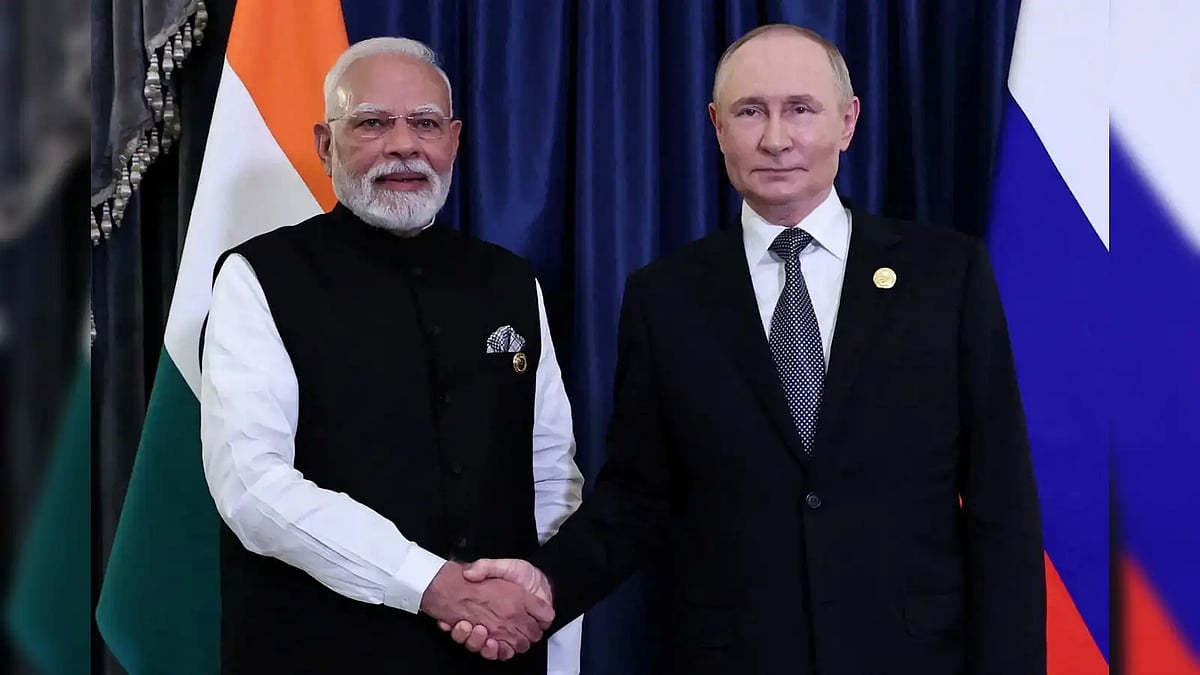
Russian President Vladimir Putin’s arrival in New Delhi later this week for his annual summit with Narendra Modi almost feels as if the trip harks back to a different era, five and a half decades back, when the Soviet Union was joining hands with India’s Indira Gandhi for a ‘Treaty of Friendship’ ahead of a definitive involvement to end a genocide in East Pakistan.
However, the world has long changed from the post-World War II era when the globe was riven between two camps led by two superpowers. Yet, what looms over this year’s meeting is not a memory but the sense that the international order itself has slipped into a new, uncharted phase, never witnessed before in the last two centuries.
For a generation, after the Cold War ended with the disintegration of the Soviet empire, geopolitics seemed to move along a predictable arc: a briefly unchallenged United States at the helm, a rising China jostling for space, and a set of middle powers largely orbiting these two giants.
By the time 2025 came about, the world realised the old bipolar and unipolar templates no longer describe the world with any accuracy. What is emerging instead resembles the early scaffolding of a multipolar system, one in which the United States remains powerful but less reliable. China continues its ascent while generating increasing anxiety among all other rising nations. Europe gropes towards greater autonomy, and India and Russia find themselves drifting, almost by necessity, into a renewed strategic compact.
This drift’s origins lie in the erosion of confidence in American consistency, compounded by Washington’s long, inconclusive wars, its domestic breakdown, and, most recently, the new tariff wars. For India, an inexplicable 50 per cent duty on most exports being the most conspicuous shock. For others, duty shocks and a demand which has seen partners, who once built their economic strategies on the assumption that the United States was their Northern Star, suddenly waking up to an unsettled world.
China, meanwhile, has created its own gravitational pull and its own set of fears. Its growing assertiveness has forced both friends and rivals to rethink long-held assumptions. For Russia, whose tactical alignment with Beijing has deepened since the Ukraine conflict, the relationship is an unequal one.
In Moscow’s strategic imagination, the country with the most long-term potential to threaten Russian space is not the United States, but China. Concerns about influence in Central Asia, latent anxieties about Siberia, and the spectre of becoming Beijing’s junior partner have all nudged the Kremlin to look again at India, not as an alternative to China, but as a hedge against excessive dependence on it.
This is why the India-Russia relationship, which has somehow survived the collapse of the Soviet Union, India’s embrace of the United States, and the upheavals of the post-Ukraine world, is once again coming into sharp focus.
When Modi and Putin sit down in New Delhi, they will be reaffirming a partnership that has weathered ideological shifts and economic dislocation. Moscow’s repeated use of its UN veto to shield India over Kashmir, and India’s refusal to join Western sanctions during the Ukraine conflict, even at the risk of US tariffs, are reminders that this is a bond sustained as much by habit and trust as by cold strategic calculations.
Yet, trust alone does not explain the intensity of the current moment. The summit comes when the global landscape is at its most unsettled in years: war in Europe, conflict in West Asia, a tariff contest spiralling across continents, and an Indo-Pacific region where no single power can set the terms.
Middle powers across Africa, Southeast Asia, and Latin America are increasingly unwilling to subordinate themselves to the ambitions of any single great power. India and Russia, each deeply protective of their strategic autonomy, find common cause in that sentiment. Their agenda reflects how deeply structural this convergence has become. Defence remains the spine of the relationship, and this year it is poised for a significant expansion.
The much-anticipated Reciprocal Exchange of Logistics Support agreement would allow both militaries to use each other’s bases, ports, and airfields, extending India’s operational reach from the Indo-Pacific to the Arctic and giving Russia a physical foothold in the Indian Ocean—the artery through which half the world’s commerce flows.
Indian and Russian officials are also assembling what could be the most ambitious military-technical package in years: expanded S-400 deployments, deep upgrades to India’s Su-30MKI fleet, renewed possibilities for longer-range BrahMos systems, and even tentative conversations about technology transfer for the Su-57E stealth fighter. In a world where supply chains are strategically weaponised, India’s need for defence partners who can promise reliability rather than conditionality has only intensified.
Nuclear cooperation forms another layer of continuity. Rosatom and India’s atomic energy establishment are pushing ahead with plans for large VVER-1200 reactors, small modular units, and potential floating plants.
A quieter but potentially transformative arena is the race for critical minerals and rare earths. With global supply chains dominated by China and under increasing geopolitical strain, India is looking to Russia’s resource-rich Far East for joint ventures.
Partnerships between Indian scientific institutions and Russian research centres could set the stage for indigenous rare-earth processing and permanent-magnet manufacturing—industries that will determine who controls the value chain for electric vehicles, high-end electronics, and advanced weapons systems.
Economic diplomacy runs parallel to these strategic shifts. Bilateral trade, now hovering around $65-66 billion and dominated by discounted Russian crude, is being pushed toward a $100 billion goal by 2030.
New Delhi is preparing to expand exports of pharmaceuticals, engineering goods, electronics, marine products, and agricultural commodities, while Moscow aims to increase its purchases of smartphones, autos, chemicals, gems, and processed foods through streamlined customs procedures.

Energy remains the bedrock: oil, LNG, coal, fertilisers, and new ventures in underground coal gasification and rare-earth extraction across Russia’s Far East. If these projects advance coherently, they could reinforce the strategic logic of the partnership.
What emerges from this week’s summit is not an alliance, and certainly not a resurrection of the old Indo-Soviet embrace. It is something more cautious, more pragmatic, and perhaps more suited to an era in which the centres of power are blurry and the ground beneath them constantly shifts.
Far from being a relic of Cold War nostalgia, the India–Russia partnership is evolving into a hedge against a world that no longer offers the comfort of clear alignments.
The writer is former head of PTI’s eastern region network.

