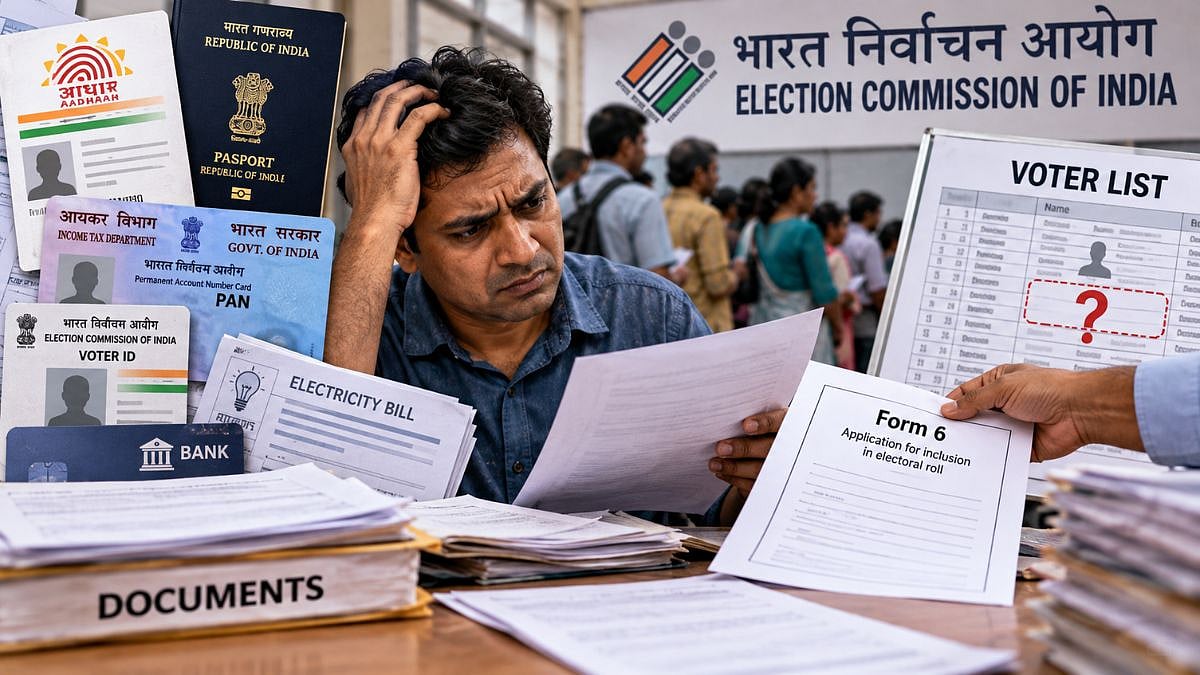
Give the state a name, an address, and a few documents, and, with sufficient photocopies, a citizen can acquire an impressive collection of identities. Aadhaar knows one version of him, the passport another, the PAN another, the bank another, and the electoral roll yet another. These systems can recognise the same person differently and still expect him to prove that he is the same person.
We have become digitally identifiable in almost every way. Yet, the moment the state asks us to prove who we are, we return to the oldest Indian jugaad: searching for a document.
SIR And The Question Of Identity
The Special Intensive Revision of electoral rolls has brought this national talent for administrative multiplication into public view. The obvious question is about the names being removed. The more uncomfortable question is how so many names became comfortable residents of electoral rolls in the first place.
Nobody should object to an accurate voter list. Dead people cannot vote. Duplicate names should disappear. People who have permanently moved should leave old addresses. Ineligible voters should not find their way into an election. A democracy has to know who is entitled to vote, and the electoral roll is supposed to be where that knowledge is kept.
India created its first electoral roll when democracy was young, digitisation barely existed, and the country had just emerged from colonial rule. Seventy-five years, eight intensive revisions, voter IDs, Aadhaar, and countless databases later, the ninth SIR still asks a familiar question: citizen, please introduce yourself again.
More than 13 crore names were excluded from draft rolls across the states and Union Territories covered so far. There are claims, objections, and routes for restoration.
Concerns Over SIR Process
The handling of the SIR has also left behind an opacity of its own. The Census was delayed by the pandemic, yet electoral-roll revision has acquired a striking urgency, even as the two exercises now share field machinery. Critics fear that an exercise meant to clean electoral rolls could become an exercise in cleaning the electorate, with particular communities or political constituencies finding their paperwork under unusual scrutiny.
Form 6 has produced its own variation. It is the statutory route for seeking inclusion as a voter and, during SIR, was also used by people seeking re-enrolment after being left out. In Maharashtra, around 1.52 crore electors marked absent or shifted found themselves dealing with a declaration intended for someone applying for inclusion for the first time.
This created the ‘experienced-first-time’ voter. He may have voted before, watched several elections come and go and still find himself dealing with paperwork designed for someone entering the electoral roll for the first time. The voter remembers the election. The paperwork, apparently, has chosen to begin the relationship afresh.
The Culture Of More Paperwork
This is how bureaucracy becomes culture. When a bank asks for a document it already possesses, the citizen produces it. When an official says, “Just attach one more proof,” he starts looking for the nearest photocopy shop. The Indian citizen has now travelled from the photocopy shop to WhatsApp, but the basic relationship with the state remains reassuringly familiar: please send one more document.
The latest Form 6 episode captures the peculiarities neatly. The Supreme Court said on October 5 that it had not approved any modification to Form 6 and would examine the records to establish who had made the changes. The Election Commission has maintained that the statutory Form 6 itself was not changed and that an additional SIR declaration was attached to it. That declaration has since been removed from the ECINET portal in states where the SIR has concluded.
The citizen is, therefore, expected to understand the distinction between a changed form and an attached declaration while trying to understand something much simpler: whether his name is on the list. Indian administration has occasionally perfected the art of making a procedural distinction more complicated than the problem it was supposed to solve, leaving the person at the counter to reconcile the two.
State Now Searches For Missing Voters
The Election Commission has now ordered a special drive in 20 states and Union Territories where the SIR has been completed to identify eligible people left out and facilitate re-enrolment. Officials are being asked to compare earlier and current rolls and find citizens whose names have gone missing. The state is now looking for some of the people it has just finished looking for.
Soon, in this digital era, the safest proof of being a voter may be having voted before, provided someone can produce the paperwork proving you were there, probably along with a selfie carrying a geotagged timestamp.
For the Booth Level Officer (BLO), it means another mountain of forms, home visits, documents, and citizens seeking explanations. Their work is largely invisible, often thankless and, during an exercise of this scale, plainly exhausting. The citizen may see only the form at the end of the process, while the BLO has to deal with the person, the paperwork, and the system behind it.
Voters Left Proving They Belong
Meanwhile, the SIR has moved across stakeholders. Politicians are protesting, the Election Commission is defending its process, courts are examining its paperwork, and citizens are spending their afternoons looking for documents. Everyone is busy deciding who belongs, while the voter is left wondering why proving that he belongs has become his part-time job.
A democracy should know who its voters are. It should also remember that behind every name is a person who assumes, reasonably, that the republic remembers him.
Otherwise, the Indian voter may arrive carrying Aadhaar, PAN, passport, voter ID, bank records, electricity bills, and enough photocopies to establish several lives, only to discover that the electoral roll has misplaced the one fact that matters that morning: his name. And then, in the finest tradition of Indian paperwork, he will be handed over a form and asked to introduce himself.
What an idea, SIR Ji!
Dr Srinath Sridharan is a policy researcher and corporate adviser. X: @ssmumbai

