When missiles fill the skies over West Asia, the tremors reach every household electricity and petrol bill. The ongoing crisis in the region has exposed the vulnerability of India, which is the world's third-largest consumer of crude oil and imports nearly 89 per cent of its requirement, i.e., roughly 1.75 billion barrels a year, or about 4.8 million barrels every single day. Over 60 per cent of that flows through the geopolitically sensitive Strait of Hormuz.
In 2024-25, India's crude oil import bill was $137 billion. If prices stay at the March average of $113.57, then the import bill would balloon to nearly $200 billion. Every ten-dollar rise in the price of a barrel of crude adds $14 to $16 billion to India's import bill. That is money drained from our precious foreign exchange reserves.
That refined oil goes into trucks that move goods, tractors that farm fields, and fishing boats that feed coastal communities. It also powers diesel generators that keep telecom towers humming across rural India.
Solar opportunity for India
There is a way to reduce this vulnerability. We are a nation bathed in light!
India is gifted by geography, which gives it a blazing sun for more than 300 days a year. Unfortunately, sometimes summer heat can also be a curse. We just witnessed a scorching April week. Nineteen of the twenty hottest places on earth were in India, and 92 of the 100 hottest cities globally. But what is a climate burden is simultaneously an energy opportunity of historic proportions.
India leads the International Solar Alliance, a coalition of over 120 sunshine-rich nations. In 2025, India added 38 gigawatts of new solar capacity, surpassing the United States, which added 35 gigawatts. The total installed solar capacity now stands at over 150 gigawatts, and annual solar generation has rocketed from 3.4 terawatt-hours in 2013-14 to 144 terawatt-hours in 2024-25.
As the brutal heatwave of April pushed temperatures into the mid-forties and air conditioners across north India ran at full blast, the electricity grid faced its highest ever demand: 256 gigawatts. Solar power alone was generating 81 gigawatts on that critical day. This was one-third of the total national generation. The grid did not collapse. It passed the stress test.
Saving forex, exporting value
Solar’s potential is not just as clean energy but also as securing our foreign exchange.
Even a ten per cent reduction in oil import dependence would save between $13 and $20 billion annually, depending on oil prices. A displacement of 100 million barrels through solar-powered electricity substituting diesel gensets, electric pumps replacing diesel pumps, and electric vehicles reducing petrol and diesel demand would still save $7.5 to $11 billion a year in foreign exchange.
But there is also an intriguing possibility that India could become an energy exporter. India's refining capacity of 258 million metric tonnes already exceeds its domestic consumption of 239 million metric tonnes. In 2025, India exported 64.7 million metric tonnes of refined petroleum products—petrol, diesel, and aviation fuel—worth over $52 billion, a record high.
The refining capacity is set to expand further to 309 million metric tonnes by 2028. If solar and electrification progressively reduce domestic fuel consumption, more and more of what India refines goes abroad, earning precious dollars. India would be importing crude, refining it far more efficiently, and exporting value-added fuel—functioning as an energy hub for the region.
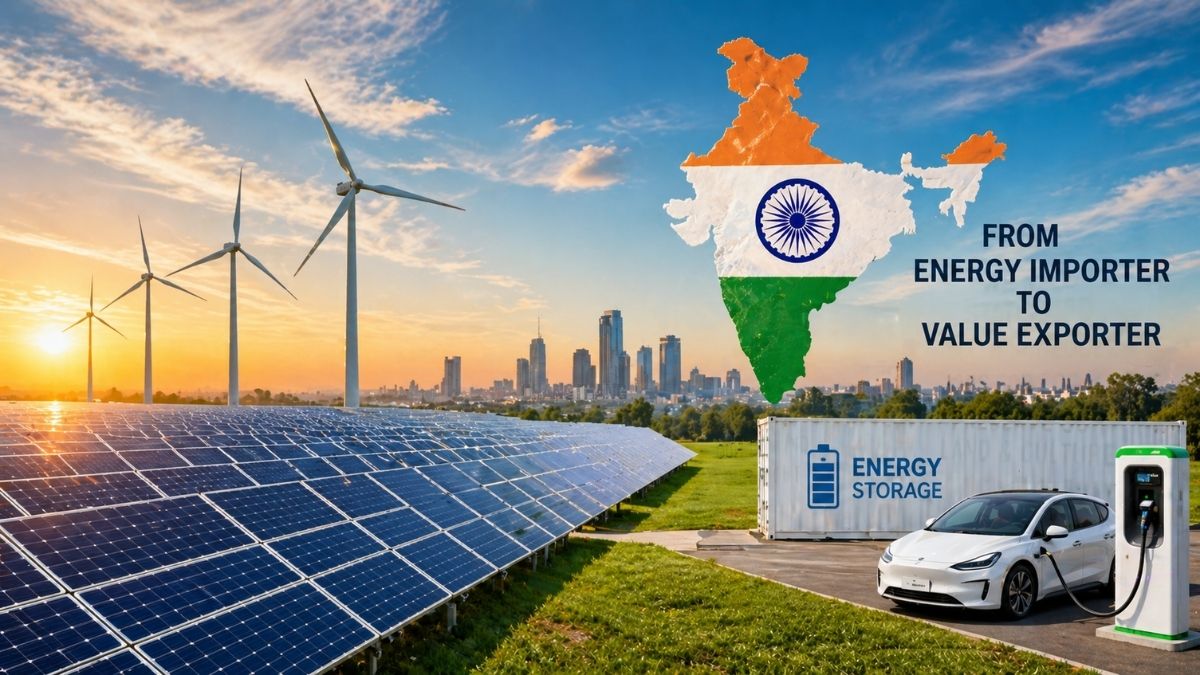
The trajectory, if pursued with determination, could see India shifting from an energy importer to a net energy value exporter. This is in the realm of the thinkable.
Challenges remain
Challenges are real, not insurmountable. There are hurdles in the solar journey. Panels need large tracts of land. This is a genuine constraint in a country where farmland is scarce and contested. The answer lies in deploying solar panels on fallow wasteland, rooftops, highway corridors, and canal banks. India already has programmes for all of these.
Solar panels also need water to wash off the thick dust that settles on them, especially in Rajasthan and Gujarat, where solar potential is greatest, but water is scarce. Waterless robotic panel cleaners are an emerging solution. India should produce these at scale domestically.
Most critically, the sun sets every evening, but demand does not. Without storage, solar power has a structural limitation. India urgently needs massive deployment of storage systems. In 2025, India curtailed 2.3 terawatt-hours of clean solar power simply because the grid could not absorb it. That is both an engineering failure and an economic one.
Then there is the China problem. India imports most of its solar panels and components from China, which deepens trade asymmetry. However, domestic solar module manufacturing capacity has grown to 172 gigawatts. The government has set a target of domestically produced solar cells and wafers by 2028. An India that makes its own solar equipment is truly energy sovereign.
Five action points
Here are five action points.
One: treat solar energy as a national security infrastructure, equal in priority to defence. Funding should be at least doubled.
Two: invest urgently and massively in battery storage. Or else every evening the grid falls back on coal and diesel.
Three: upgrade the national transmission grid. Solar-rich states like Rajasthan and Gujarat need to be able to evacuate to demand centres in Maharashtra and Tamil Nadu.
Four: accelerate electric vehicle adoption across two-wheelers, three-wheelers, and buses since transport is the single largest consumer of petroleum.
Five: scale rooftop solar energy through PM Surya Ghar and allied schemes.
India's peak power demand is projected to rise further to 271 gigawatts, driven partly by rising incomes and the spread of air conditioning. The opportunity and the urgency are both enormous.
A sovereign necessity
The current crisis in West Asia offers us a window. In a world where oil routes can be disrupted overnight by wars India did not start, energy independence becomes a sovereign necessity. Every gigawatt of solar power installed is one step away from the Strait of Hormuz. Every electric vehicle on the road is a barrel of oil India does not have to import. Every rooftop panel is a small act of national self-reliance.
The sun rises over India every morning without negotiation, without geopolitics, and without a price tag. The only question is how India can harvest it at the scale and speed the moment demands.
Dr Ajit Ranade is a noted Pune-based economist. Syndicate: The Billion Press (email: editor@thebillionpress.org)

