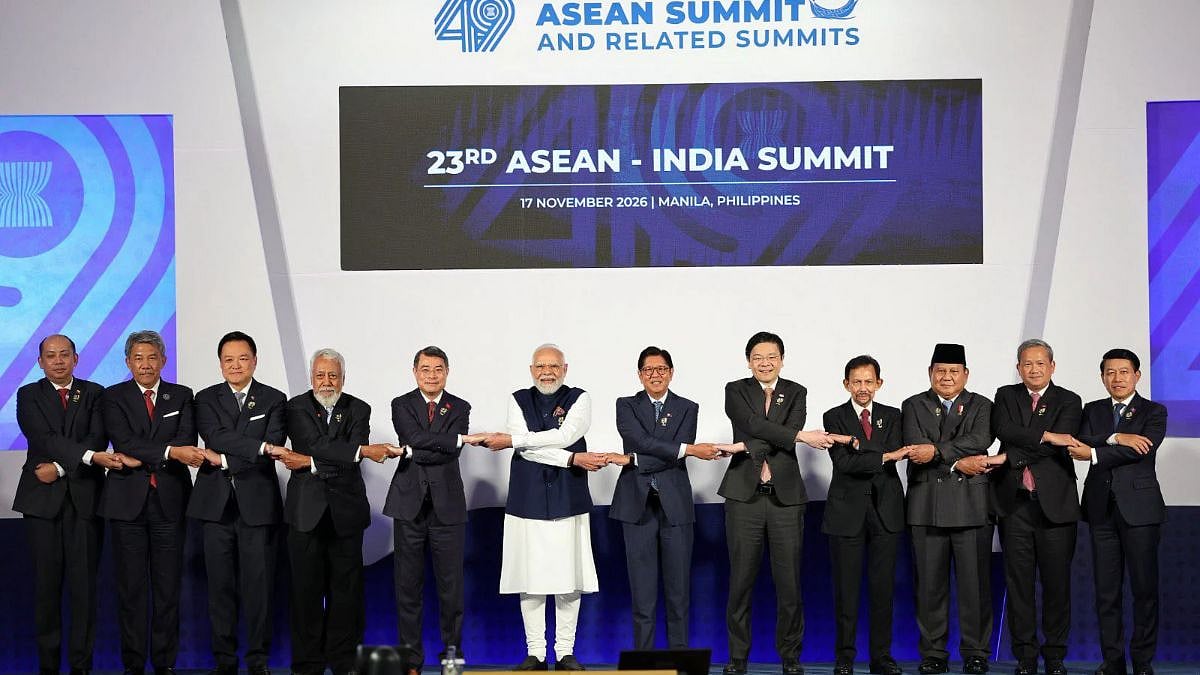
A Partnership with Strategic Significance
The 23rd ASEAN-India Summit in Manila agreed to deepen disaster cooperation through early-warning systems, data-sharing, joint exercises and faster humanitarian assistance. The agreement matters because India and Southeast Asia face common hazards, including cyclones, floods, earthquakes and tsunamis. It also reflects a strategic reality: India’s prosperity is inseparable from Indo-Pacific stability.
Modi’s Nine Proposals: Beyond Diplomatic Declarations
Prime Minister Narendra Modi placed nine proposals before the 11-member Association of Southeast Asian Nations. They include a long-term maritime cooperation plan, cyber-forensics training, nuclear-energy exchanges, a space hackathon, critical-minerals cooperation, youth exchanges, scholarships at Nalanda University, a creative partnership pavilion at WAVES 2027 and free electronic visas for ASEAN tourists. Together, they seek to build influence through practical partnerships, not military alignment.
The maritime plan is the strategic centrepiece. Connectivity, Coast Guard cooperation, maritime domain awareness and seafarers’ security respond to the reality that trade, energy supplies and regional stability depend on safe sea lanes. South China Sea disputes and China’s naval presence make this relevant. India is signalling support for a free, open, inclusive and rules-based Indo-Pacific while respecting ASEAN centrality. The message is cooperation, not confrontation.
The other proposals address emerging areas of competition. Critical minerals are essential to clean energy, electronics and advanced manufacturing; cooperation can reduce dependence on concentrated supply chains. Nuclear-energy exchanges can support energy diversification, while cyber-forensics training addresses digital fraud and cross-border threats. Space cooperation can turn satellite applications into tools for agriculture, resource management and disaster response. Youth exchanges, scholarships and creative collaboration can build constituencies beyond official diplomacy. Free e-visas promote tourism and cultural engagement.
India's Act East Policy and ASEAN's Economic Potential
For India, ASEAN anchors the Act East Policy and bridges the Indian and Pacific oceans. The relationship has evolved from sectoral dialogue in 1992 to a Comprehensive Strategic Partnership in 2022. As both sides look towards ASEAN Community Vision 2045 and Viksit Bharat 2047, the challenge is to convert institutional warmth into measurable outcomes. Modi cited more than 100 people-to-people initiatives, nearly 250 Quick Impact Projects and over 10,000 skill-building scholarships since 2014. These provide a foundation; the next phase requires timely implementation and tangible gains.
ASEAN's Achievements and the Limits of Consensus
How much has ASEAN delivered? Its record is substantial, although uneven. Founded in 1967, it helped transform a conflict-prone region into one where leaders meet regularly and manage disputes through dialogue. Its forums bring major powers, including the United States, China, Russia, Japan and India, to a common diplomatic table. It has expanded trade networks and connected Southeast Asia with wider markets through arrangements such as the Regional Comprehensive Economic Partnership.
ASEAN has demonstrated regional cooperation during economic shocks. The 1997-98 Asian financial crisis exposed the vulnerability of individual economies and encouraged financial coordination. The Chiang Mai Initiative, launched in 2000 with China, Japan and South Korea, developed into a $240-billion regional financial safety net. It has advanced disaster response and added a 2026 facility for rapid liquidity during pandemics and natural disasters. Its population of about 693 million and combined output of roughly $4.3 trillion give it economic weight.
Yet limitations remain. Consensus and non-interference have kept diverse states together, but can paralyse collective action. ASEAN has no supranational authority to enforce decisions. Myanmar’s continuing civil conflict after the 2021 coup has exposed the weakness of its peace efforts. Excluding Myanmar’s political leadership from high-level meetings has yielded no settlement. Tensions between Thailand and Cambodia and unresolved South China Sea disputes reveal the gap between declarations and effective conflict management.
These shortcomings reflect its diversity. Members differ in political systems, economic capacity and ties with Washington and Beijing. Some face direct maritime pressure from China; others prioritise economic ties with it. A consensus-based grouping struggles to formulate a common response when national interests diverge. Economic integration, meanwhile, remains constrained by non-tariff barriers and uneven development.
Challenges Ahead: US-China Rivalry and Regional Stability
The challenges ahead are formidable. US-China rivalry is intensifying, supply chains are being reorganised, and Middle East conflicts threaten energy prices and economic confidence. The South China Sea needs a credible code of conduct, not prolonged negotiations. Myanmar requires sustained diplomacy, while climate-related disasters demand stronger early-warning systems. It must address cyber threats, digital disruption and critical-mineral security, while resisting external divisions.
India's Opportunity in the Emerging Indo-Pacific Order
India should neither expect ASEAN to function as a military alliance nor underestimate its importance. ASEAN centrality gives smaller countries diplomatic space and India an inclusive platform. New Delhi, however, must match summit ambition with better trade connectivity, reliable project delivery, investment, technology partnerships and sustained maritime engagement. The review of the ASEAN-India Trade in Goods Agreement must deliver simpler and more effective market access.
Manila has reaffirmed a shared direction. The test is whether the nine proposals and disaster-management agreement become funded programmes, timelines and outcomes. ASEAN’s strength lies in keeping the region talking; its weakness is hesitation when hard choices arise. India’s opportunity is to help bridge that gap through patient, practical cooperation. In the Indo-Pacific, influence will belong not merely to those who make declarations, but to those who deliver.
(Writer is a senior political analyst and strategic affairs columnist based in Shimla. He is also Contributing Editor with The South Asian times from New York)

