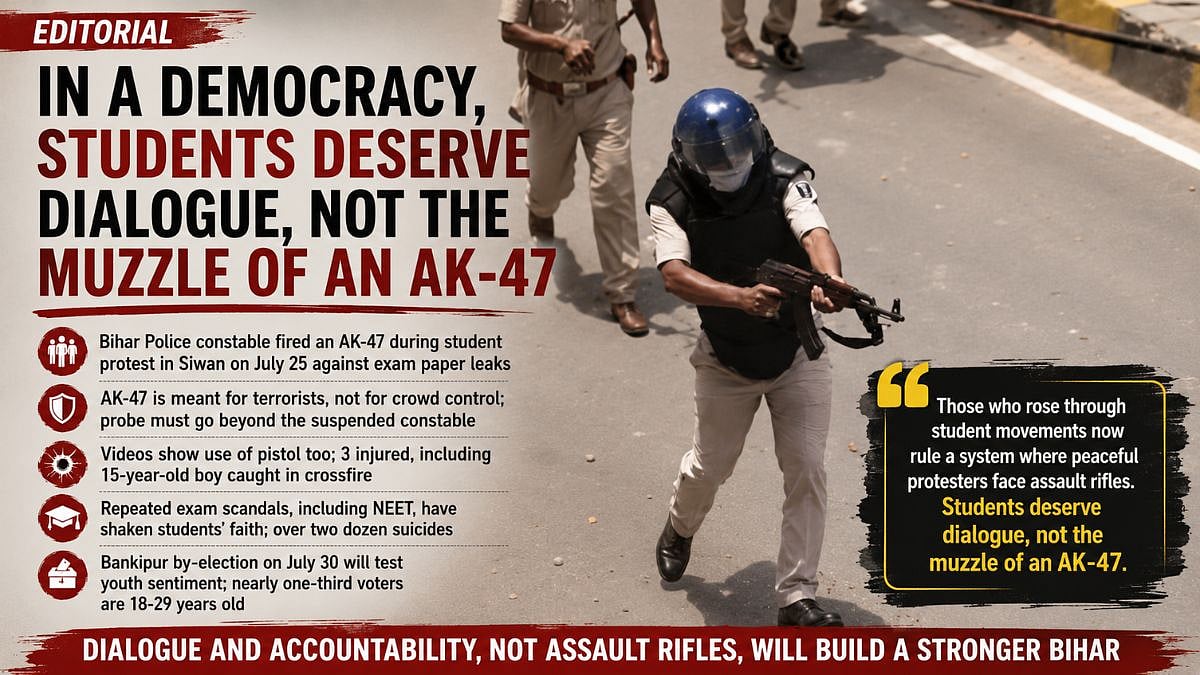
The scenes witnessed in Bihar’s Siwan district on July 25 should shock the conscience of every Indian who values democracy and the rule of law. A viral video showed a Bihar Police constable firing an AK-47 assault rifle during a student protest against recurring examination scandals.
This was not a counter-insurgency operation. It was a protest by young people demanding fairness in public examinations and accountability from those responsible for repeated question-paper leaks.
The Bihar government responded by suspending the constable and ordering a departmental inquiry. Suspension, however, cannot be the end of the matter.
An AK-47 is not a weapon ordinarily entrusted to a policeman for crowd control. It is issued for dealing with terrorists and heavily armed criminals posing a grave threat to life.
Questions Of Accountability
A constable cannot simply decide to use such a weapon on his own. The obvious questions remain unanswered: Who authorised him to carry the rifle? Who permitted its use against student protesters? Accountability must extend beyond the individual constable to every officer in the chain of command.
The AK-47 was not the only firearm reportedly used. A video released by the Leader of the Opposition purportedly shows another uniformed person using a pistol during the clashes.
Three persons sustained bullet injuries, including a 15-year-old boy who was not even participating in the protest but was caught in the crossfire. That prompt medical attention saved their lives is a matter of relief, not an excuse for the extraordinary use of force.
The irony is painful. Bihar’s political leadership owes much of its own rise to student activism. Both Nitish Kumar and Lalu Prasad Yadav emerged from the student movement inspired by Jayaprakash Narayan’s Total Revolution in the 1970s.
That generation transformed student idealism into political leadership. It is, therefore, deeply disturbing that those claiming that legacy now preside over a system in which peaceful student demonstrators are confronted with assault rifles.
Growing Youth Discontent
The protests did not arise in a vacuum. Repeated examination scandals, including the NEET controversy, have shaken young people’s faith in the integrity of competitive examinations. About two dozen students were driven to such desperation that they took their own lives.
Their demand for accountability, including the resignation of then Union Education Minister Dharmendra Pradhan, reflected widespread frustration rather than political adventurism.
The timing also gives the incident political significance. The Bankipur Assembly by-election on July 30, necessitated by the resignation of BJP president Nitin Nabin from the seat, will test whether Bihar’s youth remain silent spectators. Nearly one-third of Bankipur’s electorate is between 18 and 29 years of age.
Democracy Demands Dialogue
Whether public anger over the treatment of students influences the outcome remains to be seen. What is beyond dispute, however, is that in a democracy, students deserve dialogue, not the muzzle of an AK-47.

