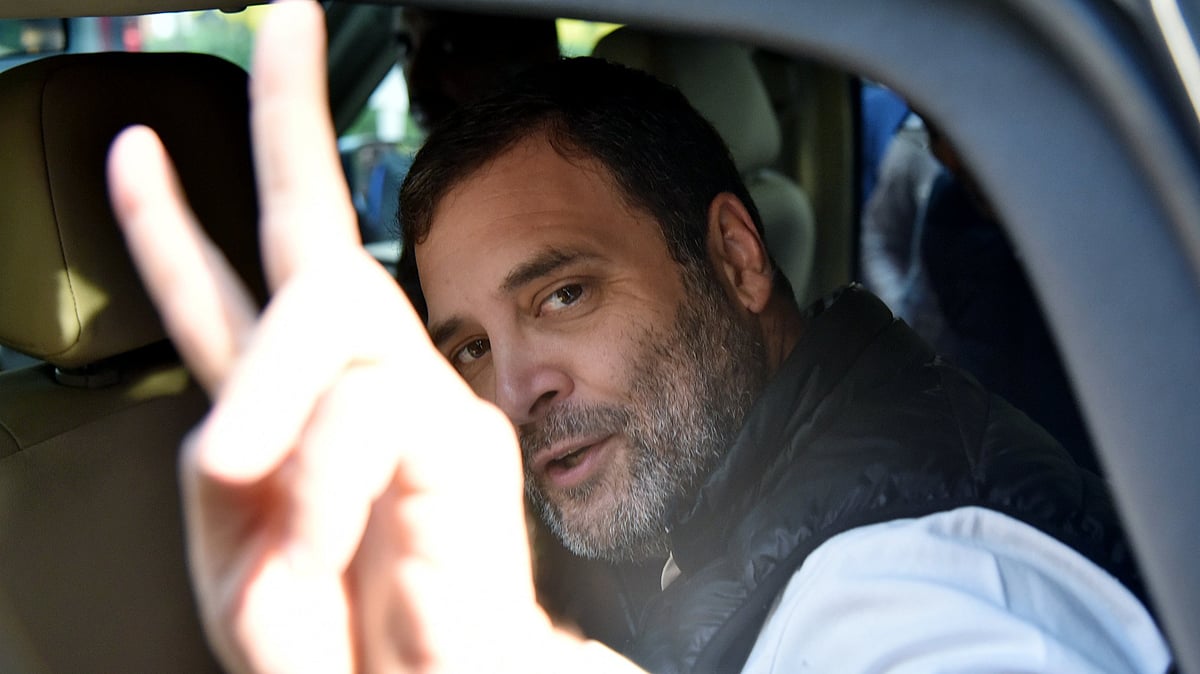
How will you define the rise of Rahul Gandhi in Indian politics? Miracle. Only one word can explain what we are witnessing today about Rahul Gandhi. No other politician in Indian political history has been maligned so much and with such a killer instinct by the ruling establishment. Massive propaganda has been unleashed against him over the past 12 years to crush him under the weight of contempt and scorn. Every attempt was made to kill him not only politically but also metaphorically. In this endeavour, the entire mainstream media was given a contract to portray him as a hateful character, a character who is good for nothing and whose entire political journey is a living certificate of entitlement and privilege.
Rahul Gandhi was aware of this. Once, he even commented that a million dollars had been spent to malign his image. This was a time when even the most vitriolic critics of Modi were not willing to listen to a word ‘good’ about Rahul Gandhi. ‘He was a ‘Pappu’ and would remain the same for the rest of his life’, was the common refrain. From the top academic to the most ordinary person in the street, everyone shared that opinion. I had many fights with fellow journalists and friends whenever I tried to tell them politely that it was wrong to write him off, that he was the victim of propaganda, and that we should remove our coloured glasses and form an honest opinion about him.
At that time, I was mocked and ridiculed when I tried to reason out with my friends about how wrong we were in our assessment of him. But then that was a different season. Now, the season has turned. Now he is seen as a beacon of hope who has pushed the Modi government into a corner.
The power of political propaganda
You know what has happened?
One of the biggest contributions of the Modi government in Indian politics is the use of propaganda. RSS has always used it effectively since its inception. Reconstruction of the human mind has always been their ideological goal: to create a ‘New Man’, an ‘Ideological Man’. This is nothing new. Every ideology, be it left or right, across the globe, does that. Communist regimes had mastered this art in the most magnificent and diabolical way. Antonio Gramsci and Louis Althusser have written about it. But in the Indian context, it was a new phenomenon.
In fact, before Rahul Gandhi was thrown into the dustbin of public ridicule through propaganda, Modi was presented to us as a messiah who would change the destiny of the country. He is a classic example of how propaganda can turn a man who was once seen as a villain after the Gujarat riot into a man of destiny, a ‘Hero’. If millions of dollars were spent to make Rahul a ‘Pappu’, similarly, the same amount or probably many times more was used to create Modi, a godlike character, a cult figure. And he was definitely successful in this game.
Contrasting communication styles of political leaders
His image was so mesmerising and infectious that top intellectuals, academicians, and journalists were unwilling to listen to even minor criticism of him. Here, my endeavour is not to belittle Modi’s persona or praise Rahul Gandhi to the roof but to underline the power of the propaganda and its blinding effect. I have always maintained and written that Modi’s entire persona was artificially sculpted, and in this game, his genius as a master communicator played a vital role. In contrast, Rahul’s biggest drawback has been communication. Over time, he has compensated for that by developing a new method of communication. The ‘Chhatron ki goonj’ programme is a classic example of this new method. Probably, his team has realised his shortcomings. It has created a format where presentation, graphics, pictures, and visuals drive his communication, and men and women are used as props to tell stories of victimisation by the government.
In this exercise, Rahul Gandhi is presented not as a spokesperson but as a Sutradhar, as a conductor of the symphony. He is not sitting in a chair but standing, moving around like a rock star holding a microphone. He talks like a professor decoding a tricky formula. When Modi speaks, he appears to be in total command of the medium and content, but Rahul presents himself as a narrator, as if he is telling a story. Unlike Modi, he hardly modulates his voice. His pauses are not well-rehearsed. Modi is like a seasoned actor. He is a performer. Rahul is a method actor. He looks what he is; he does not try to be the ‘other’. He portrays himself as a normal person; in a way, he tries to deconstruct his image as a dynast from a privileged background.
Rahul Gandhi's unconventional political identity
It is also important to note that, unlike a traditional Indian politician, Rahul Gandhi does not wear a kurta pyjama. Rather, he is happy in a T-shirt and baggy trousers. Is it because he harbours a contempt for the traditional politician and politics? Or is he trying to be what he is in normal life and does not feel the need to change his lifestyle? In my understanding, it is a combination of both. In his heart, he is not comfortable with the way politics has evolved in India and, through a T-shirt, he does not hide his rejection of the same.
Connecting with a new generation
While his unorthodox nature was a liability and the reason for misunderstanding once in Delhi, the same is now the cause of attraction and vitality, and when he says, “Gyanesh, it is done, bro,” he connects with Gen Z. No wonder Modi, the master communicator, is struggling to connect with new-age kids, and Rahul Gandhi has become a reason for a headache for him. These are interesting times and defining moments. Let’s see how they pan out.
The writer is Co-Founder, SatyaHindi.com, and author of Hindu Rashtra. He tweets at @ashutosh83B.

