When TVK emerged as the single-largest party in the Tamil Nadu assembly elections on May 4, with an unprecedented 35% vote share, many senior leaders of the incumbent DMK predicted the worst for themselves.
Vijay would rule the roost for the next 10-15 years and keep DMK out of power, the leaders worriedly told journalists in off-the-record conversations. Their predictions were drawn from history; matinee idol-turned-politician MG Ramachandran, who split the DMK to start AIADMK, kept them out of power until his death in 1987.
Six months down the line, Vijay doesn’t seem as infallible to the DMK, despite his personal popularity staying intact—TVK winning two by-polls and looking set to win five more to inch closer to the majority mark of 118.
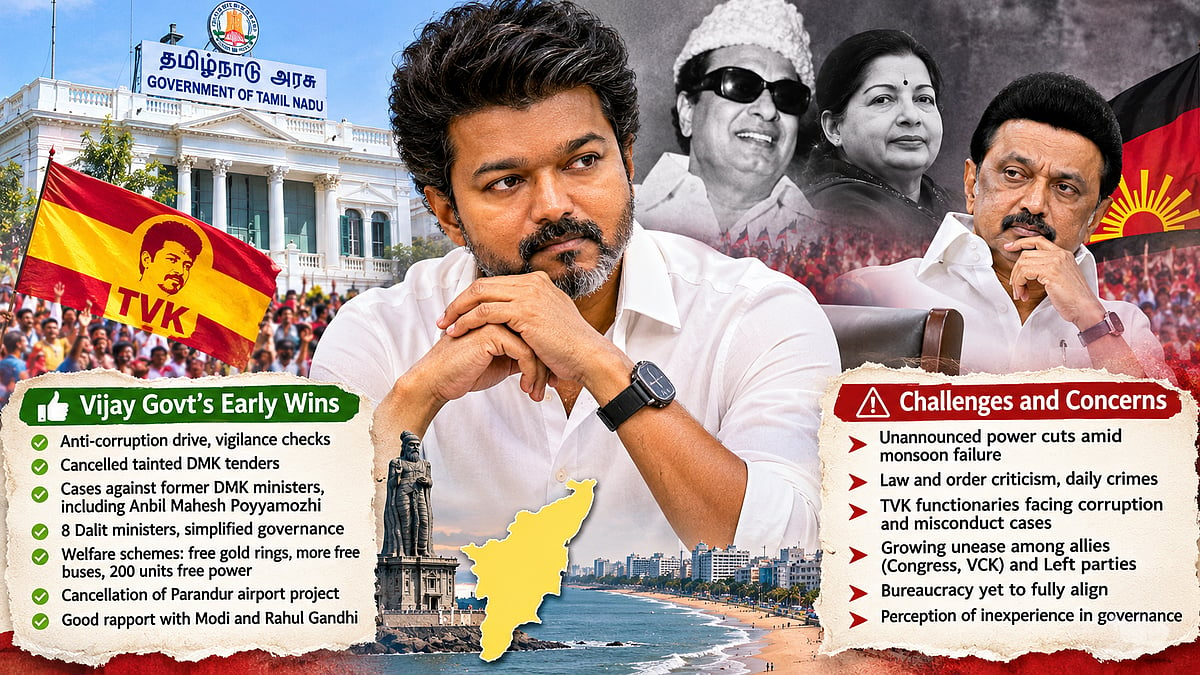
This is because the honeymoon period of the Vijay government has indicated that India’s latest political start-up has not learnt the ropes of governance as fast as realpolitik. It remains high on intent but average on delivery, weighed down in no small measure by the administrative inexperience of its 34 first-time ministers, including the Chief Minister himself.
The start was great; Vijay’s own sustained public denouncement of corruption backed by regular vigilance checks to curb bribery in sarkari offices drew massive approval. Tainted high-value tenders finalised by the DMK government were cancelled. The TVK even indicated it meant business by going after at least four former DMK ministers, registering corruption cases against them. By arresting former school education minister Anbil Mahesh Poyyamozhi, DMK scion Udhayanidhi Stalin’s best friend, they sent out a message that Vijay wasn’t averse to touching even the DMK first family. The excise minister has, on multiple occasions, signalled an intent to clean up the corrupt and substandard liquor industry. An unprecedented eight Dalits are ministers, and there has been a conscious attempt to simplify government processes for citizens.
Welfare schemes announced in their indulgent pre-poll manifesto, like free gold rings to newborns, expansion of the free bus scheme, and 200 units of free power, have been implemented despite a circumspect bureaucracy citing fiscal prudence. Even the cancellation of the Parandur international greenfield airport project, which drew the ire of the industry and the bureaucracy, sent a political message that Vijay is unwilling to back away from his promises. Meanwhile, the most industrialised state in India awaits the TVK government’s vision on mega projects, which have the potential to accelerate growth.
Nationally, too, Vijay earned the envy of other politicians by emerging as a popular Prime Ministerial face and publicly displaying an excellent relationship with both Prime Minister Narendra Modi and his bête-noire, Rahul Gandhi. Despite allying with Congress, the TVK government seems to have the blessings of the Modi-Shah BJP, a political quadratic equation that befuddles long-timers.
And yet, the Vijay government seems to have neutralised the advantages gained by these ‘theatre moments’ by sheer mishandling of several issues that have a direct bearing on citizens’ daily lives, irking even its hardcore supporters.
Multiple unannounced power cuts coincided with the failure of the south-west monsoon and an extended summer thanks to Super El-Nino set tongues wagging about the mishandling of the power ministry. The opposition went to town with it, given how power cuts invoke PTSD and were a major reason for the fall of the 2006-11 DMK government.
The TVK is also grappling with an inability to change people’s perception of a breakdown in law and order, a stick they used effectively to beat their predecessor during the election campaign. This has spectacularly boomeranged, with an aggressive opposition and a charged-up media ecosystem keeping count of the daily murders and heinous crimes across the state, pushing TVK’s ministers on the back foot. For instance, DMK president MK Stalin lampooned the Vijay government as being in an ICU by citing 17 murders on the Deepavali day.
To make matters worse, multiple elected and unelected TVK functionaries face allegations of misdemeanour and misbehaviour; one was even arrested by the DRI in a 137 kg meth trafficking case, while another faces allegations of misbehaving with an IAS officer and a third, the deputy speaker nonetheless, is accused of thrashing a constituent.
This is meant to be direct pressure for the Captain Cool-like Vijay; he has the home portfolio. His detractors keep reminding us that he hasn’t addressed the press, let alone granted interviews to friendly journalists like You-Know-Who. Allies like Congress and the Viduthalai Chiruthaigal Katchi (VCK), which kept mum while with the DMK, have suddenly found their voices; the left parties helped the TVK establish a majority in the assembly but have emerged as its most trenchant critic on a daily basis. The bureaucracy, too, hasn’t warmed up to the reality of a fresh party replacing a comfortable duopoly, observers point out.
Bureaucrats say the Vijay 1.0 government is like Jayalalithaa 2.0, but an experienced hand remarks how he can’t be as ruthless, given the lack of a majority. If he had, say, 130 MLAs in a house of 234, the erring MLAs might have been dumped and arrested to set an example like Jayalalithaa did. To be fair, Vijay hasn’t been completely hands-off; insiders say most ministers are scared stiff of him, and feedback is taken seriously. The transport minister drew praise for personally ironing out issues at inter-city bus termini in Chennai during the Deepavali weekend after a fiasco during Ganesh Chaturthi. During the rains last month, MLAs were on the streets with the people, helping solve waterlogging issues.
All is not lost, given that Vijay still enjoys the unstinted support of the masses, as witnessed in the massive organic crowds that turn up every time he steps out of his house or even Tamil Nadu. His well-wishers want him to take greater control of the party and the government, be more ruthless than accommodative, and, overall, speak to the public a lot more often. The next six months will be crucial; opposition parties will be waiting to move another no-confidence motion, but he might probably be just a few good decisions away from regaining the assumed invincibility that DMK’s top leaders thought he was bestowed with on May 10.
Siddharth Prabhakar is an independent journalist based out of Chennai with proven expertise in investigations, crime and politics.

