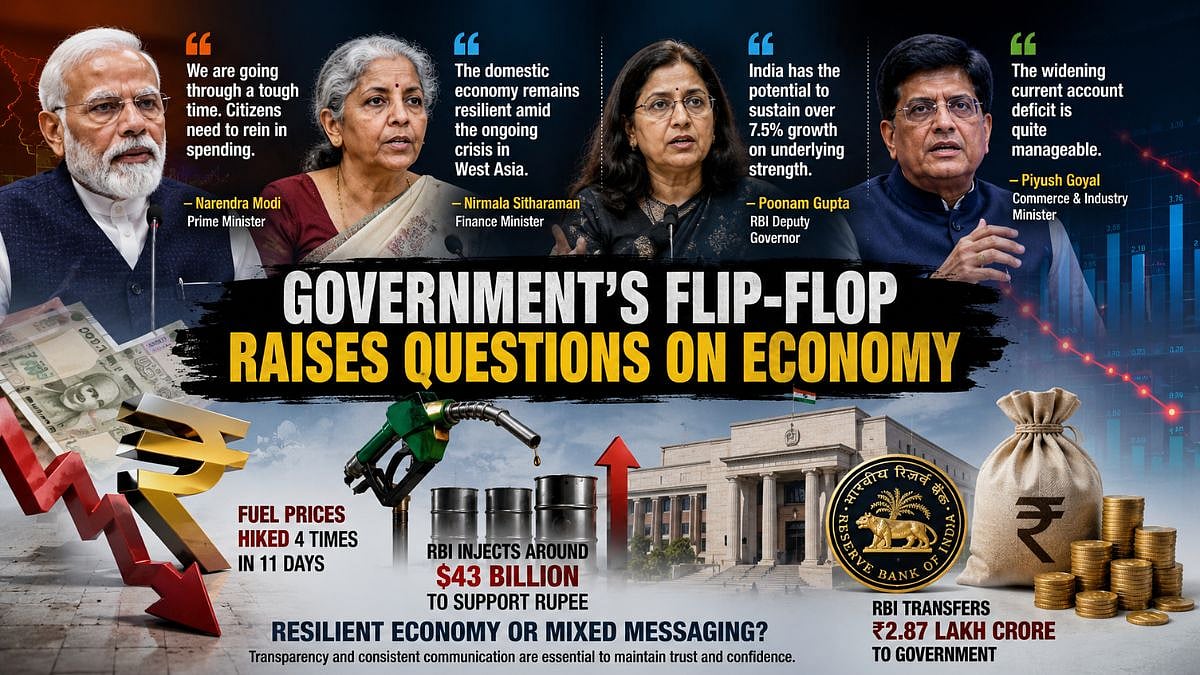
How is the Indian economy performing? Finance Minister Nirmala Sitharaman claims that the domestic economy remains resilient amid the ongoing crisis in West Asia. RBI Deputy Governor Poonam Gupta, at a recent event and even earlier, said that India has the potential to sustain over 7.5 per cent growth on underlying strength, even as she defended the 4 per cent targeting framework.
But Prime Minister Narendra Modi strikes a different note. In a speech in Secunderabad, he cautioned citizens that the country was going through a tough time and they needed to rein in spending. Meanwhile, Commerce and Industry Minister Piyush Goyal believes the widening current account deficit is quite manageable.
These are mixed signals from those in positions of power, leaving citizens no clearer on the picture than before. Neither Modi nor his Finance Minister is willing to share how grave the situation is, even as fuel prices have been increased four times within 11 days, while the RBI has injected around $43 billion into the market to stabilise the rupee's downward slide.
The RBI, last week, transferred a record Rs 2.87 lakh crore to the government, lower than expected and a routine surplus transfer rather than a crisis measure. That it arrived at a moment of rupee stress was fortuitous, but it does not change the underlying picture.
Contradictory signals and public uncertainty
What common Indians are left with is a hollow sense of reassurance. If the country is really resilient, it does not justify four fuel price hikes in 11 days. A manageable current account deficit does not account for $43 billion in market interventions. And growth estimates of 7.5 per cent sit uncomfortably alongside a Prime Minister telling citizens to tighten their belts.
These contradictions are not simply politically embarrassing; they reflect a government that either does not want to admit the truth or has not reached an honest and balanced assessment of its position.
Citizens deserve to know what the external pressures are, whether the government’s fiscal position is what it appears to be in practice, and what trade-offs are being made on their behalf.
Instead, what is being doled out are optimistic projections from one quarter, caution from another, and technical reassurance from a third, with little connection between them.
Need for clarity in economic communication
Economic communication is more important than governments want to admit. When leadership speaks in contradictory voices, it not only confuses but also erodes the trust that is itself a stabilising force. Markets price in uncertainty.
So do households. India should be able to get through this without a formal crisis, but doing so while keeping citizens in the dark would be neither good governance nor sound economics. A government sure of its management ought not to have any trouble explaining itself.

