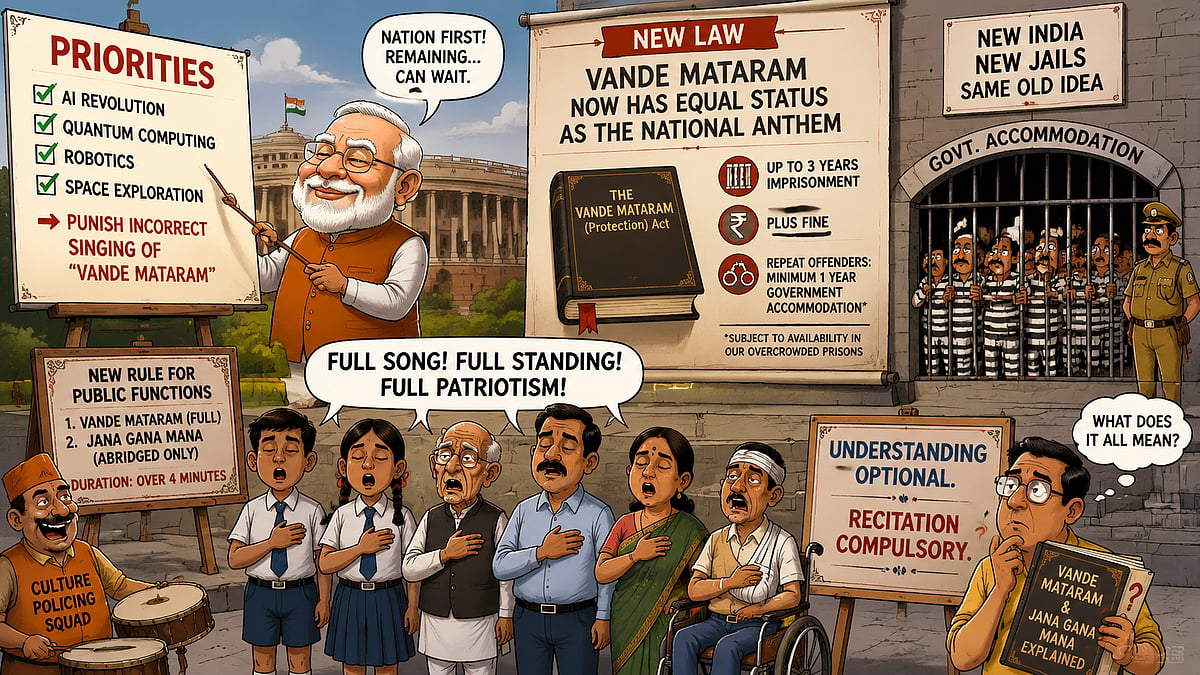
The Narendra Modi government deserves a pat on its back for its impeccable sense of priorities. At a time when the rest of the world is busy embracing artificial intelligence, quantum computing, and robotics, India has chosen to tackle the challenge that was clearly keeping the nation awake at night: what to do with people who fail to sing the full Vande Mataram properly? The government has now moved to give the national song the same statutory protection as the national anthem. Any intentional disruption, obstruction or perceived disrespect can attract imprisonment for up to three years, besides a fine. Repeat offenders are assured of a minimum one-year stay in government accommodation, provided, of course, there is room for them in our already overcrowded prisons.
The legislation comes after making it mandatory at important public functions to sing Vande Mataram first and Jana Gana Mana afterwards. India, that is Bharat, may well become one of the very few countries where both the national song and the national anthem must be rendered compulsorily before proceedings can begin. Together they consume over four minutes, during which everyone—from energetic schoolchildren to the elderly and infirm—is expected to stand in respectful attention. As if that were not enough, the government has decided that the abbreviated version of Vande Mataram, sung for the last 75 years, will no longer do. The entire composition by Bankim Chandra Chatterjee must now be sung. One must, however, express gratitude for small mercies. Rabindranath Tagore’s Jana Gana Mana has not yet been ordered to be sung in its entirety. Had that happened, India might have entered the record books for possessing not merely the longest election speeches but also the longest mandatory musical prelude to official functions.
The irony is difficult to miss. The Supreme Court once ruled that no citizen could be compelled to sing even the national anthem. The judgement arose from the case of three children belonging to a Jehovah’s Witness family in Kerala who respectfully stood while the anthem was played but declined to sing it because of their religious beliefs. The Court rightly held that respect could not be measured by vocal participation and restored their rights after the state had acted against them.
There is another small inconvenience. A large majority of Indians do not fully understand the meaning of either Vande Mataram or Jana Gana Mana. Some countries have modernised their national symbols to make them meaningful to contemporary citizens. The Netherlands, for example, replaced an archaic version of its anthem because younger generations could scarcely understand it. India has chosen a different path. Understanding is optional. Recitation is compulsory. Patriotism, it seems, is best measured not by what citizens do for their country but by how accurately they remember every stanza.

