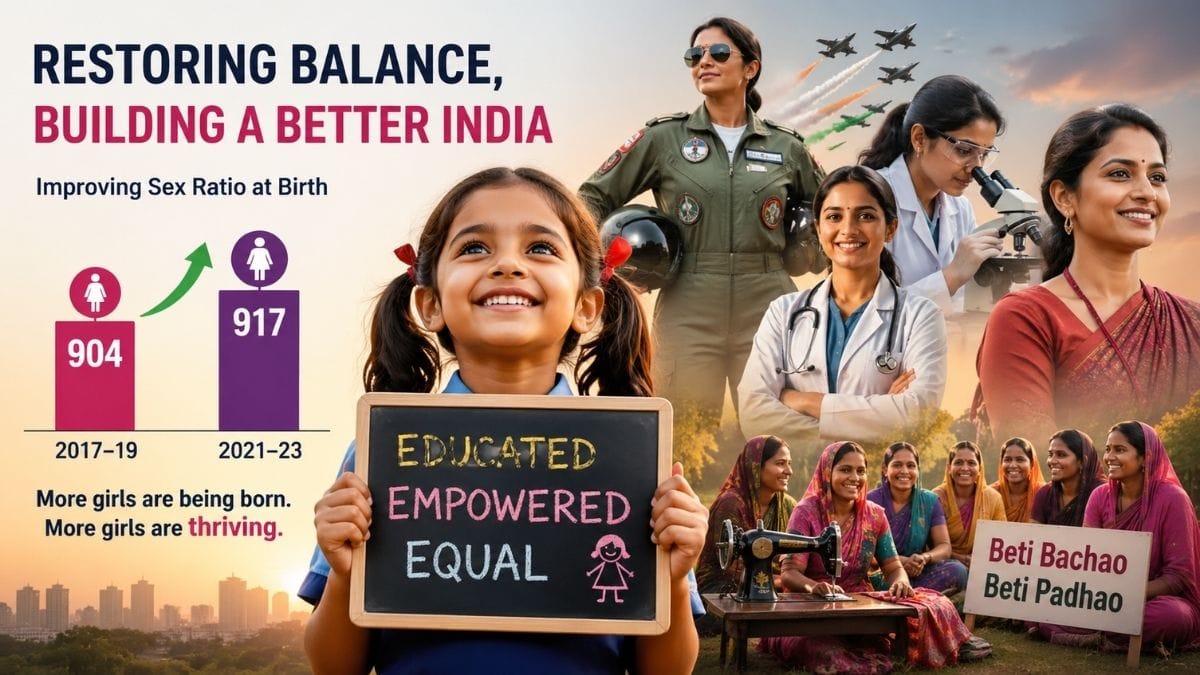
India’s sex ratio at birth has shown a notable improvement at the national level, rising from 904 in 2017–19 to 917 in 2021–23—an indicator that more girls are not only being born but are also surviving. This shift, modest in numbers but profound in implication, marks a significant correction of a long-standing demographic distortion.
For decades, the country grappled with entrenched gender bias that resulted in the systematic elimination of girls before birth. That trend now appears to be reversing, suggesting that a combination of policy intervention, legal enforcement, and changing social attitudes is beginning to yield results. The ongoing census will offer a more comprehensive and granular picture, but the trajectory is clearly encouraging and deserves both recognition and reinforcement.
Policies and campaigns drive change
Several factors have contributed to this turnaround. Foremost among them is the strict enforcement of laws prohibiting the disclosure of a foetus’s sex by diagnostic clinics, with stringent penalties acting as a deterrent. The medical fraternity, once complicit in enabling sex-selective practices, now functions under far tighter oversight.
Equally important has been the sustained social campaign against female foeticide, which has helped reshape public attitudes over time. Government initiatives, such as Beti Bachao Beti Padhao, have reinforced this shift by combining advocacy with targeted interventions.
In states like Haryana, once notorious for skewed sex ratios, the consequences of imbalance became starkly visible as men struggled to find brides locally, prompting them to look as far afield as West Bengal and Kerala. Social necessity, in this case, reinforced the urgency of reform, turning a social crisis into a catalyst for change.
Women’s progress reshapes attitudes
Incidentally, in the Muslim-majority Nuh district in the same state, the sex ratio has always been much better, underlining that skewed gender outcomes are driven by socio-economic conditions and cultural practices.
At a deeper level, the transformation in the status of women has been decisive. Women today are excelling across fields, from aeronautics and the armed forces to astrophysics, journalism, and grassroots politics. In schools, universities, and competitive examinations, they often outperform men, challenging outdated notions of gender roles.
The idea that women can match or even surpass men in every sphere is gaining wider acceptance.
Towards a balanced society
As Nobel-laureate Amartya Sen once argued, the elimination of girls before birth amounted to “murder in the womb” and contributed to the phenomenon of “missing women”. Science, however, underscores that the female sex possesses greater biological resilience, suggesting that nature itself favours balance rather than disparity.
The improving sex ratio is, therefore, both a moral and demographic correction. While vigilance must continue, the trend offers hope that India is moving towards a more equitable and humane society, one where daughters are valued as much as sons and where balance, long denied, is steadily being restored.
