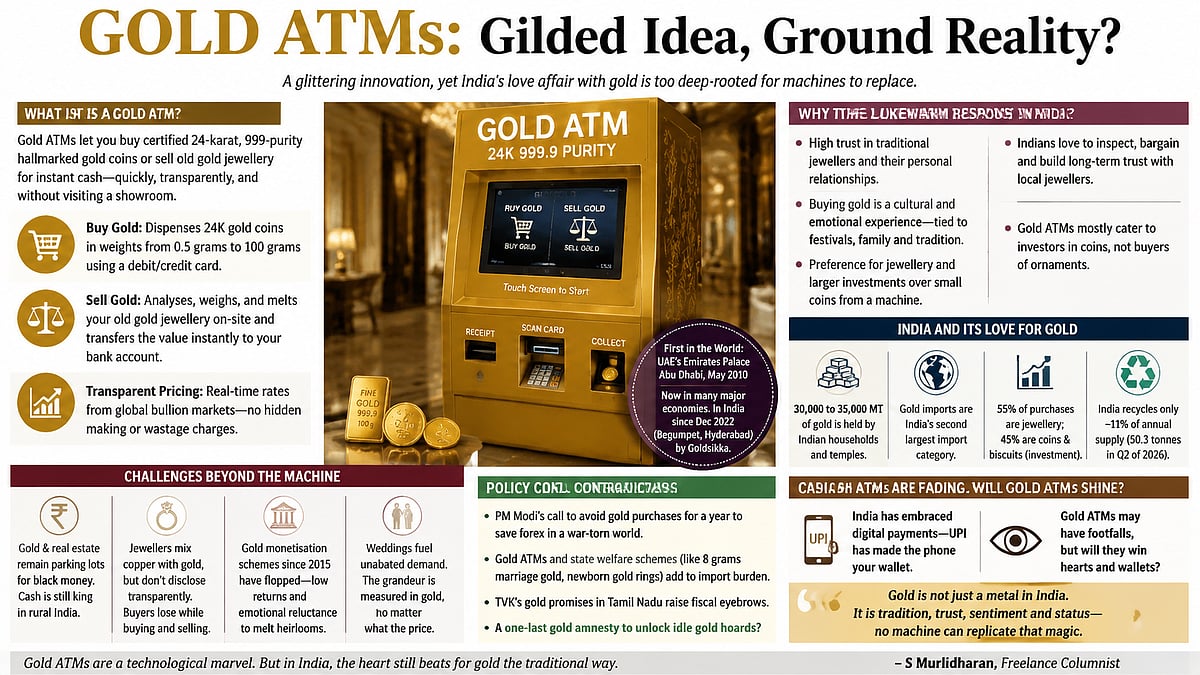
Gold ATMs serve the purpose of letting people buy certified physical gold coins or sell old gold jewellery for instant cash without visiting a traditional showroom. They dispense 24-karat, 999-purity hallmarked gold coins in small weights (from 0.5 grams up to 100 grams) using a credit or debit card. They also help sell gold. Some advanced machines analyse, weigh, and melt old gold jewellery on-site to instantly transfer equivalent cash values into a bank account. Real-time pricing from global bullion markets is the basis for valuation, so customers pay or receive transparent market values without hidden fabrication or wastage fees.
The United Arab Emirates (UAE) has the distinction of being home to the very first gold ATM introduced at the Emirates Palace hotel in Abu Dhabi in May 2010, with newer fintech-powered networks expanding across the UAE. Now it has a presence in most of the major economies of the world. Launched in India in December 2022 in Begumpet, Hyderabad, by Goldsikka, with tech support from OpenCube Technologies, it hasn’t had many takers, though such ATMs might have registered a good number of footfalls. There is also a gold ATM in the temple town Tirupati to cater to pilgrims wanting to offer gold coins at His feet. Gold ATMs face a lukewarm response in India due to high trust in traditional jewellers, the large ticket size of gold purchases, and the preference for personalised jewellery experiences over buying raw coins from an impersonal machine. Indians prefer visiting trusted local jewellery shops where they can inspect, bargain, and build long-term relationships. Buying gold is a cultural and emotional experience, often tied to festivals and family traditions, which a cold vending machine cannot provide. ATMs mostly dispense small 24-karat coins or bars, whereas buyers usually want wearable ornaments or heavier investments. In the event, gold ATMs could at best cater to investors in gold coins.
In India, gold and real estate beckon black money as parking lots. Despite the government’s attempt to discourage cash in these two avenues in particular, splitting of purchases so as to remain within the limits has frustrated the government’s attempt at mainstreaming the gold economy, especially because gold is keenly sought as much in the urban centres as in the rural ones. And in rural areas, cash is still the king. There has been a pronounced skew in favour of gold jewellery, around 55%, as opposed to around 45% of gold purchases being in the form of coins and biscuits by way of investments.
India is home to a massive 30,000 MT to 35,000 MT of gold mainly held by households and temples, in addition, of course, to the Reserve Bank of India, as a safe haven asset. With the production having dried up long ago, gold imports account for the second position in the nation’s basket of imports. Prime Minister Narendra Modi’s recent clarion call for eschewing gold purchases for a year to conserve foreign exchange in the war-torn world was timely, but gold ATMs seem to be working at cross purposes. It also works at cross purposes with the government’s effort to wean away investors from physical gold to paper gold via units of mutual funds. In hindsight, Tamil Nadu Chief Minister C. Joseph Vijay’s party, the Tamilaga Vettri Kazhagam (TVK), included major gold-related welfare commitments in its election manifesto, featuring 8 grams of marriage gold and newborn gold rings. Such state-sponsored schemes add to the nation’s import burden. Welfarism should not become an exercise in profligacy. Instead, schemes should be devised to persuade and incentivise people to sell their idle gold hoards, perhaps with a one-last gold amnesty scheme.
India recycles roughly 11% of its local annual gold supply, reaching a record high of 50.3 tonnes in just the second quarter of 2026 due to soaring metal prices. But even that is pitifully low when viewed in the context of the idle gold piled up over the years. The world over, the near-northward trajectory of gold prices is thanks to its scarcity value and shrinking fresh discoveries of gold mines. With the industrial use of gold hardly accounting for 2% of the total, gold holding has always been perceived as wasteful. But the government’s gold monetisation schemes since 2015 have been a spectacular flop, with returns being pitifully low and housewives being loath to allow melting of their mangalsutras for sentimental reasons. The grandness or success of Indian weddings is judged on the scale of gold jewellery the bride is bedecked with, so much so that the demand for wedding jewellery goes on unabated, no matter what the price is. There is a bit of delusion in jewellery buying in India. The wily jeweller mixes copper with gold to make the jewellery but doesn’t disclose transparently the gold content. At the time of sell-back or recycling, he steeply decreases the value in the name of the alloy diluting the yellow metal’s purity but justifying such mixing without batting an eyelid to make it malleable. In the event, the customer ends up losing while buying as well as selling gold. The morbid fascination with gold extends across the nation.
Cash-dispensing ATMs are now, by and large, languishing, thanks to India embracing digital payments, particularly UPI, under which the cell phone doubles as a digital wallet. Time alone will tell whether its gilded variant will fare any better. The current spate of saturation television ads on Tamil channels, asking buyers to wait till August 21 for gold ATMs, has naturally raised eyebrows. What extra it is going to offer remains to be seen by the starry-eyed people of Tamil Nadu.
S Murlidharan is a freelance columnist and writes on economics, business, legal and taxation issues.

