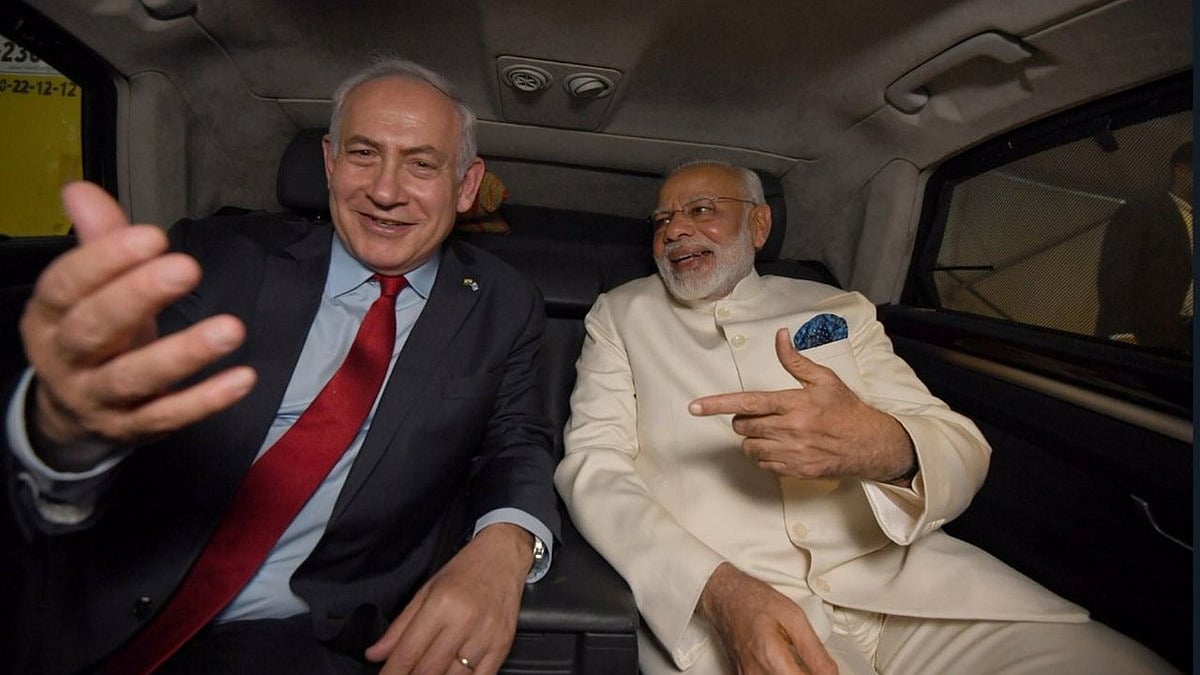
When Prime Minister Narendra Modi met his Israeli counterpart Benjamin Netanyahu and elevated bilateral ties to a “Special Strategic Partnership,” the gesture went far beyond diplomatic symbolism. The announcement of 16 structured agreements across defence, digital architecture, emerging technologies, agriculture and innovation reflects a decisive shift in the character of India–Israel engagement. What was once largely a discreet, defence-driven relationship has now evolved into a multisector compact with long-term strategic intent. In a geopolitical climate defined by technological rivalry, regional volatility and contested supply chains, the breadth of this framework signals that both nations are preparing for a more uncertain Asian century.
Beyond Defence Purchases: Institutionalising Strategic Convergence
For decades, India’s engagement with Israel was anchored in defence procurement—efficient, quiet and purposeful. The new framework alters that template. The sixteen agreements create an institutional lattice that integrates research collaboration, digital infrastructure coordination, fintech connectivity, artificial intelligence partnerships, cyber security mechanisms, industrial R&D, agricultural modernisation and defence co-production. The transformation lies not in any single memorandum but in the ecosystem being constructed. By moving from buyer–seller equations to co-development and joint innovation, the partnership acquires structural resilience.
This matters because contemporary power is increasingly measured not merely by hardware inventories but by technological ecosystems. AI algorithms, secure digital payments architecture, cyber resilience and precision agriculture are as central to sovereignty as conventional weapons platforms. By embedding cooperation in these domains, New Delhi and Jerusalem are effectively synchronising elements of their national transformation agendas.
Technology As The New Strategic Currency:
At the core of this expanded partnership lies technology. Israel’s reputation as a start-up powerhouse and India’s scale in digital public infrastructure create a complementary dynamic. Collaboration in fintech integration pathways and payment systems could facilitate smoother cross-border innovation flows. Joint work in artificial intelligence and dual-use technologies has implications not only for civilian industries but also for defence modernisation. Equally significant is cybersecurity. As state and non-state actors intensify operations in the digital space, building interoperable security frameworks becomes indispensable.
The agreements suggest recognition on both sides that technological dependence without security safeguards creates vulnerability. By coordinating cyber architecture and information protection systems, the two countries seek to pre-empt such risks. In agriculture and water management, the dividends are practical and immediate. Israel’s advances in drip irrigation, desert farming and water recycling align closely with India’s need to improve productivity amid climate stress. These partnerships move beyond theory into domains directly affecting livelihoods, rural resilience and food security.
A Message To Washington Without Confrontation:
The timing of the partnership’s elevation carries layered diplomatic meaning. Under President Donald Trump, Washington has favoured sharper strategic alignments among its partners. A visibly strengthened India–Israel axis can be read as complementary to American interests, given both countries’ close ties with the United States. Stronger technological and defence capabilities in two democratic states arguably reinforce a broader stabilising architecture.
Yet there is also a subtler undertone. By expanding cooperation on its own terms, India reiterates its doctrine of strategic autonomy. The relationship with Israel is not framed as an adjunct to any larger bloc discipline; it is presented as an independent, interest-driven partnership. In doing so, New Delhi underscores that even as it converges with major Western powers in several theatres, it retains sovereign latitude in shaping bilateral engagements.
Islamabad's Calculated Concern:
For Pakistan, the implications are neither abstract nor rhetorical. The deepening of India–Israel defence collaboration, particularly in joint production and technological transfer, will be viewed through a security prism. Enhanced cooperation in unmanned systems, electronic warfare, air defence integration and surveillance technologies could alter tactical balances over time. Even if specific platforms remain undisclosed, the architecture of co-development signals long-term capability accretion.
Pakistan’s strategic community may interpret this as a gradual narrowing of its operational space, especially in emerging theatres such as drone warfare and network-centric operations. However, the broader impact is psychological as much as material: a reinforced India–Israel axis suggests durability in technological collaboration, complicating Islamabad’s calculus in future escalatory scenarios.
Beijing's Quiet Appraisal:
China, too, will observe developments with measured interest. Beijing maintains substantial defence ties with Pakistan and has expanded technological and infrastructure influence across South Asia. An India–Israel compact centred on AI, cyber systems and advanced manufacturing intersects directly with sectors in which China seeks primacy. While Israel and China share economic linkages of their own, Beijing is likely to assess whether this upgraded partnership strengthens India’s resilience in sensitive technological domains. If joint innovation reduces India’s dependence on external supply chains, it indirectly limits avenues for strategic leverage. Thus, even absent overt rivalry, the partnership subtly reshapes the regional technology equation.
Strategic Gains For New Delhi:
For India, the dividends are layered. First, defence-industrial collaboration aligns with the drive for indigenous manufacturing and coproduction. Technology infusion, rather than outright imports, enhances domestic capability and employment generation. Second, digital and AI cooperation complements India’s ambition to position itself as a global technology hub. Third, agricultural and water initiatives offer tangible socio-economic returns in a climate-constrained future. Importantly, this partnership bolsters deterrence without binding India into a treaty-based alliance. The absence of formal military alignment preserves diplomatic flexibility even as capability deepens. In a multipolar environment, such calibrated strengthening of bilateral ties enhances leverage rather than constraining it.
Political Capital For Jerusalem: For Prime Minister Netanyahu, the expanded engagement carries strategic and symbolic weight. Amid persistent regional volatility, a robust embrace from India—one of the world’s fastest-growing major economies—reinforces Israel’s international partnerships. It signals that Israel’s diplomatic space extends well beyond its immediate neighbourhood. Economic cooperation with India offers access to scale, investment and collaborative research ecosystems. Politically, the partnership can be presented domestically as validation of Israel’s enduring global relevance. In turbulent times, strategic diversification becomes both shield and signal.
A Partnership Defined By Structure, Not Sentiment: Ultimately, the significance of the 16 agreements lies in their architecture. They transform a historically defence-heavy engagement into a multi-dimensional strategic compact. By interlinking digital economies, innovation corridors, cyber frameworks and defence industries, India and Israel are institutionalising cooperation in sectors that define 21st-century power. In Asia’s shifting strategic theatre—marked by technological rivalry, contested supply chains and fluid alignments—the India–Israel partnership emerges as a case study in calibrated convergence. It strengthens autonomy rather than diluting it, enhances capability without formal alliances and projects stability amid uncertainty. The move from transaction to transformation may well prove the defining feature of this new chapter—one that resonates far beyond the bilateral axis and into the broader architecture of Asian geopolitics.

