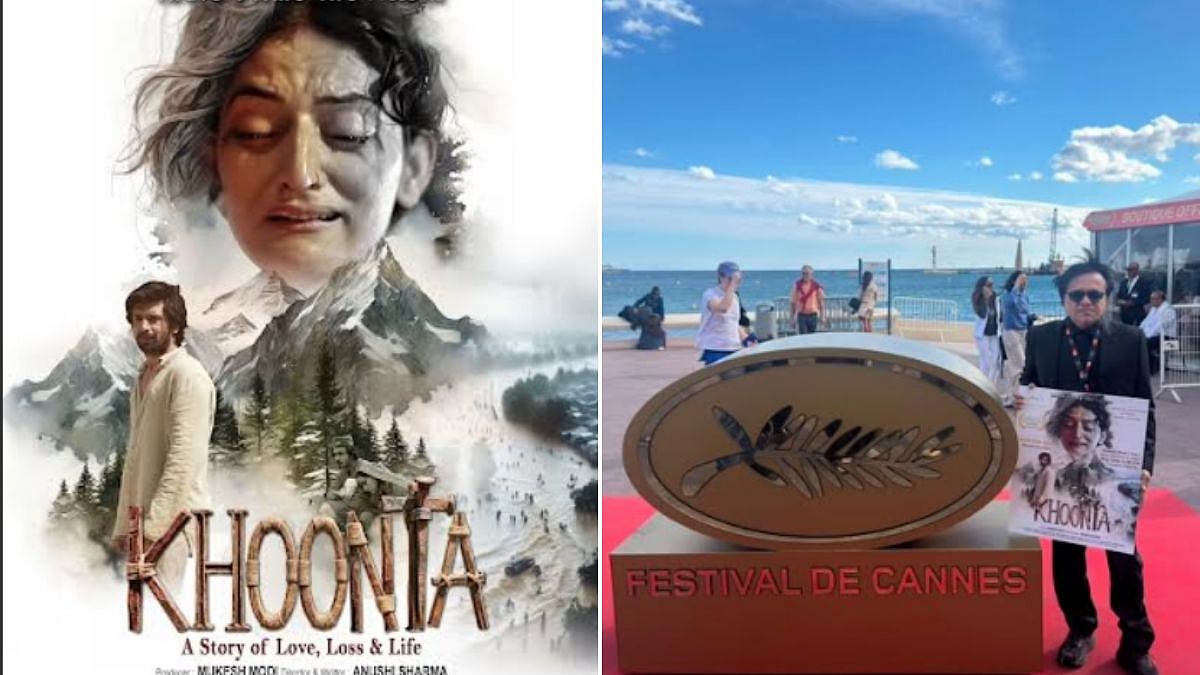
It is an extraordinary success story of 32-year-old Anushi Sharma, a gifted writer and artist from the obscure and backward village of Dravil in Shillai of Himachal Pradesh’s Sirmaur district who carved her path to the prestigious Cannes Film Festival which was neither smooth nor predictable. It was a hazardous, struggle-ridden journey marked by isolation, hardship and relentless determination — a journey that ultimately culminated in her film Khoonta securing an entry for screening into Cannes, the world’s most celebrated international film festival.
Speaking to this writer from Cannes after the screening of film, Mukesh Modi, New York-based Indian-American producer, said, “The response was tremendous and the audience turnout of producers and directors from the USA and France was bigger than for many other films screened here, my decision to venture into an innovative cinematic idea stemmed from a desire to support independent filmmakers who face enormous hurdles in their careers — struggles that I myself experienced. I eventually overcame those barriers in 2015 when my first film was shot in America.”

Director and producer,Mukesh Modi at Cannes |
Deeply influenced by the script and its cultural depth, Modi travelled extensively across Himachal Pradesh before production began in order to understand the region’s traditions, spiritual ethos and way of life. Referring to the film Khoonta — symbolising a binding force — Mukesh said, “The film has been shot entirely against the backdrop of rivers, remote villages and untouched landscapes to showcase to the world how deeply people remain committed to preserving their faith, traditions and cultural identity despite the growing lure of modernism.” The rural folk have got 100 % commitment to preserve their faith (Astha)and culture (Riti Riwaj) despite a list for modernism in present world, he added.
Regarding the project, he felt that he has particularly highlighted the extraordinary devotion local communities hold toward ‘Mahasu Maharaj’(local deity) and the deeply spiritual character of mountain life — elements rarely explored seriously in Indian cinema.
According to people associated with the project, Modi strongly believed the film should remain culturally honest rather than commercially diluted for wider markets. That decision may ultimately become one of the film’s greatest strengths.
From a Remote Himalayan Village to the Red Carpet of Cannes:
“Khoonta”, as a title and metaphor, reflects the invisible tether of tradition, roots and cultural identity that keeps individuals and communities emotionally bound to their homeland and heritage.
When Khoonta was premiered at the Cannes Film Festival Market on May 16, 2026, it marked far more than an international screening for an independent film. Overwhelmed by the moment, Anushi said her “dream had finally come true,” as the young filmmaker struggled to contain the emotions of a journey that had carried her from a remote Himalayan village to the global spotlight of Cannes. With deep gratitude, she credited Mukesh for backing the project, remarking that Khoonta might never have reached this stage without his patronage and faith in her vision.
Coming from a humble family background, Anushi dared to enter the unforgiving ocean of opportunities called Mumbai without influence, connections or a godfather in the industry. For five relentless years, she battled uncertainty, rejection and survival in silence, but her determination refused to break — a perseverance that eventually transformed struggle into success and brought the first light of recognition to her cinematic dream.
When the Mountains Found Their Own Cinematic Voice:
For Himachal Pradesh, this moment could mark the beginning of an entirely new cinematic identity — one in which the mountains are no longer merely a backdrop, but the very soul of the story itself.
At the centre of this remarkable journey stands Anushi Sharma, a young filmmaker and actor from the remote Shillai region of Sirmaur district. Her path to Cannes bears little resemblance to the familiar Bollywood narrative of privilege, studios and powerful industry networks. It began quietly in theatre groups in Solan before moving through the crowded and uncertain struggle of Mumbai’s television industry. Yet even amid the glare of commercial entertainment, the mountains kept calling her back.
For generations, the mountains of Himachal Pradesh appeared in Indian cinema only as picturesque scenery — snow-covered peaks for romantic songs, winding roads for dream sequences and pine forests for fleeting visuals. The camera admired the landscape, but rarely paused long enough to understand the people living within it. Their language, faith, folklore, loneliness and emotional world remained largely invisible.
That silence has finally been broken.
A Story Rooted in the Soil of the Himalayas:
That emotional pull eventually became Khoonta — a film deeply rooted in the spiritual and cultural landscape of rural Himachal. The title itself symbolises attachment, belonging and the invisible bond between people and their ancestral world.
Set against the backdrop of a Himalayan village devoted to Mahasu Maharaj, the story explores the quiet conflict between modern transformation and disappearing traditions. Instead of dramatic political speeches or loud cinematic spectacle, the film reportedly captures change through ordinary lives, fading customs and emotional silences.
What makes the project especially unusual is its refusal to imitate mainstream cinema. The makers chose authenticity over glamour at almost every level. Local dialects were preserved. Costumes emerged from actual village homes rather than studio wardrobes. Traditional rituals were recreated with careful cultural accuracy. Even the actors largely came from Himachal or from Himachali families living outside the state so that the emotional texture of the region remained genuine.
In many ways, Khoonta appears less interested in performing Himachal for the camera and more interested in allowing Himachal to speak for itself.
Cannes and a Dream Once Considered Impossible:
For decades, Himachal’s own film industry remained almost invisible despite the state’s extraordinary artistic traditions. Talented actors, writers and theatre performers often had little option except to migrate toward Mumbai or Chandigarh in search of opportunities.
That is why the Cannes screening carries symbolism far beyond cinema.
For young artists from remote mountain districts, it sends a powerful message that stories emerging from small villages can also travel to global platforms without losing their cultural roots. In an industry where regional authenticity is often sacrificed for commercial formulas, Khoonta is attempting the opposite — building a cinematic language directly from local memory, faith and identity.
Veteran actor Jawahar Kaul, who is also part of the film, has described the moment as potentially transformative for Himachali filmmaking. Many within the state’s artistic community believe the project could encourage a new generation of writers and directors to tell stories grounded in Himalayan realities rather than imitate metropolitan narratives.
When a Village Becomes the Hero:
Perhaps the most striking aspect of Khoonta is that the film does not revolve around conventional stardom. The real protagonist appears to be the mountain world itself — its rivers, rituals, silences and spiritual rhythms.
The production reportedly unfolded across remote villages in Sirmaur and Solan, where local communities became active participants in the filmmaking process. Villagers opened their homes, shared traditional objects, helped recreate rituals and, in many cases, became emotional stakeholders in the project.
This organic relationship between cinema and community has given the film an intimacy rarely visible in commercial productions.
The makers also avoided excessive visual stylisation. Instead of presenting Himachal as a tourist fantasy, the cinematography reportedly focuses on its emotional realism — weathered homes, temple traditions, mountain isolation and the fragile beauty of everyday life.
More Than Cinema:
What makes Khoonta emotionally compelling is that its journey mirrors the story it is trying to tell. Just as the film speaks about preserving identity in an age of rapid change, its own creation represents an act of cultural preservation.
At a time when regional cultures across India are increasingly being flattened into uniform entertainment formulas, Khoonta attempts to protect something fragile — memory, language and belonging.
Whether the film eventually achieves commercial success may matter less than what it has already accomplished symbolically. A girl from the remote hills of Shillai has carried the emotional landscape of Himachal to Cannes without surrendering its authenticity.
For Himachal Pradesh, that alone may mark the beginning of a historic cinematic chapter.
(Writer is strategic affairs columnist and senior political analyst based in Shimla)

