If governance were an Olympic sport, renaming would surely be India’s strongest event. It requires no feasibility study, no environmental clearance, no parliamentary debate of consequence—just a fresh coat of paint on signboards and a press release thick with cultural pride. For governments pressed for quick achievements, it is the administrative equivalent of instant coffee.
In recent years, the renaming drive has gathered impressive momentum. BJP governments at the Centre and in states have energetically rechristened towns, roads, railway stations, and institutions.
The underlying impulse is not hard to decode: anything redolent of the mediaeval period—read Muslim—must make way for names deemed more authentically Indian. History, after all, is far easier to repaint than to rewrite.
When former President APJ Abdul Kalam passed away, Aurangzeb Road in Delhi was promptly renamed in his honour. The Mughal emperor and the “People’s President” shared little beyond their religion, but symbolism rarely waits for logic.


Rajpath, the grand boulevard of imperial pomp, had already shed its colonial aura after Independence; under Prime Minister Narendra Modi, it became Kartavya Path—the Path of Duty—suggesting that a change of signage might inspire civic virtue. .
Raj Bhavans, too, have been reborn as Lok Bhavans, though the metamorphosis has done little to reduce the considerable expense of maintaining these stately reminders of the Raj. Renaming, it seems, is more about optics than outcomes.
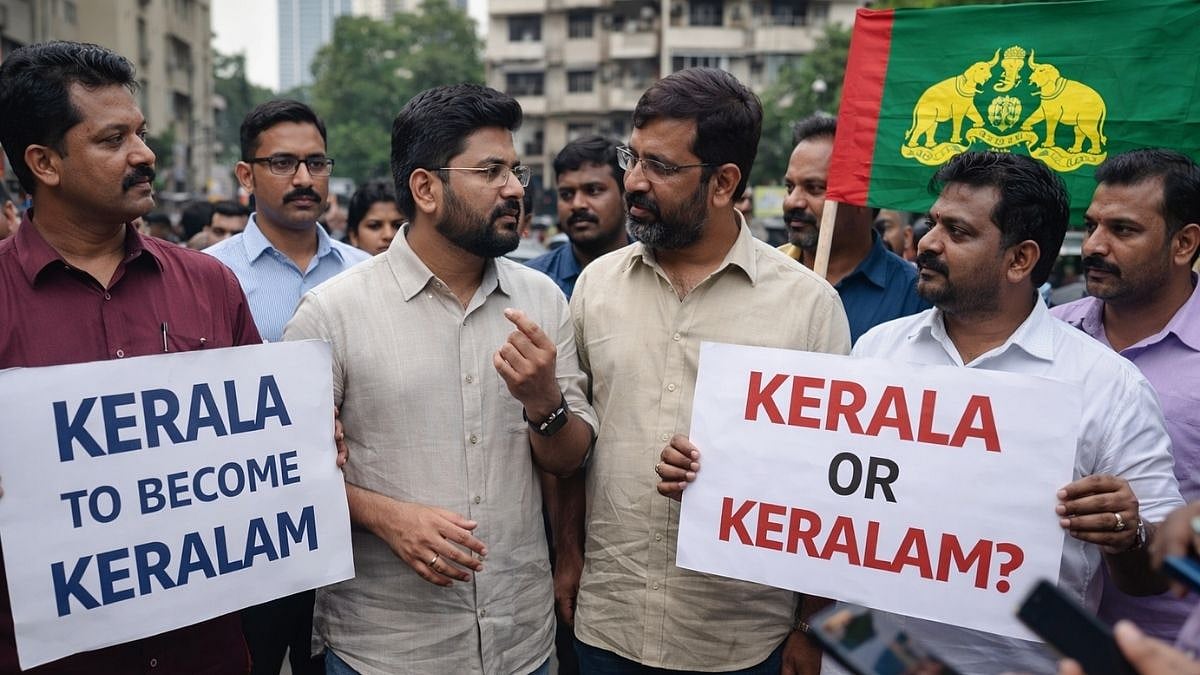
Kerala to Keralam debate
Not to be outdone, non-BJP states have joined the great nomenclature yagna. The Left Democratic Front government in Kerala has proposed renaming the state as Keralam. The Union government has been only too happy to oblige; once Parliament passes a resolution, Kerala will officially become Keralam.
Unlike the Bombay State becoming Maharashtra and Gujarat (divided along linguistic lines) or Mysore becoming Karnataka—changes that aligned state names with linguistic identities—the Kerala-to-Keralam shift is largely phonetic.
Keralam is how Malayalam speakers refer to their state. Yet language, that stubborn repository of habit, may have the last laugh. “Kerala” slips easily into adjectival duty: Kerala State, Kerala House, Kerala cuisine. “Keralam,” however, resists such flexibility.
“Keralamites” sounds like a new species of mineral. In Malayalam, “Keralathinte Peru” (Kerala’s name) renders the final “m” silent, quietly defeating the purpose of the change. One might argue that Portugal’s people are called Portuguese, not “Portugalese”, but linguistic quirks evolve organically; they rarely obey government orders.
Shakespeare famously asked, “What’s in a name?”—assuring us that a rose would smell just as sweet by any other name. He did not, of course, know Malayalam, a language playful enough to be read the same way in either direction.
Nor did he foresee that, centuries later, political rivals would find common ground in the art of renaming. For now, the LDF and the BJP appear united on at least one front: name-calling brings them together.
