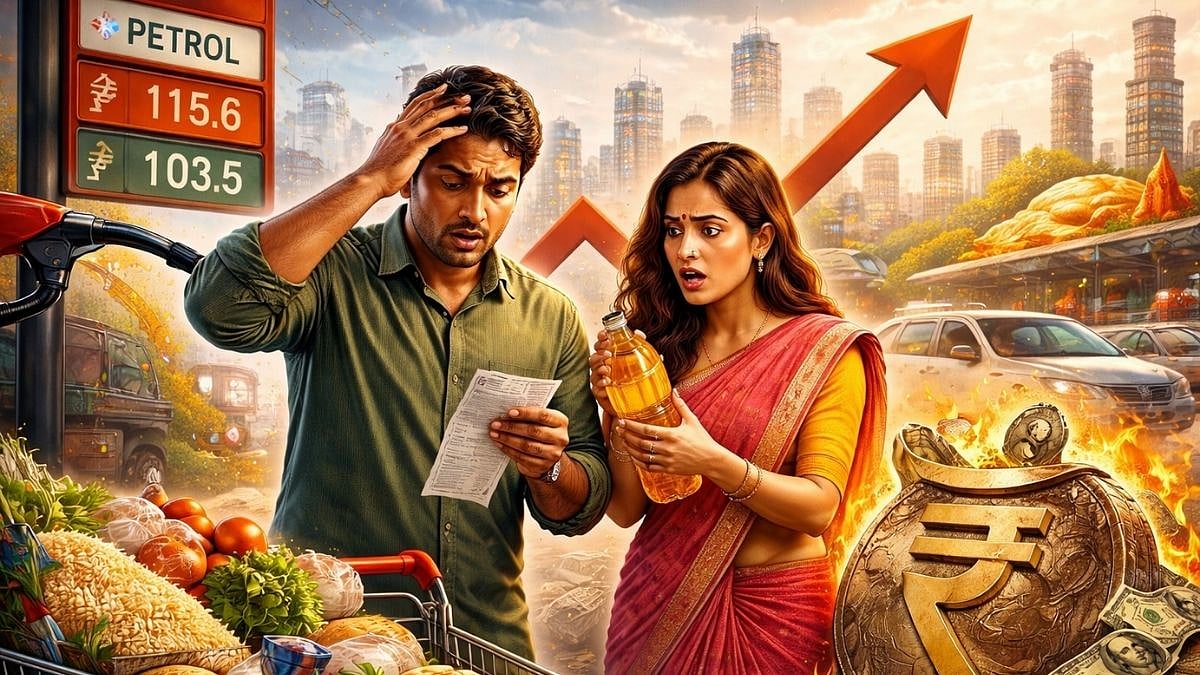
The Reserve Bank of India’s bi-monthly Inflation Expectations Survey of households in March 2026 shows perceived inflation to be 7.2 per cent. This is more than double the official Consumer Price Index-based reading of 3.2 per cent for February. The CPI was revamped recently to be more representative of true inflation.
The RBI survey also shows households expect prices to rise 8.5 per cent over the next three months and 8.8 per cent over the year. This is not a statistical quirk or popular pessimism; it is lived experience. And the gap between official data and ground-level perception of reality has rarely been more politically charged.
Double oil squeeze intensifies pressure
Meanwhile, India is caught in a double oil squeeze. The first is fuel. With crude at $115 per barrel in March, driven by the West Asia conflict, transport and power costs and the prices of virtually all manufactured goods are rising.
The RBI itself acknowledges that its baseline assumption of $85 per barrel for the year could easily be breached if hostilities resume. The ceasefire between the US and Iran, announced earlier this month, is fragile. Peace talks have failed. A resumption of conflict would push oil, and therefore Indian inflation, sharply higher.
The second oil is what Indians use for cooking. India imports nearly 90 per cent of its edible oils—palm from Indonesia and Malaysia, soya from Argentina and Brazil, and sunflower from Russia and Ukraine. The West Asia crisis has rattled global commodities markets and sent vegetable oil prices surging alongside crude.
Retail edible oil prices rose by Rs 1 to 4 per kg in just one week. India’s palm oil imports fell 19 per cent in March to a three-month low, as price-wary refiners held back. This will only tighten domestic availability in the months ahead. Both oils singe the household budget.
Gap between official data and lived reality
The lived experience of inflation in healthcare, medicines, education, transportation, and house rents has all been high for several years, as documented in a new book called “Breakpoint”.
India’s recently revised CPI basket still has a structural blind spot. It captures the rents paid by sitting tenants whose leases escalate by a formulaic 5–10 per cent annually, rather than the market rents faced by new entrants.
Brokers and tenants across Indian cities routinely report double-digit rent increases even as official housing inflation remains subdued. The index is measuring the wrong price. The official thermometer is not reporting the correct temperature.
Wage stagnation and social impact
All of this is happening against the backdrop of stagnant real wages, especially in rural India. When everything costs more and wages do not keep pace, households cut on nutrition, defer medical care, and pull children from private schools.
The violent protests for wage hikes we are witnessing in Haryana’s Manesar and Noida’s industrial clusters are not merely labour disputes; they are inflation’s social manifestations.
In Manesar, factory workers boycotted work, clashed with the police, and drew the government into a dramatic concession. The government announced a 35 per cent hike in minimum wages for unskilled workers. It is barely enough. The protests are a damning verdict on years of inflation outpacing wage growth.
In Noida, workers in the garment and hosiery factories turned to stone-pelting, arson, and vandalism. They, too, are asking for a raise in minimum wages just like in Haryana. India has around 400 million internal migrant workers acutely sensitive to food and fuel costs.
When a meal doubles in price and LPG becomes scarce, many simply return to their villages. “Once labour leaves, it is very difficult to get them back,” is a refrain from the India SME Forum. The threat to India’s manufacturing competitiveness, already under pressure from global supply chain disruptions, is real.
Rupee pressure and RBI response
On the macro front, the rupee fell 10 per cent in the last fiscal year against the dollar. The fall in March was sharp, and the exchange rate crossed 95. The RBI responded with a dramatic crackdown. The RBI has virtually banned domestic bank participation in offshore betting in the rupee-dollar rate.
This is called the non-deliverable forward (NDF) market, which is technically outside the regulatory ambit of the RBI and operates in Singapore, London, or New York. It is an offshore $149 billion-a-day market which offers an opportunity to hedge against a falling rupee. It is also a signal for onshore people to gauge which way the rupee will move.
While the RBI’s sudden crackdown made the rupee bounce up, it is not clear whether this will last if the war in the Middle East continues. As such, for the RBI, the intervention to prop up the rupee has cost India $30.5 billion in precious foreign exchange reserves in March alone.
Structural challenges persist
The RBI has expressed its deep displeasure at banks using the offshore-onshore gap to profit from the rupee’s weakness. But as any careful observer will note, the offshore NDF market is a symptom, not the disease.
The disease is India’s structural current account deficit, widened by high oil import bills. This is combined with portfolio outflows of $26 billion over two years and net FDI that has turned zero or negative. These are real economy vulnerabilities that no amount of derivative-market policing can permanently cure.
Outlook remains uncertain
This week, as the IMF and the World Bank hold their spring meetings, global growth forecasts are being revised downward. The RBI has held the repo rate at 5.25 per cent and projects inflation to average 4.6 per cent in 2026–27.
These are carefully calibrated projections. But they will be hard to defend if oil prices remain elevated, if the West Asia ceasefire breaks down, and if the monsoon disappoints—none of which can be dismissed as unlikely.
Household reality vs official data
The Indian household does not read CPI press releases. It reads the price on the cooking oil tin, the gas cylinder bill, the school fee notice, and the medical invoice.
And it is telling the RBI survey that prices are rising at more than twice the official rate. That is the voice that matters—and it is saying, clearly and urgently, that the singeing is far from over.
Dr Ajit Ranade is a noted Pune-based economist. Syndicate: The Billion Press (email: editor@thebillionpress.org)

