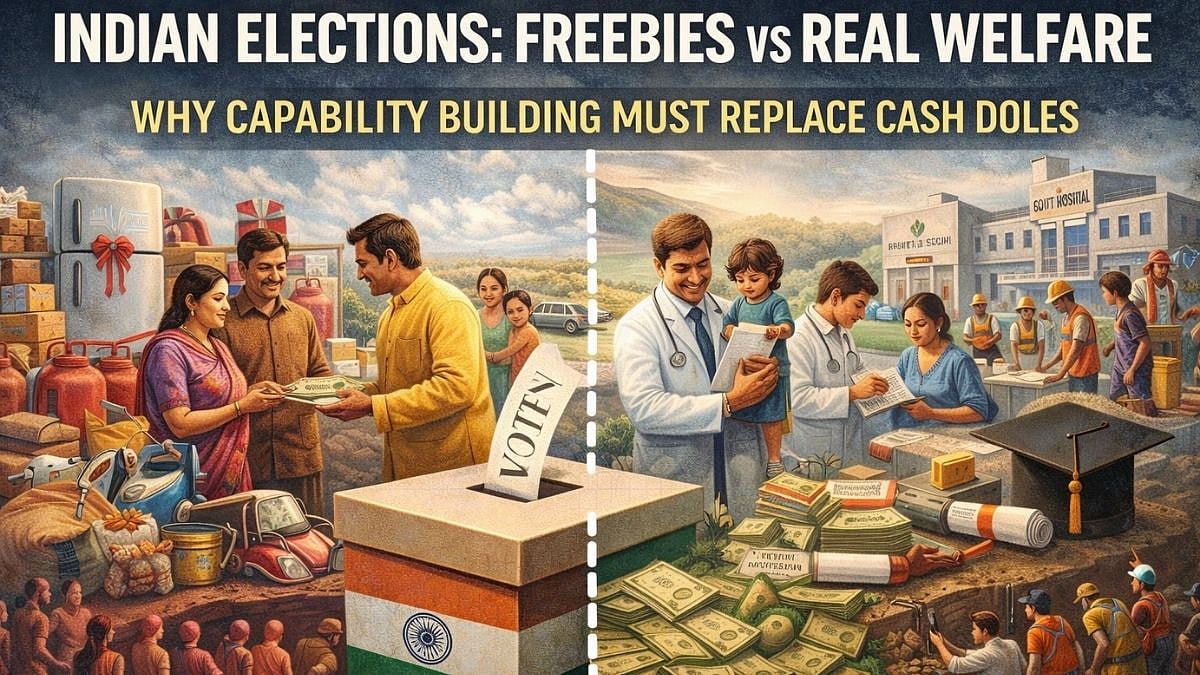
State elections are increasingly supercharged by grand campaign announcements by major political parties of cash grants and shiny private goods, making them stand out from traditional welfare schemes.
Although they were deplored by Prime Minister Narendra Modi as ‘revdi’ in 2022, the BJP too hopped on the bandwagon and came up with competing offers of its own a year later for the Madhya Pradesh and Rajasthan elections. The PM personally presented cheques to beneficiaries under Maharashtra’s Ladki Bahin scheme in 2024.
Tamil Nadu, with its overall good social development indicators, is the crucible of populism, and the keen battle of 2026 has brought forth a fresh round of spectacular promises from the two major contenders this time—the ruling DMK has added to its list a consumer durables scheme worth Rs 8,000 for homemakers who have a ration card, while the AIADMK has dangled a free refrigerator and a Rs 10,000 grant to meet the high cost of living.
Actor Vijay, making his debut, is seeking a mandate for his Tamilaga Vettri Kazhagam (TVK) with an offer of eight grams of gold for poor women getting married and a gold ring for newborns, besides six LPG cylinders in a year.
Debate over effectiveness of freebies
The present debate on populist promises covers a spectrum of arguments, ranging from the liberal view that these are positive redistribution mechanisms to scepticism that this approach does little to genuinely empower and advance the state’s economy. To critics, it is no more than largesse-based cultism at the exchequer’s cost.
Do cash benefits address deeper economic issues?
It would be valid to argue that extraordinary cash offerings to wide sections of the population do represent some level of redistribution, but the question arises whether this is actually a politically rewarding manoeuvre to mollify anger over low real wages, absence of general prosperity, and declining purchasing power.
The gifts timed for elections take attention away from the heavy burden of direct and indirect taxes on the middle classes and poor, contrasted with a liberal tax regime for corporates and those with unearned incomes, such as from stock market speculation.
Refrigerators and scooters are poor substitutes for the high cost of education, healthcare, and housing, which are dominated by for-profit investors facing little regulation.
Call for structural welfare and capability building
The general powerlessness of the voter is reflected in inequality studies which show 1% of Indians owning 40% of national wealth and 10% owning 65%. This should be sobering to those hoping to see development through doles and lead to calls for higher wealth taxation and social sector investments in public education, social housing, skill-building, and tax-funded healthcare.
These remain unaffordable to many in spite of citizens working hard to produce a high GDP growth over three decades. True welfare should have a universal floor, such as free bus rides for all, be rights-based, and raise capabilities.

