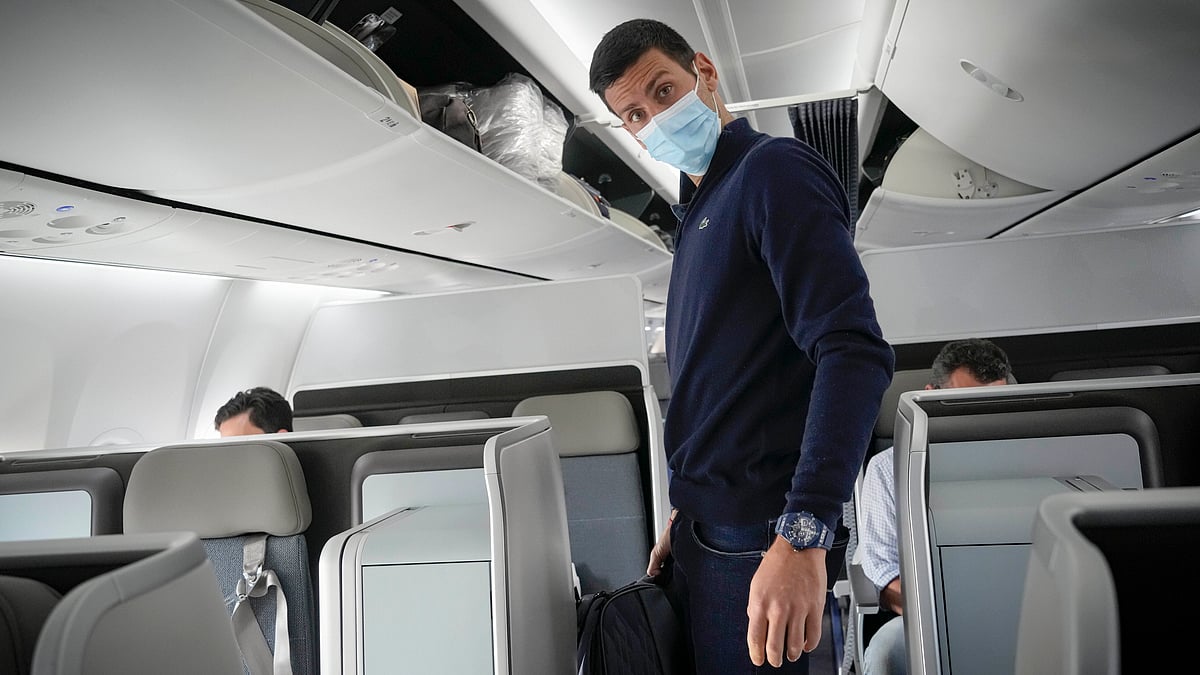
The high-profile deportation of Novak Djokovic from Australia, after the Australian immigration minister Alex Hawke exercised special powers to cancel the visa granted to the world No.1 tennis player “on health and good order grounds” and on the basis that it was “in the public interest”, has once again rekindled the debate over the trade-off between ‘public interest’ and ‘personal choice’. In fact, our own Supreme Court is seized of a similar question, while hearing arguments on a plea filed by an NGO, Evara Foundation, which had sought directions from the apex court to the government to provide door-to-door and priority Covid-19 vaccination for persons with disabilities, as well as an exemption for such persons from producing vaccination certificates. While the question of the law underlying the two cases may be similar, the circumstances could not be more different. Djokovic is a known vaccine sceptic and has never made his vaccination stance public. Although Australian rules require a Covid vaccination certificate, Djokovic had travelled to Melbourne banking on a medical exemption granted by Tennis Australia’s chief medical officer and an independent Victorian government board, to allow him to take a shot at his 10th Australian Open title and a record 21st Grand Slam singles title, cementing his place in history as the greatest male tennis player of the modern era. That now looks unlikely, given that deportation on visa cancellation also debars him from returning to Australia for three years.
The Djokovic affair has sharply divided fans and critics of the Serbianace, as well as pro and anti-vaccine lobbies. The Serbian president has accused the Australian government of playing politics, while critics of the Morrison government have charged, with some justification, that the government was using Djokovic’s celebrity status to detract from its mismanagement of the Covid pandemic in Australia. Most parts of Australia are currently in the grip of an Omicron wave, which means any additional danger posed by an unvaccinated Djokovic would have been negligible.
However, the issue in India is quite different. The Centre, in an affidavit filed before the Supreme Court, has said, “It is humbly submitted that the direction and guidelines released by Government of India and Ministry of Health and Family Welfare, do not envisage any forcible vaccination without obtaining consent of the concerned individual.” The Centre also submitted that it had “not issued any SOPs which make carrying of vaccination certificate mandatory for any purpose”, although the affidavit emphasised that vaccination was in “the larger public interest”.
While the Centre is technically correct, it must be noted that various state and civic administrations have issued orders from time to time during the pandemic, which more or less amount to mandating a vaccination requirement. For instance, one cannot buy a ticket or travel in Mumbai’s suburban trains without proof of vaccination. A vaccination certificate has been made mandatory for being allowed entry into many states or regions or cities particularly badly affected by rising cases. A number of civic administrations have made it mandatory for vaccinations in order for employees to be paid their salaries, while those operating shops/restaurants or delivery services have also required their employees to be mandatorily vaccinated. Such orders may be seen as violative of the fundamental right to privacy and freedom of choice to pursue livelihood guaranteed in the Constitution.
However, the state routinely exercises its over arching powers to impose other kind of restrictions in the public interest. For instance, prohibitory orders, or even preventive detentions during times of civic unrest or strife are justified in the name of maintaining law and order. A similar justification was used while invoking the powers under the Disaster Management Act and the Epidemic Diseases Act to impose lockdowns, quarantines and curfews to tackle the Covid pandemic, which deprived millions of their work and livelihoods. While undoubtedly harsh, most people accepted these restrictions because there was widespread acceptance of the need for such steps in the larger public interest. The same principles apply in the Djokovic case. While personal freedoms and fundamental rights are undoubtedly of the highest importance and need to be preserved, there are exceptions to this. Reckless behaviour which endangers others cannot be allowed under the guise of personal choice. Noone will question the police detaining someone driving recklessly on the roads for instance, posing risk to the life and limb of others. Refusal to vaccinate oneself, or wear a mask, or move about in public while knowing oneself to be infected, poses similar danger to others.
That said, both the Djokovic case and the ongoing plea in the Supreme Court have exposed the absence of an equitable and rights-based public health law in India. This would have ensured that while empowering the government with the broad and sweeping powers necessary to tackle a public health emergency, structured responses, transparency of due process and accountability for excesses are also built in. Power must, in all such cases, be accompanied by responsibility and accountability.

