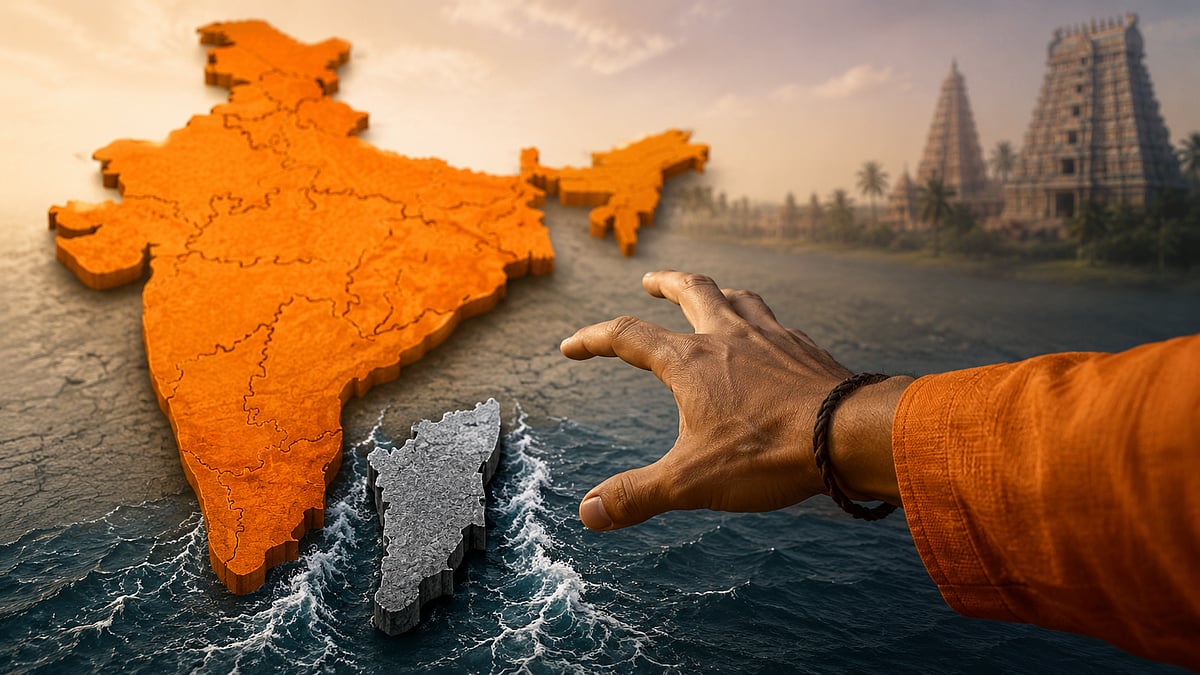
The BJP and its earlier avatar, the Jan Sangh, have been repeatedly stymied from registering a significant presence in Tamil Nadu. Its Hindutva politics and espousal sit ill with the Dravidian ideals, enunciated by Periyar and other ideologues, across the state. The late Meghnad Desai, the Indian-origin Labour Party member of the House of Lords in the UK, long ago said gloomily that long before Jammu and Kashmir seceded from India, Tamil Nadu had already. Therefore, the mention of the BJP is a red rag for Dravidian parties, who camouflage their hatred for the BJP with rants against Hindi imposition and Sanatana Dharma as a perpetuation of Brahminical hegemony. In other words, Hinduism is distinct from Dravidian culture. Such a hiatus is conspicuous by its absence in other parts of the nation despite Hinduism being non-monolithic. Hindi and Sanathan are projected cleverly by the Dravidian parties as the overweening facets of Brahminism.
In fact, the Indian National Congress (INC) attempted to make Hindi compulsory in Tamil Nadu (then Madras Presidency/State) multiple times, primarily in 1937–1940 and 1965, leading to significant anti-Hindi protests. These moves were seen by locals as a threat to Tamil identity and cultural autonomy, triggering intense political resistance. Through 1937-40, the first Congress government in the Madras Presidency, led by C. Rajagopalachari (Rajaji), introduced mandatory Hindi teaching in schools. This prompted massive protests led by EV Ramasamy (Periyar). Post-independence, through 1948-50, the Congress government under OP Ramasamy Reddiar again tried to make Hindi compulsory in schools. In 1965, the Congress government in Madras, headed by M. Bhaktavatsalam, faced massive student protests against the central government's efforts to make Hindi the sole official language of India. The protests led to violent crackdowns and around 70 deaths.
These repeated attempts to impose Hindi are widely credited for the downfall of the Congress party in Tamil Nadu, paving the way for the rise of Dravidian parties like the DMK. The point isn’t whether Congress was wrong; the point is the BJP, to date, is reaping a bitter harvest of revulsion for the seeds sown by the Congress, which itself has recovered somewhat by cosying up to the DMK. Somehow, Dravidians are venting their angst and anger at the imposition of Hindi on the BJP, which is only trying to make Hindi the second language in the state after Tamil.
In the face of such a groundswell against Hindi and Hindutva, the BJP has been floundering in Tamil Nadu. It has the mortification of having to play second fiddle to DMK’s arch-rival, the AIADMK, which condescends to throw crumbs at best when it comes to the power sweepstakes. In no other state does the BJP face such a stubborn wall of resistance. Annamalai, the firebrand ex-IPS officer, girded himself to win over people’s support for the BJP, but the party seems to have botched it up and shot itself in the foot by keeping him on the sidelines only to please the AIADMK. The recent Assembly results are proof, if one were needed, of the downhill course of the fortunes of the BJP in the state of Tamil Nadu—just one seat from the four it had after the 2021 elections.
Out on a limb, the BJP has reportedly toyed with the idea of the trifurcation of Tamil Nadu, with the carving out of Kongu Nadu in the western part being central to its calculations. For strange reasons, the BJP has been coy about it, as evident from the August 2021 declaration by Union Minister of State for Home Affairs Nityanand Rai in the Lok Sabha that there was no plan to bifurcate Tamil Nadu. Apparently, the BJP is willing to hit but unwilling to hurt its alliance partners. If trifurcated, it will not be a first-time exercise. Jharkhand was carved out from Bihar when Vajpayee was the prime minister. So was Uttarakhand from UP and Chhattisgarh from Madhya Pradesh. Smaller states and their adjunct bifurcation or trifurcation have been an article of faith with the BJP, a la its three favourite espousals—abolition of article 370, construction of Ram Mandir, and Uniform Civil Code. There are more such unstated articles of faith, with smaller states being one of them for administrative convenience and efficiency. If the push comes to shove, the BJP government at the centre might trifurcate the state so as to put at least two large parts of Tamil Nadu beyond the Dravidian pale and push its nationalistic agenda. The regional parties in Tamil Nadu and the Congress would have no option in such an event but to grin and bear it.
The other possible move, albeit tangential, could be One Nation One Poll (ONOP) in the faint but dizzying hope that a Tamil Nadu elector voting on two EVMs, one for the Lok Sabha and the other for the state assembly, at the same time might yield to the psychological temptation of voting for the same party on both EVMs. But that is a long shot, and perhaps a little far-fetched. The only sure-footed response could be to ask its grassroots workers to fan out to the hinterlands and disabuse the notion that the BJP was anti-Tamil. For that, it would have to rope in the RSS and opinion makers on the mainstream and social media. The young voters without ideological baggage and prejudices, whom Vijay wooed, can be counted upon to veer towards the BJP.
It has the resoluteness to break the jinx, as it showed in West Bengal in the just concluded assembly elections. The same doggedness is showing results in Kerala too. Agreed, Tamil Nadu is a different kettle of fish, but it must make a start and walk alone.
S Murlidharan is a freelance columnist and writes on economics, business, legal and taxation issues.

