French-Algerian philosopher Albert Camus, who spent his youth as a goalkeeper, famously said that “all that I know most surely about morality and obligations I owe to football”. In October 1957, when his Nobel Prize for Literature was announced, French television interviewed him at a football match. Along with the theatre, he said, the football pitch was one of his two “real universities”.
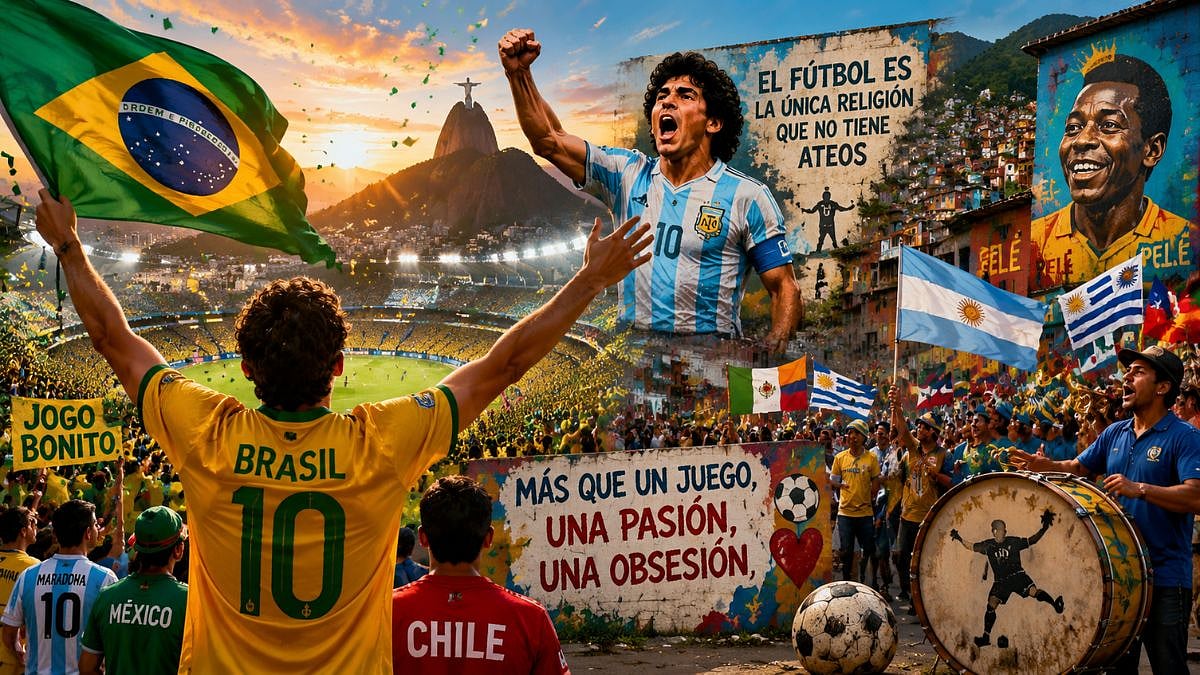
To the wider world, football may be a game; to Latin America, it “is the only religion”, says Uruguayan writer Eduardo Galeano, “that doesn’t contain atheists”.
Football, like baseball, boxing, cricket and basketball, was brought by the colonisers to the New World. Today, it is the heartbeat of Latin America. It also represents hope and pride.
In Brazil, football arrived at the end of the 19th century as a symbol of a persecuted modernity. It was a hobby for a few Jesuit priests, who imported “street football” to their schools as moral and physical development tools for the youth. In Argentina and Uruguay, the game was brought by British immigrants and expatriates.
Football And Identity
But Latin America transformed the game in its own image. Football is not only played; it is lived. It unites nations but also stirs passion. In 1969, Honduras and El Salvador even fought a 100-hour Football War.
Today, football has become both a carnival and a catharsis. When life hurts, football heals. It is also an escape and a path to glory. If football is “jogo bonito” (beautiful game) in Brazil, in Argentina it is synonymous with technical precision and tactical intelligence.
Soccer has helped Brazil to create a sense of “Brazilness”. In Argentina, during the “futbol mundial” or “Copa Americana”, organised religion and football vie for supremacy. During the crucial moments of the game, while the religious invoke their god, football fanatics plead with their heroes for deliverance.
Latin Americans have made football what Eduardo Galeano calls “a caress in a game of seduction”. Galeano writes in his book, Su Majestad, el futbol (His Majesty, the Football), that “like all Uruguayans, I was born shouting goal.”
Literature And Resistance
Football is not just a game; it is also a canvas on which writers paint their masterpieces. There is a significant corpus of literary works in Latin America that includes football as a means of explaining key issues of the social and political conditions in the region. Latin American writers have used both literature and football to challenge dominant narratives about the region.
Brazil’s carnival is incomplete without football-themed floats and costumes. But in the 1970s and 1980s, football in Brazil was a way to protest against military dictatorship. Brazil’s Corinthians football team became a symbol of resistance during military rule.
Football is both a passion and an obsession in Mexico. Mexico doesn’t just play soccer; it celebrates it. In 1970, Mexico was the first developing country to host the FIFA World Cup, only two years after hosting the Olympics. It was in Mexico that the world saw Pele’s brilliance as Brazil lifted the trophy.
In 1986, when Colombia was unable to host the FIFA World Cup, Mexico became the host. It was there that Maradona’s “Hand of God” and “Goal of the Century” captivated fans. Mexico is the only country to host or co-host the tournament three times.
Mexico’s iconic “Estadio Azteca” is not just a stadium; it is Mexico’s mythical temple. It is the only stadium to have staged two World Cup finals. As Pele famously said, “There is just something very special about the Azteca. You need to be inside it to feel it and understand it.”
Football Beyond Sport
Soccer fiction itself has become a genre. ‘Cronica’ is a literary genre in Latin America that combines journalistic reporting with a literary flourish. One can find a major mode of football writing across Latin America—Mario Vargas Llosa, Eduardo Galeano, Osvaldo Soriano and Juan Villoro, to name a few.
Some believe football became a means to overcome the perceived inferiority of the “raza latina” vis-à-vis the Anglo-Saxons. Faith in football had the intended objective of taking forward the drive for potential moral and physical progress and its practice as the embodiment of Western modernity.
The relationship between a footballer and a fanatic, a hero and a worshipper is encapsulated in the writings of Gabriel Garcia Marquez. This is one sport in Latin America “where the players are transformed, as if by magic, from athlete to idol”. This metaphysical transformation is football’s greatest appeal to Marquez.
For Latin America, football is about so many complex, contradictory and conflicting things: memory, history, place, social class and gender, in all their troubled variations. As Marquez writes, football aficionados in the stands, “carrying their flags and banners, wearing their hats and scarves, are not themselves.” They are “at once themselves and, at the same time, someone else, some other version of themselves”.
As Andreas Campomar writes in his book, Golazo!, football, which began as an eccentric pastime of a few expatriate cricket players, “has become a defining force, the architect of national identity, and a reflection of the region’s soul.” It represents “a chronicle of sport, politics and culture”, intersecting with and influencing each other in the region.
Global Legacy Of Football
Today, a large number of African and non-European players play for European teams. Isabelino Gradin was one of the very first Black footballing stars who played for Uruguay and won the inaugural Copa Americana in 1916. Gradin was the top scorer of the tournament. Two of his goals came in a 4-0 victory over Chile, which led to protests from the Chilean camp that Uruguay was fielding African players. Uruguay was then a football superpower. It won the gold medal in football at the Olympics in 1924 and 1928.
All said, today football may not be at the centre of Latin America’s identity, but it still enhances social cohesion. It continues to be an important cultural symbol and a powerful medium for constructing national narratives. Latin American footballers continue to acquire iconic status in global political culture.
The author comments on global affairs.

