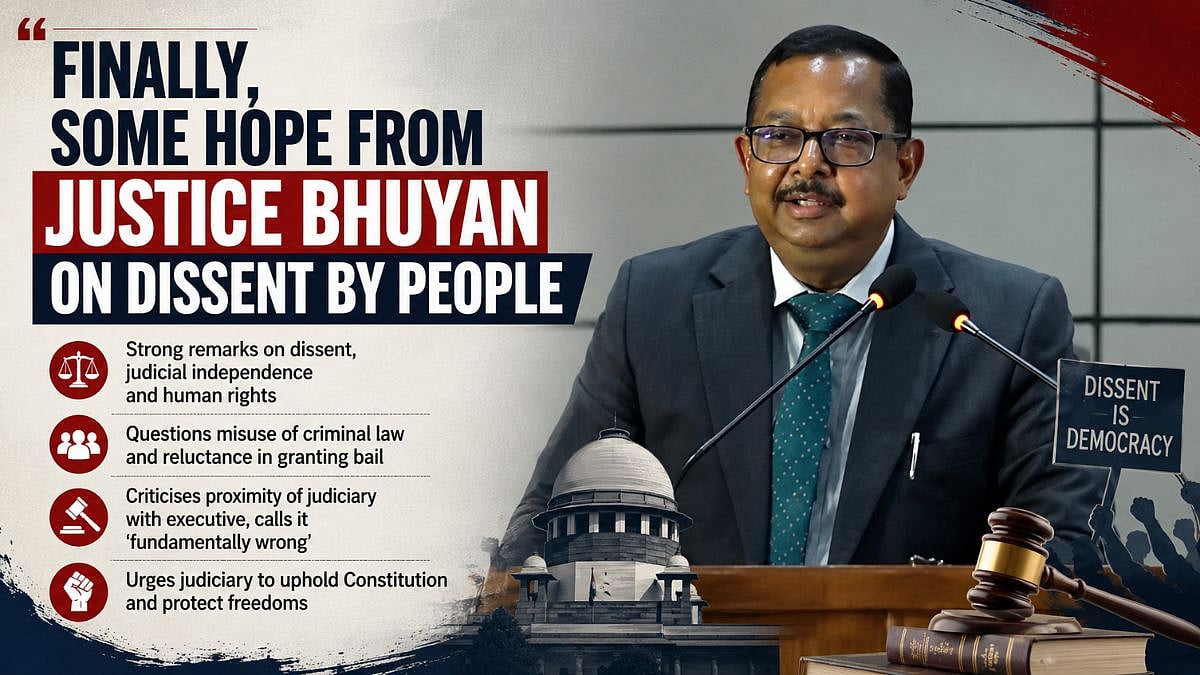
Over the past few months, Supreme Court Justice Ujjal Bhuyan has been speaking boldly on the lecture circuit about things we always wanted to hear from those in power: the smothering of dissent, wildly erratic judgments, and the unwillingness to grant bail.
He is obviously disturbed by the national perception that the judiciary has been largely, and willingly, influenced by those in power and has consistently delivered judgments that go against the basic precepts of law and human rights. Bhuyan's recent speeches are a spark of hope.
A few months back, he took a dig at a former Chief Justice who was made a member of the Rajya Sabha. The ex-judge justified it, saying it would help bridge the gap between the executive and the judiciary.
This goes against the basic tenets of jurisprudence, as the judiciary must always keep a distance from the executive instead of playing footsie with those in power. "It is fundamentally wrong," Bhuyan said.
Concerns Over Criminal Law
Last month, Bhuyan also termed as "untenable" the arrest of a few Muslims who were eating biryani while boating on the River Ganga in Varanasi. "I am sure consuming chicken biryani is not an offence," he remarked, adding that no law bans eating chicken on the river. He said such cases raise important questions about the use of criminal law.
Various aspects of criminal law have been rampantly misused by various courts, especially in the granting of bail, even though there are various judgments stating that bail is a right and not a judicial favour.
Though bail is granted very reluctantly in some cases, the courts curtail many rights of the person, as Bhuyan pointed out, preventing the accused from travelling outside his own state, speaking in public and, in many cases, seizing his passport, which is per se illegal.
Also, many judges can be seen sending messages to the executive by making oral orders and statements that are politically slanted towards the government. This tendency has to be curbed.
Call For Judicial Reform
The series of embarrassing judgments over the past decade has forced many senior advocates to say that the judiciary has lost its spine and its moral fibre is in decay. Most dangerous is the perception that the judiciary has become an arm of the executive, which is what Bhuyan has been trying to point out through his speeches.
It is encouraging that a Supreme Court judge is trying to course-correct the judiciary. Many such speeches have been made by former judges who were sarcastically called "IIC liberals".
But the lecture circuit is quite distant from the Bench. It is from there that jurisprudence has to be taken to a higher level. The judiciary needs a lot of healing and spine-straightening if the underprivileged and those on the fringes of society are to drink from the fount of freedom and dignity.

