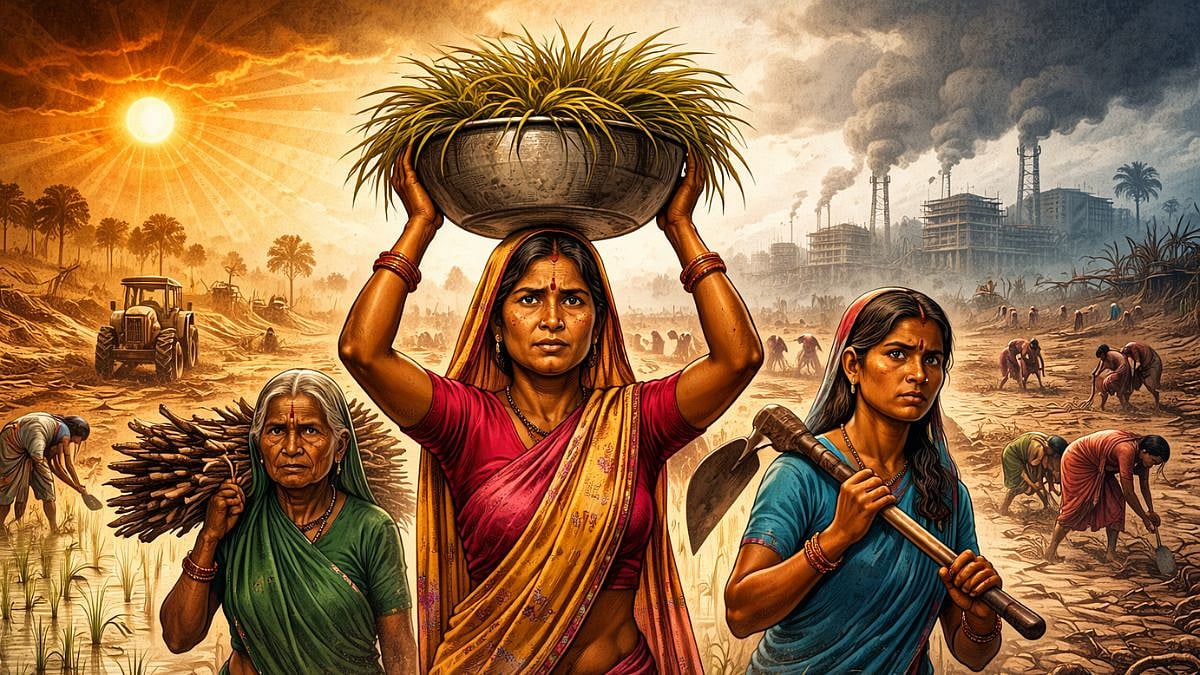
Indian agriculture has been feminised. The Periodic Labour Force Survey of 2024 confirmed that women now constitute over 42% of India’s agricultural workforce. Statistics confirm that the women’s work participation has risen from 24.8% in 2017 to 42% in 2023. Increasing male migration and shrinking farm returns have seen women step in to manage farms, livestock and farm households.
Women farmers facing mounting challenges
Sadly, these women farm workers are working against great odds. They receive little governmental support, forced as they are to bear the brunt of extreme weather events, including heat waves, floods and droughts that are leaving large tracts of agricultural land degraded and unusable.
Impact of land diversion and development projects
The last decade has seen these women face another more insidious threat: huge tracts of forest and agricultural land have been diverted for non-forestry, mining, hydropower and road construction. The Parliament was informed in 2025 that over 1.73 lakh hectares of forest land had been diverted between 2014 and 2024 for mining, roads and other infrastructure projects. Four million hectares of prime agricultural land have also been lost for such projects.
Such large-scale diversion of land has impacted agricultural productivity, though few statistics are available on just how much the productivity levels have dipped. What is known is that the diversion of fertile land has forced women to farm on less productive, marginal or barren land, thereby reducing yields and income. Women agricultural workers complain that this trend, along with land fragmentation, is making it difficult for them to hold on to their agricultural jobs even when it means earning little more than a daily wage.
Invisible workforce without land ownership
The problem is compounded by the fact that in the majority of cases, women’s labour is either unrecorded or unaccounted for, so despite their large numbers, they remain an invisible workforce. The majority of the women are not recognised as ‘farmers’ because they lack ownership of the land they till. They are not entitled to any form of compensation or rehabilitation when the land is acquired for development projects.
Adivasi women and loss of forest livelihoods
For millions of Adivasi women, destruction or loss of access to forest resources has meant a loss of livelihood and culture. Adivasi women are primary collectors of mahua, honey and medicinal herbs, which were sold in the local markets. Massive land acquisition has led to displacement of communities who are forced to migrate, leaving women more vulnerable to violence and exploitation.
Displacement in the Mahan forests
A trip to the Mahan forests located in the Sonabhadra-Singrauli belt by this reporter brings home the stark reality of the price people are paying for displacement. This region has 11 coal mines and nine thermal power plants producing ten per cent of coal-based thermal energy in the country, but this has come at the cost of over 13 lakh people, largely villagers and tribals, being displaced. Worse, increasing effluents in their springs and rivers have led to an increase in mercury poisoning, resulting in deformities amongst their children.
The last major forest in this region to have received clearance has been the Mahan Forest. Over 54 villages within the 10 km radius of the coal block have already been directly impacted by the mining. Nearly 100,000 people are expected to be impacted overall, of which around 20,000 are from Scheduled Tribe communities like Baiga, Gond, Khairwar and Panika.
“The forest is our mother without which we cannot survive. Our livelihoods, our water and our air are all linked to this forest,” said Sheetal Bai, a tribal woman living in the Mahan forest. The tribals have struggled for over a decade to prevent coal mining in these forests but to little avail. Although mining has not yet commenced, newly allotted coal blocks in the immediate vicinity are moving towards production.
Lives uprooted by mining and displacement
The treeless landscape of Singrauli-Sonabhadra appears almost surrealistic as overburdens (hills of debris) loom on the horizon, throwing up huge gales of dust throughout the year. Sheetal Vaiga, who was evicted from her home in the forest of Jharia some time ago and was given a tin shack at the Amlori Visthapan Colony in Amlori to live in, is still shell-shocked at being denied access to forest land. Lamenting her eviction, Vaiga says, "I am a refugee who is no longer allowed access to our forests. Life has no meaning for my husband or me anymore."
Another example of forcible dispossession is the elderly Shanti Bai, who belonged to the Korku tribe and was evicted along with her family from agricultural land measuring 50 acres owned by her father. The land had been acquired to set up the Central Proof Range in Itarsi in 1972. She fought a legal battle against the state for several years to receive at least five acres of land as compensation.
Activist Smita of Kesla village in Madhya Pradesh pointed out, “Villagers from 49 villages have been displaced. Originally, the government used to give a negligible amount as cash compensation and a little land, but today, with this range being extended once again, the displaced receive no land and have to settle for money.”
After Shanti Bai lost her land, she began doing odd jobs and told Smita, “Earlier I drank milk every day, and my family and I could eat ghee and curd with our meals. After we were evicted, I never tasted milk again.”
Climate pressures pushing women out of farming
Take the case of Rajni Rawat, the sole breadwinner of her family with a paralysed husband and two minor sons from the village of Chamoli in Uttarakhand. “I worked as an agricultural worker on a neighbour’s field for almost eight years. Erratic monsoons and the drying up of our local springs have made short shrift of our crops. I now work as a daily labourer on the Char Dham road. I receive a better salary, but increasing landslides in these regions can prove life-threatening,” says Rajni.
Leelavati from Sikar in Rajasthan has also recently lost her job as an agricultural labourer. With wells drying up and monsoons failing, Leelavati takes up whatever odd jobs come her way, including at construction sites.
She hopes that one day the situation will improve and she will be able to return to farming. “I can’t imagine spending an entire life working at construction sites. I have to go back to the land, to farming. Working on the fields and seeing the crop ripen before my eyes fill me with a sense of hope and satisfaction,” says Leelavati.
Rising farm distress and impact on women
In areas like Maharashtra, high farm debt and suicides have intensified, and the first three months of 2025 saw 269 suicides in Marathwada alone. This adversely impacts women labourers who are the worst-hit. If their husbands kill themselves or become incapacitated, the responsibility of keeping their families together and ensuring there is food to eat falls on the women.
Need for support and institutional access
The need of the hour is for agricultural extension services to be accessed by women so they can integrate technology at their workplace. They must also be able to access credit and legal services to be able to increase their decision-making power.
Rashme Sehgal is an author and an independent journalist.

