Indian agriculture faces a serious climate risk in 2026-27. El Niño is taking a toll. We are halfway through the four-month southwest monsoon cycle (June to September), and the picture is one of concern.
Earlier, despite the late onset and tardy progress of the southwest monsoon in June, copious rains in July prevented drought-like conditions and brought a sense of relief for stakeholders in the farm sector.
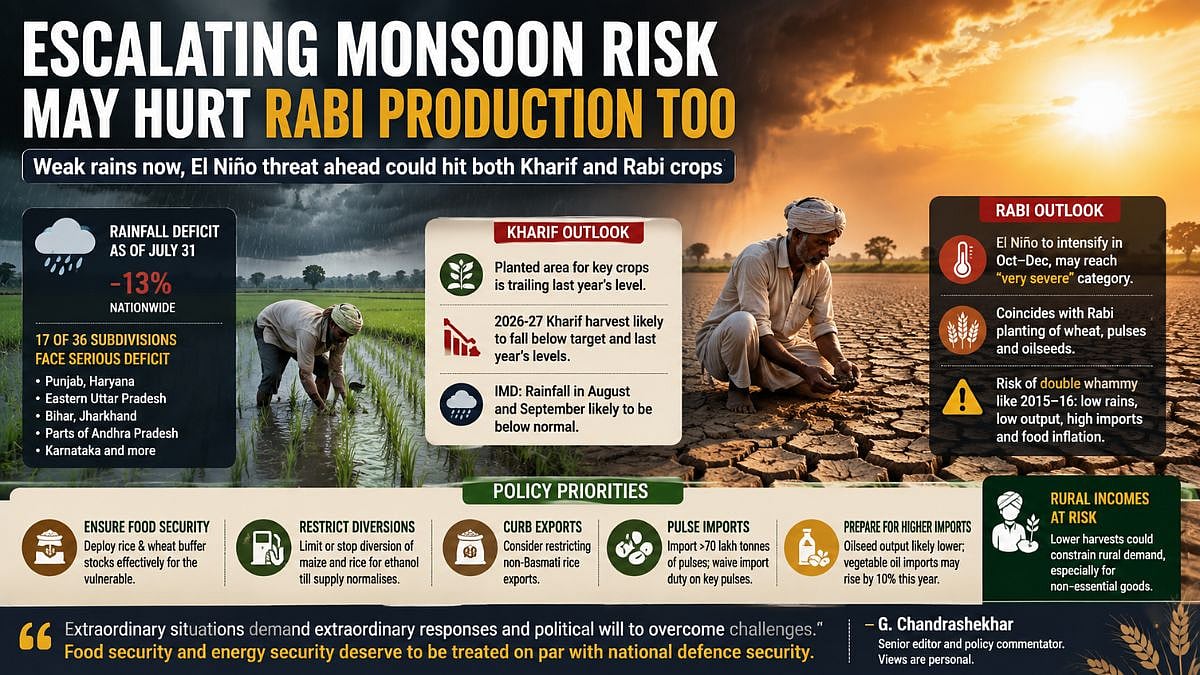
Yet, as of July 31, the rainfall deficiency nationwide is 13 per cent (-13%). Out of the 36 meteorological subdivisions, 17 subdivisions still face a serious deficit in precipitation. These include Punjab, Haryana, eastern Uttar Pradesh, Bihar, Jharkhand, parts of Andhra Pradesh and Karnataka. In other words, the spatial distribution of rains so far is less than satisfactory.
The India Meteorological Department (IMD) recently said rainfall in August and September would be below normal. This is sure to hurt Kharif crop conditions and harvest prospects.
Kharif Outlook Weakens
As of July 24, the planted area for key crops, such as paddy, pulses, coarse cereals, oilseeds and cotton, is actually trailing last year’s level at this time. There is a long way to reach the normal area coverage (five-year average), but the planting window effectively closed by mid-July.
So, further reports of area coverage will only show a small increase, considering the usual lag in states reporting the planted area. In other words, it is becoming increasingly clear that the 2026-27 Kharif crop harvest size is likely to fall well below the season’s target and last year’s levels too.
Worse, going by the IMD’s latest prediction, a more alarming picture is emerging for Rabi crops. El Niño conditions are likely to intensify during the October-December quarter and reach the ‘very severe’ category. This period coincides with Rabi crop planting. Major Rabi crops include wheat, pulses (mainly chickpea (chana) and lentils (masur)) and oilseeds (mainly rapeseed-mustard), and the crops need soil moisture and winter rains for healthy growth.
The big concern is that it may turn out to be a double whammy, reminiscent of the 2015-16 season, when the country faced two successive seasons of less-than-normal rainfall, a sharp decline in crop production, food inflation and higher imports.
Food Inflation Concerns
This year, too, we may have to brace for food inflation. The situation can worsen if the Persian Gulf crisis continues to disrupt energy supply chains and crude oil continues to trade at triple digits (Brent US$100 a barrel and above) for an extended period. Fertiliser shortages and elevated prices may further skew farm conditions.
So what are the policy options for the government? Food security and inflation control ought to be the two primary priorities for policymakers. Sugar exports are suspended till September, and stock limits are imposed.
It is necessary to ensure that buffer stocks of rice and wheat are deployed in a manner that ensures adequate availability of fine cereals for the vulnerable sections of the population. Diversion of grains (maize and rice) for ethanol purposes should be severely restricted, if not stopped, until supply normalcy is restored by next year. Restricting non-Basmati rice exports may also be considered, given the potential tightness in rice supply that may emerge later this year.
On the pulses front, the country will continue to import pulses such as pigeon pea (tur/arhar), black matpe (urad), lentils (masur), yellow peas and others. It is possible that the import duty on chickpeas and lentils may be waived to contain the price rise. I expect India will import over 70 lakh tonnes of various pulses to meet the shortfall.
The limited prospect of oilseed production will force larger imports of various vegetable oils, including palm and soy oils. Already, our annual import volumes are rather high at 150-160 lakh tonnes, and they may increase by 10 per cent this year.
Need For Contingency Planning
There is a looming risk to income growth in rural areas because of lower harvests. It can potentially result in some constriction in rural demand and consumption, especially of non-essential goods.
New Delhi needs to be ready with contingency plans for various scenarios. It is going to be a daunting challenge. Extraordinary situations demand extraordinary responses and political will to overcome challenges. Food security and energy security deserve to be treated on par with national defence security.
G. Chandrashekhar is a senior editor and policy commentator. Views are personal.

